

March 20, 2012

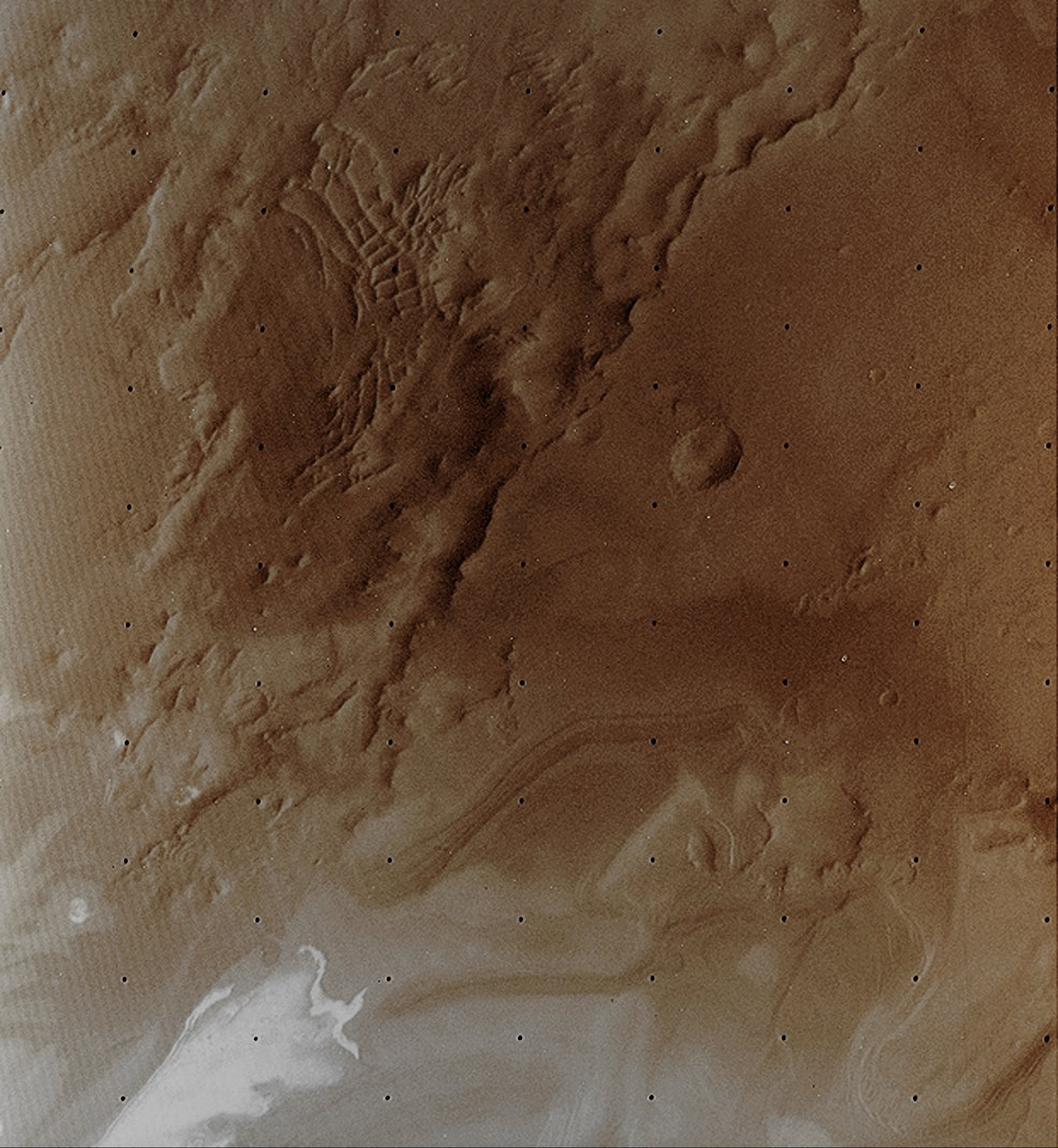
Credits: NASA/JPL-Caltech/Viking Orbiter 2 - Credits for the additional process. and color.: Dr Paolo C. Fienga/Lunar Explorer Italia/IPF
|
Once again, on our daily APOD, we chose to show you an intriguing Martian Surface Feature that is known as "Inca City" and which it was believed to be, for a very long time, the eroded and almost completely consumed remnant of an ancient Martian City. Anyway, and as a matter of fact, like everybody can see in this NASA - Viking 2 Orbiter image, the semi-rectangular grid forming Inca City is far away from being a real City... What is it then? Well, a final answer to a question like that, as we have learned, cannot yet be given but, as many Scientists reasonably believe, this however really peculiar Surface Feature could just be the final result of a phenomenon of Wind Deflation which affected a relatively large portion of the Martian South Polar Layered Deposits (or SPLDs); a wind-related phenomenon that was strong enough to reveal, in time and throughout a constant and powerful erosional action, the Gridded Terrain laying underneath the aforementioned SPLDs. Furthermore, and in order to give you an idea of the dimensions of this entire Surface Feature, you have to consider that each of the individual Square Cells forming the "City" is about 4 to 5 Km across! In addition to all that, if you look carefully towards to bottom part of the frame, you will also be able to see a few Glaciers (on the left - Sx - side) and a very large (and highly reflective - as much as the Glaciers themselves) Ice Deposit that is very close (and, partially, connects ) to the South Pole of Mars. This frame has been colorized in Natural Colors by (such as the colors that a perfect human eye would actually perceive if someone were onboard the NASA - Viking Orbiter 2 and then looked towards the South Polar Region of Mars), by using an original technique created - and, in time, dramatically improved - by the Lunar Explorer Italia Team. |
News visualized: 869 times