
March 17, 2012

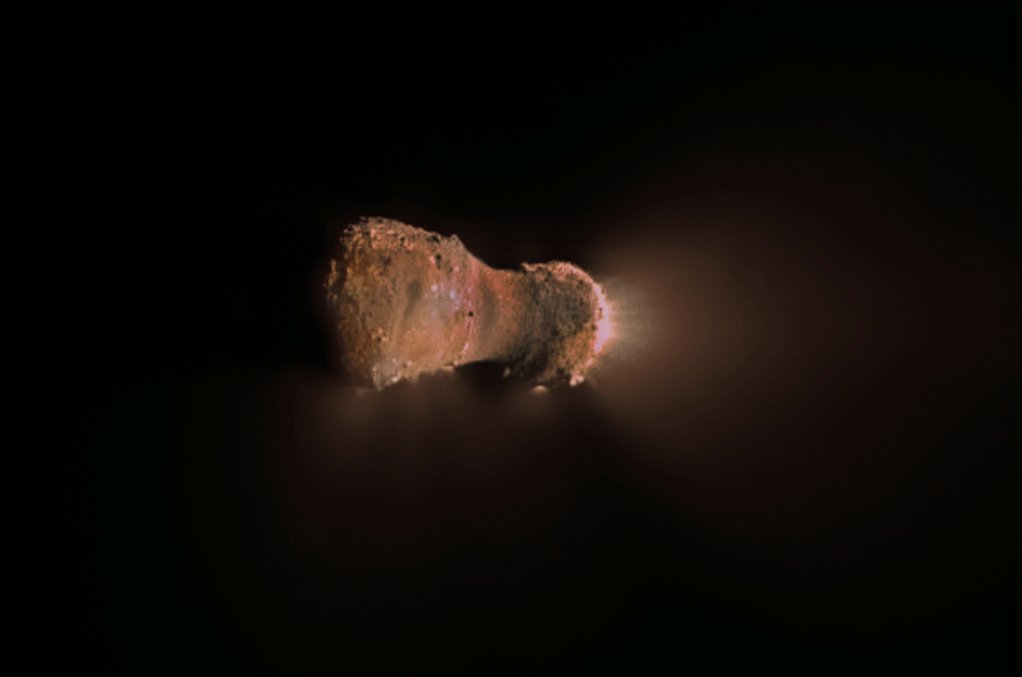
Credits: NASA/JPL - Credits for the additional process. and color.: Dr Marco Faccin/Lunar Explorer Italia/IPF
|
Comet Hartley 2, also designated as 103P/Hartley by the Minor Planet Center (a Center which operates at the Smithsonian Astrophysical Observatory - SAO - and that it is part of the Center for Astrophysics - CfA - along with the Harvard College Obervatory (HCO); under the auspices of the International Astronomical Union (IAU), the Minor Planet Center it is the official organization in charge of collecting observational data for Minor Planets - such as Dwarf Planets, Asteroids, Trojans, Centaurs, Kuiper's Belt Objects and Trans-Neptunian Objects - and Comets, calculating their orbits and publishing all the results via the "Minor Planets Circulars") is a small Periodic Comet (remember that Periodic Comets are Comets having orbital periods of less than 200 years - they are also known as "short-period comets" - or which have been observed during more than a single perhelion passage (e.g. 153/Ikeya-Zhang) with an orbital period of only 6,46 years. This Comet was discovered by Dr Malcolm Hartley in 1986 at the Schmidt Telescope Unit, Siding Spring Observatory, Australia. Its diameter is estimated to be approx. 1,2 to 1,6 Km (such as about 0,75 to 0,99 miles). Hartley 2 was also the target of a fly-by from the NASA - Deep Impact Spacecraft, as part of the EPOXI Mission, on November 4, 2010; the Deep Impact Spacecraft was able to come as close as to about 700 Km from Comet Hartley 2 as part of its extended mission. This frame has been colorized in Absolute Natural Colors by (such as the colors that a human eye would actually perceive if someone were onboard the NASA - Deep Impact Spacecraft and then looked towards the Comet Hartley 2), by using an original technique created - and, in time, dramatically improved - by the Lunar Explorer Italia Team. |
News visualized: 816 times