

June 14, 2014

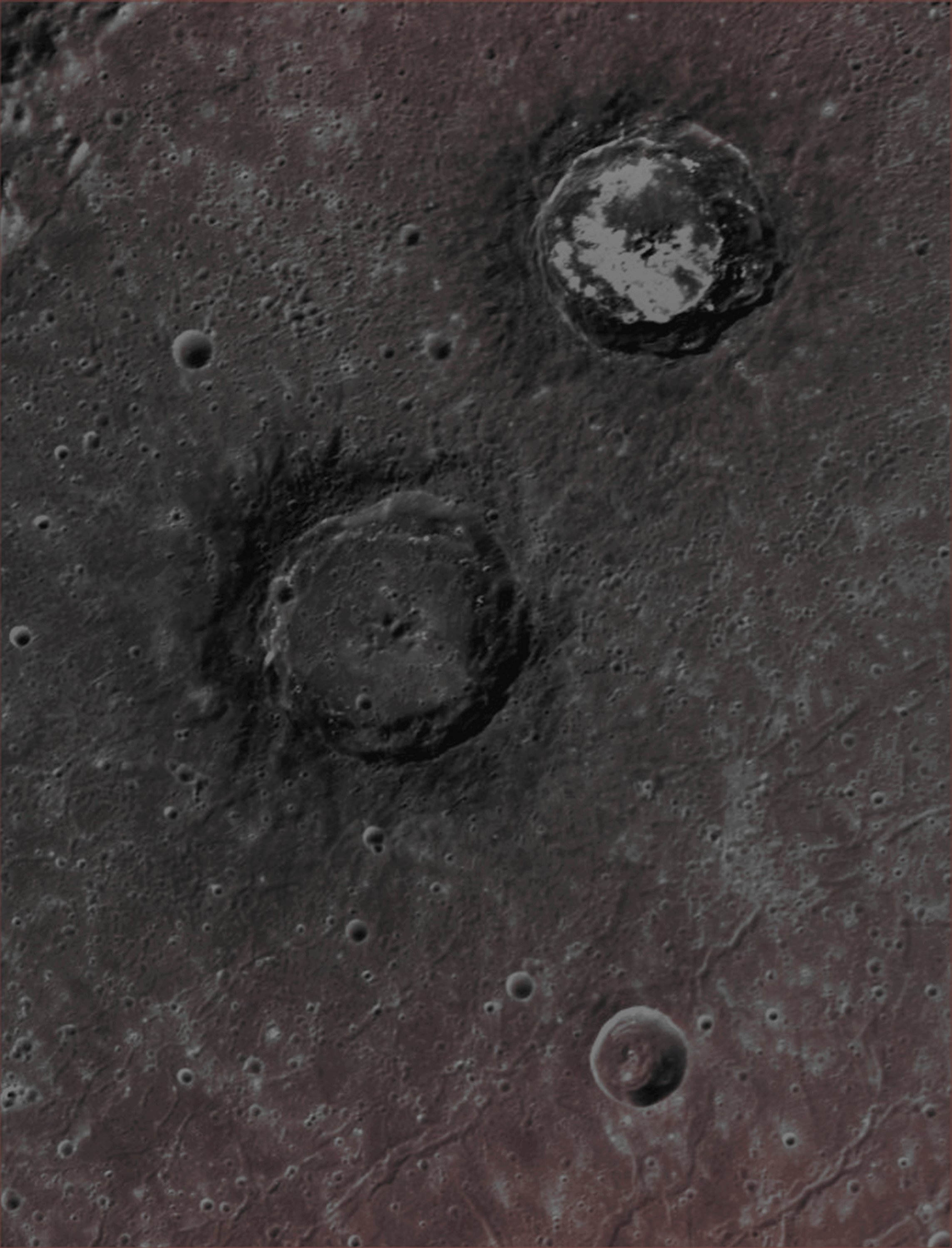
Credits: NASA/Johns Hopkins University Applied Physics Laboratory/Carnegie Institution of Washington and Dr Paolo C. Fienga/LXTT/IPF for the additional process. and color.
|
Today's APOD features a stunning view (actually, it is an Image-Mosaic made out of three pictures taken by the NASA - MESSENGER Spacecraft on April, 26, 2014) of two Complex Impact Craters (Sander and Munch) which both located within the huge Mercurian Region known as Caloris Basin. The Floor of Sander Crater (located toward the upper right corner - Dx - of the frame, and approx. 51 Km - such as about 31,671 miles - in diameter) is covered (let's say "just as usual"...) with extremely bright Hollows, while Munch Crater (whose diameter is approximaltely the same one as Sander's) stands out because of its VERY DARK (Inner and Outer) Rim, which is completely covered by the so-called Low Reflectance Material (or "LRM" for short); a Material, possibly unearthed (---> excavated, taken out from the Sub-Surface) during the Impact Event, but whose true origin and chemical composition are, as of today, still unknown. A few (and, in fact, not too bright) Hollows, however, can also be spotted inside Munch Crater (particularly, on its Western Inner Slopes). Date acquired: April, 26th, 2013 This picture (which is a crop taken from an Original NASA - MESSENGER Spacecraft's false-colors and Map-Projected image-mosaic published on the NASA - Planetary Photojournal with the ID n. PIA 18448) has been additionally processed, contrast enhanced, Gamma corrected, magnified to aid the visibility of the details and then re-colorized in Absolute Natural Colors (such as the colors that a human eye would actually perceive if someone were onboard the NASA - MESSENGER Spacecraft and then looked outside, towards the Surface of Mercury), by using an original technique created - and, in time, dramatically improved - by the Lunar Explorer Italia Team. Different colors, as well as different shades of the same color, mean, among other things, the existence of different Elements (Minerals) present on the Surface of Mercury, each having a different Albedo (---> Reflectivity) and Chemical Composition. |
News visualized: 768 times