

May 18, 2014

Credits: NASA/JPL/University of Arizona - Credits for the additional process. and color.: Dr Paolo C. Fienga/LXTT/IPF
|
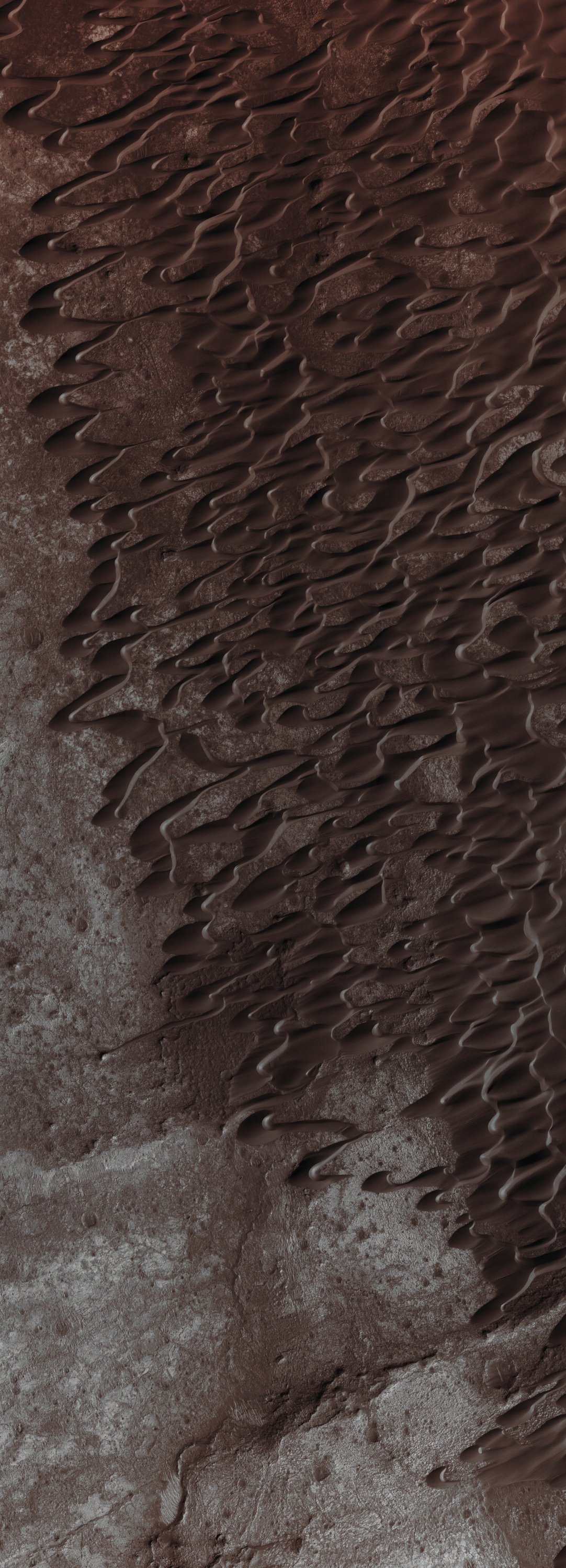
In the Martian Volcanic Region of Nili Patera (*) there is one of the most large and active Dunefields of the entire Planet Mars and, as such, this Dunefield is almost continuously monitored by the NASA - Mars Reconnaissance Orbiter (HiRise), with a new image acquired about every six weeks. (°) Nili Patera is Syrtis' Summit Caldera, such as the now collapsed Volcanic Mouth from which the Lava flowed. The Floor of Nili Patera lies about 1800 mt (roughly 5904 ft) lower than its Western Rim, which is marked by Curving Fractures and Faults. Nili spans about 50 Km (such as approx. 31,05 miles) wide and forms part of a bigger Caldera Complex stretching some 400 Km (such as approx. 248,4 miles) in a North-South direction. What makes Nili Patera of special interest for Planetary Geologists, is the circumstance that it contains two kinds of Lava Flows: some made of Basalt, and some made of Dacite (---> a Volcanic Rock containing free Quartz). This fact is unusual for Mars, where most of the Lavas are Basaltic and, in the end, the discovery showed that the whole Red Planet is - was, in fact - a Volcanically Complex World. By monitoring the Sand-dune changes, it is possible to determine how the Winds vary both seasonally, and year-to-year. This observation is one of the more recent Nili images (it was taken on March, 1st, 2014). Compared to another image acquired on the date of November, 22nd, 2012, many changes are obvious. As a matter of fact, the Ripples on the Dunes have moved, as well some of the Dune boundaries. Even new Sandslides which occurred on the Dunes' Lee-faces - look at the central portion of the image - are apparent. Such changes, which happened in just 16 months (and finer scale changes have also been noticed in just a couple of weeks), demonstrate the effectiveness of the Wind in modifying the Martian Landscape. Mars Local Time: 15:16 (Early Afternoon) This picture (which is a NASA - Original Mars Reconnaissance b/w and NON Map-Projected frame identified by the serial n. ESP_035603_1890) has been additionally processed, reduced in seize to fit the page, contrast enhanced, Gamma corrected, and then colorized in Absolute Natural Colors (such as the colors that a human eye would actually perceive if someone were onboard the NASA - Mars Reconnaissance Orbiter and then looked down, towards the Surface of Mars), by using an original technique created - and, in time, dramatically improved - by the Lunar Explorer Italia Team. |
News visualized: 757 times