

April 24, 2014

Credits: NASA/Johns Hopkins University Applied Physics Laboratory/Carnegie Institution of Washington and Dr Paolo C. Fienga/LXTT/IPF for the additional process. and color.
|
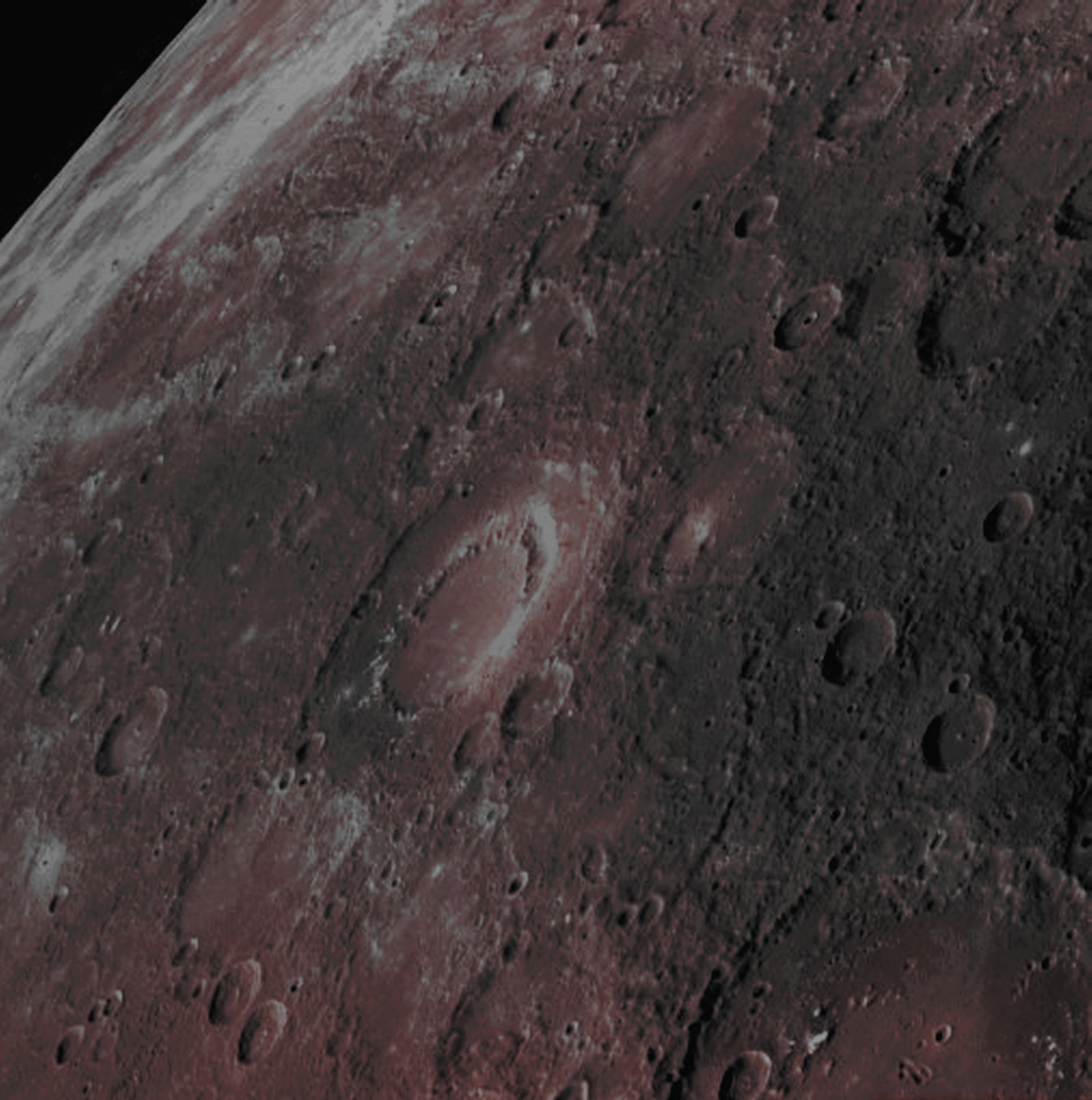
In this image-mosaic, obtained by putting together three frames taken by the NASA - MESSENGER Spacecraft on March, 30, 2014, we can see, located almost at the center of the frame, the large (such as approx. 132 Km - such as about 81,97 miles - in diameter) Peak-Ring Basin known as Scarlatti. While Scarlatti has a typical Peak-Ring in many respects, if you take a good look towards its North/Eastern Section (upper right side - Dx - of the Feature), you will be able to notice its "transition" to a relatively wide (in this case, approx. 30 Km - such as about 18,63 miles - across) sort of Collapse Pit, surrounded by High-Reflectance (white and reddish in color) Surface Material. This Pit (perhaps a Volcanic Vent or a Caldera, eons ago), according to several NASA Planetary Scientists, could have been - and we say, as IPF, reasonably, considering all the visible Features characterizing it - the site of some (most likely extremely ancient as well as really powerful) Explosive Volcanic Activity. Date acquired: March, 30th, 2014 This picture (which is an Original NASA - MESSENGER Spacecraft's false colors and NON-Map-Projected image-mosaic published on the NASA - Planetary Photojournal with the ID n. PIA 18215) has been additionally processed, contrast enhanced, Gamma corrected, magnified to aid the visibility of the details and then re-colorized in Absolute Natural Colors (such as the colors that a human eye would actually perceive if someone were onboard the NASA - MESSENGER Spacecraft and then looked outside, towards the Surface of Mercury), by using an original technique created - and, in time, dramatically improved - by the Lunar Explorer Italia Team. Different colors, as well as different shades of the same color, mean, among other things, the existence of different Elements (Minerals) present on the Surface of Mercury, each having a different Albedo (---> Reflectivity) and Chemical Composition. |
News visualized: 748 times