
March 10, 2012

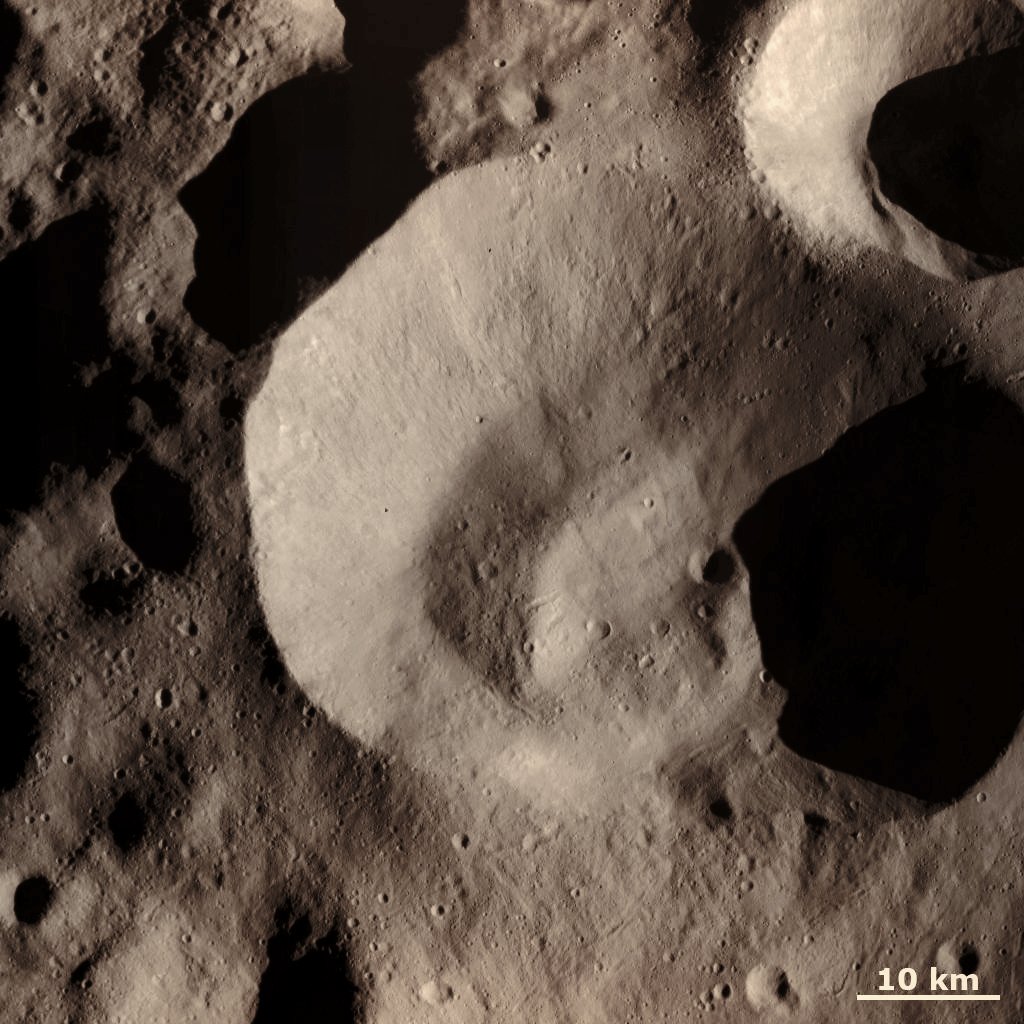
Credits: NASA/JPL-Caltech/UCLA/MPS/DLR/IDA and Dr Paolo C. Fienga for the additional process. and color.
|
This NASA - Spacecraft Dawn FC-Cam (Framing Camera) image is dominated by a very interesting Impact Crater located on the Giant Asteroid 4-Vesta: it is the Caparronia Impact Crater. Caparronia Crater is approximately 55 Km in diameter and has a mostly fresh, irregularly shaped Rim. It also has a curved, linear mound running across most of its base and therefore, for all of these reasons, Caparronia is a very peculiar and highly distinctive Crater for 4-Vesta and this is why it was chosen to name the Quadrangle in which it is situated. The (always relatively speaking) smooth Region which surrounds Caparronia Crater is most likely made by fine Impact Ejecta, which were thrown out from the Crater at the time of its formation. Other impact related features are the linear chains of small (such as less than 1 km wide) Secondary Craters that can be seen throughout the image. Some particularly distinctive Crater Chains are also visible in the bottom part of the frame. This frame has been colorized in Natural Colors (such as the colors that a perfect human eye would actually perceive if someone were onboard the NASA - Dawn Spacecraft and then looked down towards the Surface of 4-Vesta), by using an original technique created - and, in time, dramatically improved - by the Lunar Explorer Italia Team.
|
News visualized: 916 times