

March 11, 2014

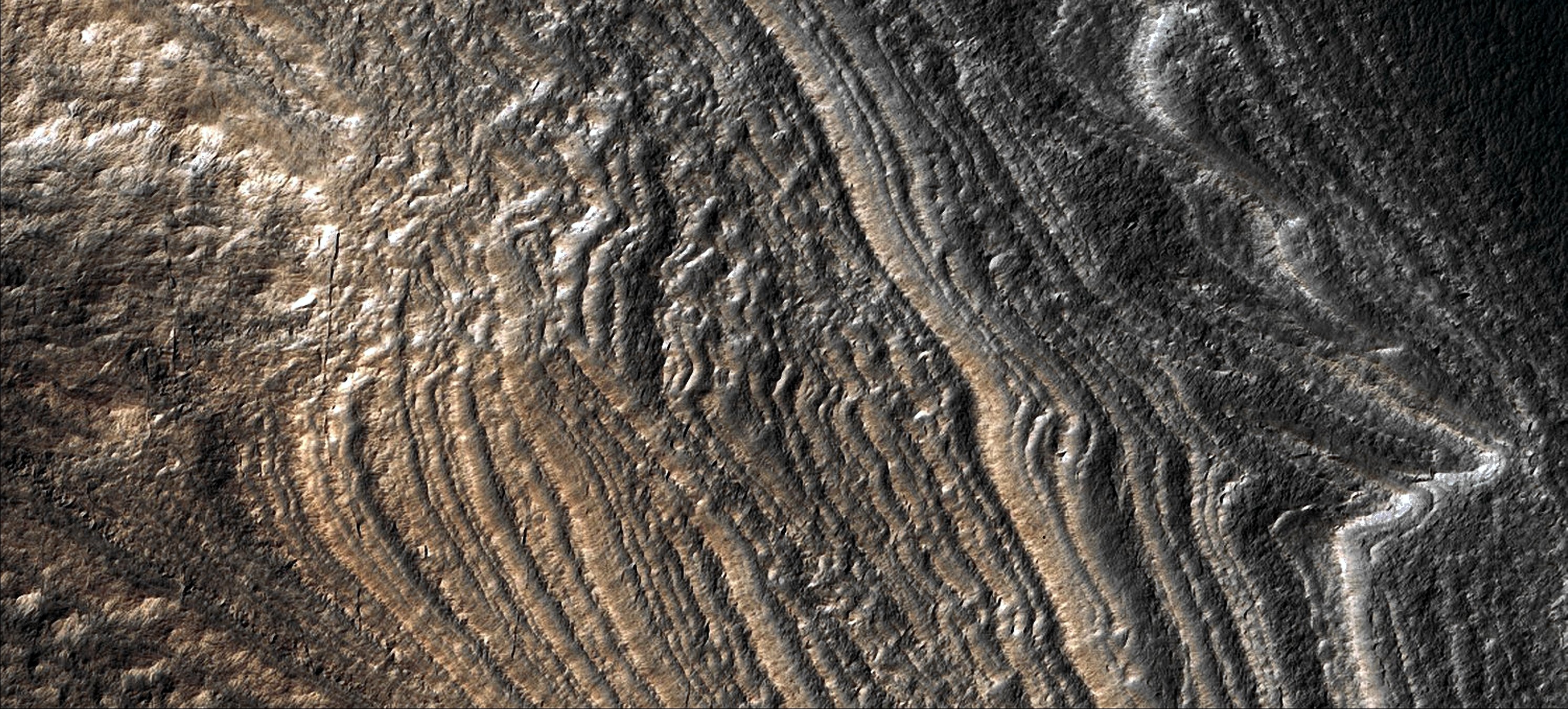
Credits: NASA/JPL/University of Arizona - Credits for the additional process. and color.: Dr Paolo C. Fienga/LXTT/IPF
|
This NASA - Mars Reconnaissance Orbiter's Absolute Natural Colors sub-image (approx. 1,2 Km - or about 0,74 miles - across) shows us a section of the so-called "South Polar Layered Deposits", which are an accumulation of Layers consisting mostly of Water and Carbon Dioxide (CO2) Ice and Dust. Perhaps their closest analog on our Home Planet Earth could be found in the Ice Caps of Greenland and Antarctica. This specific sub-image is particularly interesting because the Layers are not flat-lying, but they rather appear "Wavy" (---> ondulated). It also should must be taken into duly consideration, though, that such an extremely peculiar appearance of the Layers could (also partly) be the result of an “optical illusion”, caused by the occurrence of a phenomenon of Erosion that might have happened after that the flat-lying Layers were deposited. In that case, the Wavy look of the Layers should be due to the fact that the Layers' Edges are themselves Wavy - this meaning that they are going in and out of the plane of the Outcrops that expose them. Alternatively, this Waviness of the aforementioned Layers could also be due to the deformation of their folding; a deformation which might have been caused by the occurrence (some time in a remote past of this Region) of (liquid) Flows over the already deposited/formed Ice. However, if this last hypothesis were true, the Flows - most likely - must have occurred, as we already said, a very long time ago, since the current temperatures at the South Pole of Mars are way too low to allow the Ice (whatever it might be basically and/or mainly made of) to flow (---> float, over another Layer of Ice) at a significant rate (---> speed). Mars Local Time: 14:50 (Early Afternoon) This picture (which is a NASA - Original Mars Reconnaissance Orbiter false colors and NON-Map Projected sub-frame identified by the serial n. PSP_005418_1075-1) has been additionally processed, magnified to aid the visibility of the details, contrast enhanced, Gamma corrected, and then re-colorized in Absolute Natural Colors (such as the colors that a human eye would actually perceive if someone were onboard the NASA - Mars Reconnaissance Orbiter and then looked down, towards the Surface of Mars), by using an original technique created - and, in time, dramatically improved - by the Lunar Explorer Italia Team. |
News visualized: 787 times