

March 6, 2014

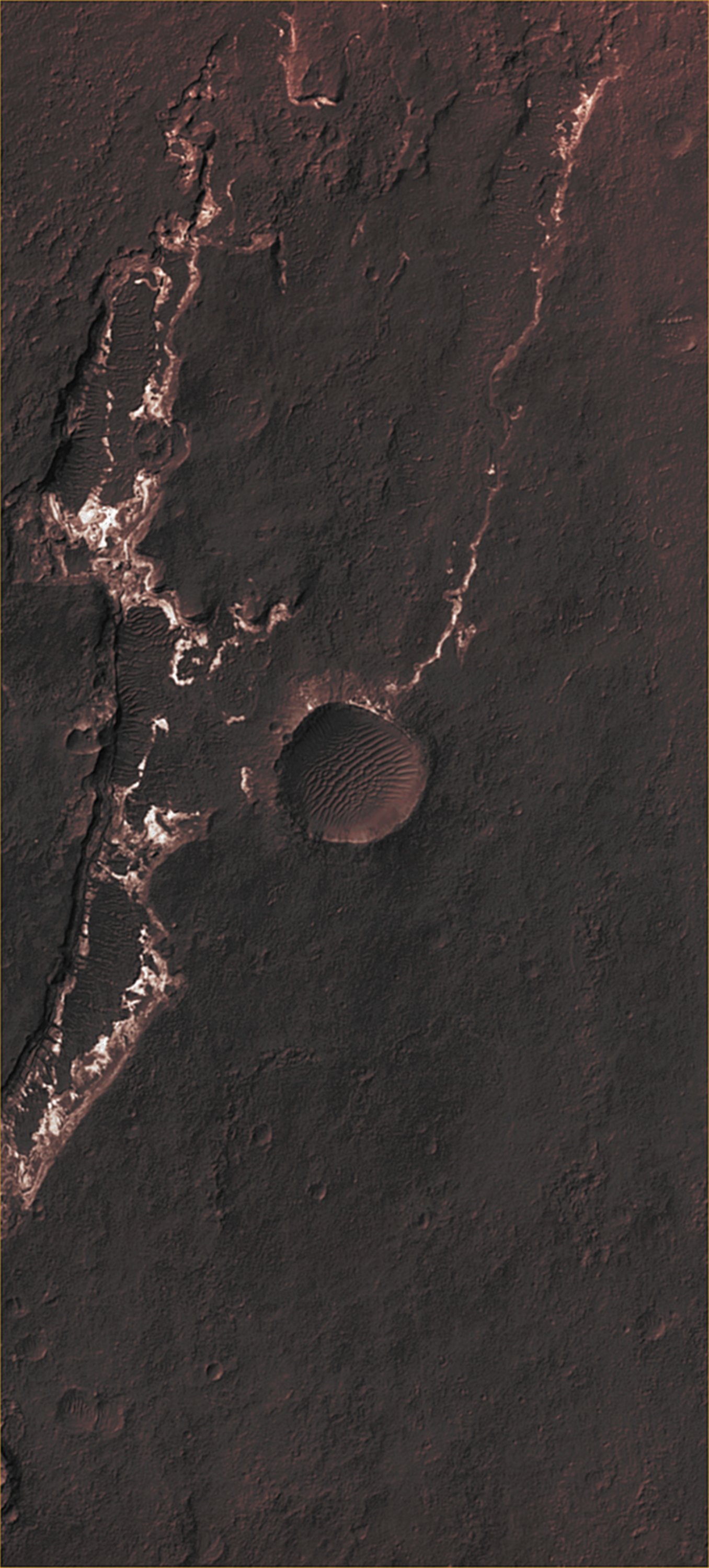
Credits: NASA/JPL-Caltech/University of Arizona - Credits for the additional process. and color.: Dr Paolo C. Fienga/LXTT/IPF
|
This image, taken by the NASA - Mars Reconnaissance Orbiter on November, 13, 2013, shows us some Bright Layered Deposits which have been exposed within a Linear Trough that goes along the Floor of the Ladon Basin. There is a large Channel System that runs into the Basin, called Ladon Valles, and Planetary Sscientists think that the Basin itself could have once been filled with - fresh? - Water, until another Channel - this one going to the North - formed and drained it. These exposures of Light-Toned Layered Sediments provide us with clues about the Environment that existed within Ladon Basin, at the time when the Waters existing inside it might have ponded (---> become totally still) and then, in time, deposited the abovemntioned Sediments. Mars Local Time: 14:57 (Early Afternoon) This picture (which is a crop taken from a NASA - Original Mars Reconnaissance Orbiter b/w and NON-Map Projected frame identified by the serial n. ESP_034209_1605) has been additionally processed, reduced in size, contrast enhanced, Gamma corrected, and then colorized in Absolute Natural Colors (such as the colors that a human eye would actually perceive if someone were onboard the NASA - Mars Reconnaissance Orbiter and then looked down, towards the Surface of Mars), by using an original technique created - and, in time, dramatically improved - by the Lunar Explorer Italia Team. |
News visualized: 752 times