

February 7, 2014

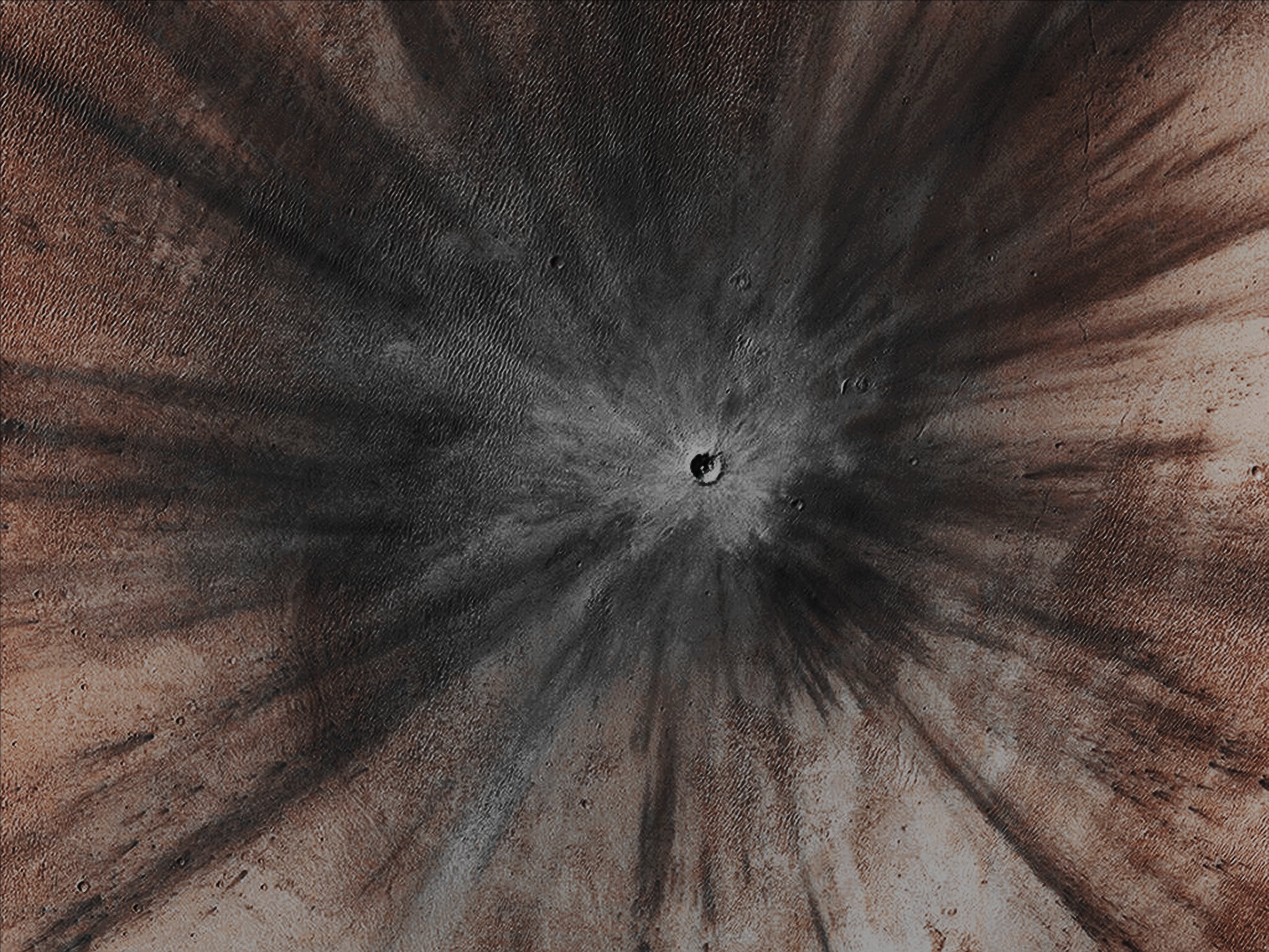
Credits: NASA/JPL-Caltech/University of Arizona - Credits for the additional process. and color.: Dr Paolo C. Fienga/LXTT/IPF
|
A spectacular-looking and, in fact, also VERY fresh Impact Crater, dominates this image taken by the High Resolution Imaging Science Experiment (or "HiRISE", for short) Camera located onboard the NASA - Mars Reconnaissance Orbiter on November 19, 2013. Researchers used HiRISE to examine this specific Martian Site because the Orbiter's Context Camera had revealed a change in appearance, here, which must have had occurred between the observations made in July 2010 and May 2012, bracketing the formation of the Impact Crater that we can see today just in-between those two dates. This Impact Crater spans approximately 100 feet (such as approx. 30,48 meters) in diameter and it is surrounded by a large "Rayed Blast Zone". Because the Terrain where the Crater formed is Dusty, the bowl and its immediate surroundings of such a young Impact Crater appears gray - in this Absolute Natural Color image -, and this fact is due to the removal of the orange/reddish Dust that is present all over the impacted area. The Rocky Debris (belonging to the impacted Surface and created during the formation of the Crater) which have been tossed outward are called, as you should already know, Ejecta. In examining the Ejecta's distribution, Planetary Scientists can learn more about the Impact Event. Furthermore, it is interesting to notice that the blast which excavated this (however small) Crater, was strong enough to throw some Ejecta as far as 9,3 miles (such as a little less than 15 Km) away from the Impact Site itself. Mars Local Time: 14:57 (Early Afternoon) This picture (which is a NASA - Original Mars Reconnaissance Orbiter false colors and NON-Map Projected sub-frame identified by the serial n. ESP_034285_1835) has been additionally processed, magnified to aid the visibility of the details, contrast enhanced, Gamma corrected, and then colorized in Absolute Natural Colors (such as the colors that a human eye would actually perceive if someone were onboard the NASA - Mars Reconnaissance Orbiter and then looked down, towards the Surface of Mars), by using an original technique created - and, in time, dramatically improved - by the Lunar Explorer Italia Team. |
News visualized: 763 times