

March 5, 2012

Credits: NASA/JPL-University of Arizona - Credits for the additional process. and color. of the EDM/inset: Dr Paolo C. Fienga/Lunar Explorer Italia/IPF
|
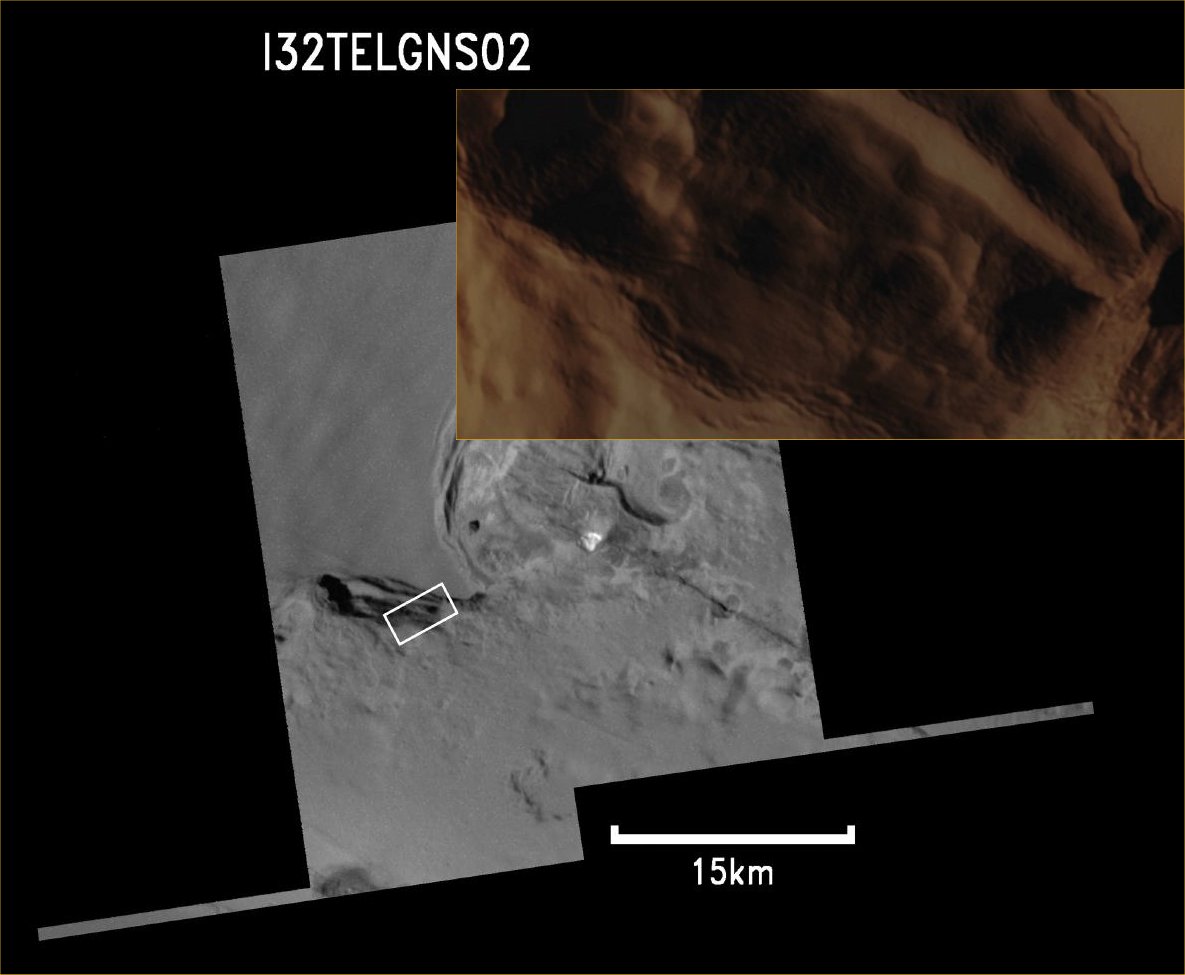
A Cliff slumps outward in these two High-Resolution views that NASA's - Galileo Spacecraft captured while looking at the edge of a Mountain named Telegonus Mensa, located on the Jovian moon Io. When the Galileo Spacecraft flew near the South Pole of Io, in October 2001, scientist's targeted this Cliff for the purpose of studying the process of erosion occurring on this still Geologically (VERY!) active small moon of the Giant Gas-Planet Jupiter. Water, Ice and Wind cause most of the erosion on Earth, but Io has neither Surface Water, nor Ice or Atmosphere (ergo there are no Winds on Io). This Cliff, therefore, was (and, most likely, still is) slumping due to a phenomenon known as Gravity (or either Mass) Wasting: a phenomenon that actually occurs on every known Celestial Body, including Earth (however, we have remarkable examples of the effects and visual appearence relative to the occurrence of this phenomenon - as far as we talk about a Celestial Body that does not have an Atmosphere - on our only Natural Satellite: the Moon). In particular, the phenomenon known as Mass Wasting basically consists of the down-slope movement of Regolith (such as a loose uncemented mixture of Soil and Rock Particles which covers the Surface of almost every known Celestial Body) because of the action of the sole Force of Gravity, and without the aid of a transporting medium - such as, as we wrote hereabove, Water, Ice, or Wind. Mass Wasting, in fact, causes the Regolith to move down-slope until a site of Final Deposition, such as a flat Surface, is found. In order for the Regolith to move in a Mass Wasting process, anyway, the slumping loose material must of course be on (or VERY close to) a Slope, or an inclined Surface of some kind (like, for instance, the edge - Rim - of either a Crater or a Pit). It is also very important to consider and keep in mind, in our opinion and as far as Celestial Bodies without an Atmosphere are concerned, that the initial event that may prime the slumping (which, in this case, shall NOT be a Mass Wasting phenomenon but a Sliding Down Event - like, for instance, a Mud and/or a Landslide) can also be a movement (shaking) of the Surface where the Regolith, or even other bigger and larger objects, like rocky boulders, sit on. In this second situation, the movement of the ground can be due, among others, to the occurrence of some (even Residual) Seismic Activity or - maybe - by a strong vibration, induced by a Meteor Strike that occurred in the proximities of the inclined Surface that, afterwards, shall be involved by the Sliding Down Event. The EDM/inset has a resolution of 10 meters (33 feet) per picture element. Galileo's camera took it from a distance of about 1000 Km (approx. 620 miles). The CTX image sets context with a resolution of 40 meters (131 feet) per picture element, and was taken from a distance of about 4200 Km (approx. 2600 miles). North is towards the top of the CTX image and the Sun illuminates the Surface of Io from the upper right. The EDM-inset frame has been colorized in Absolute Natural Colors (such as the colors that a human eye would actually perceive if someone were onboard the NASA - Galileo Spacecraft and then looked down, towards the Surface of Io), by using an original technique created - and, in time, dramatically improved - by the Lunar Explorer Italia Team. |
News visualized: 904 times