
December 23, 2013

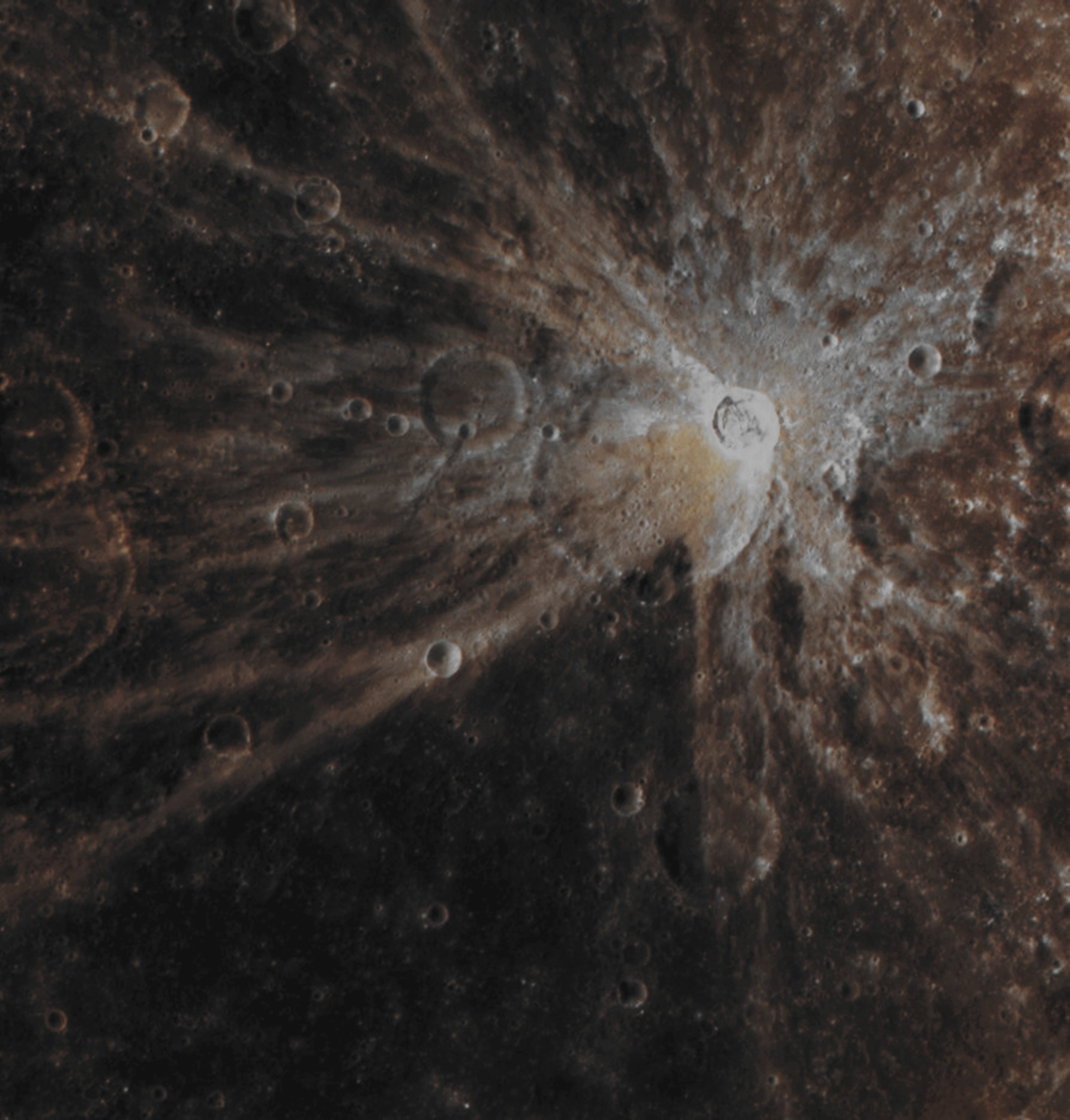
Credits: NASA/Johns Hopkins University Applied Physics Laboratory/Carnegie Institution of Washington and Dr Paolo C. Fienga/LXTT/IPF for the additional process. and color.
|
The (relatively) young Rays of Mena Crater (approx. 15 Km - such as about 9,315 miles - in diameter) contrast brightly against the surrounding Mercurian Surface, though these beautiful and colorful Rays will gradually fade, and disappear, with time (Eons, in fact). Furthermore, the asymmetric pattern of the Rays themselves, with an obvious gap in their South-Western direction, may be due to the angle at which the Impact that formed the Crater occurred or, maybe, it can also be due to the circumstance that Mena Crater formed on a very uneven Surface, such as just right on top of the Outer Rim of a larger, pre-existing, Impact Crater, as it can well be seen in this contextual image-mosaic. We, as IPF, believe that the second scenario which was mentioned herebefore is quite more plausible than the first one (even though a combination of the two scenarios/factors cannot be excluded). Date acquired: November, 12th, 2011 This frame (which is an Original NASA - MESSENGER Spacecraft's false colors and Map-Projected image-mosaic published on the NASA - Planetary Photojournal with the ID n. PIA 15202) has been additionally processed, contrast enhanced, magnified to aid the visibility of the details, Gamma corrected and then re-colorized in Absolute Natural Colors (such as the colors that a human eye would actually perceive if someone were onboard the NASA - MESSENGER Spacecraft and then looked down, towards the Western Edge of the Mercurian Impact Crater "Mena"), by using an original technique created - and, in time, dramatically improved - by the Lunar Explorer Italia Team. Different colors, as well as different shades of the same color, mean, among other things, the existence of different Elements (Minerals) present on the Surface of Mercury, each having a different Albedo (---> Reflectivity) and Chemical Composition. |
News visualized: 778 times