

October 29, 2013

Credits: NASA/Johns Hopkins University Applied Physics Laboratory/Carnegie Institution of Washington and Dr Paolo C. Fienga/LXTT/IPF for the additional process. and color.
|
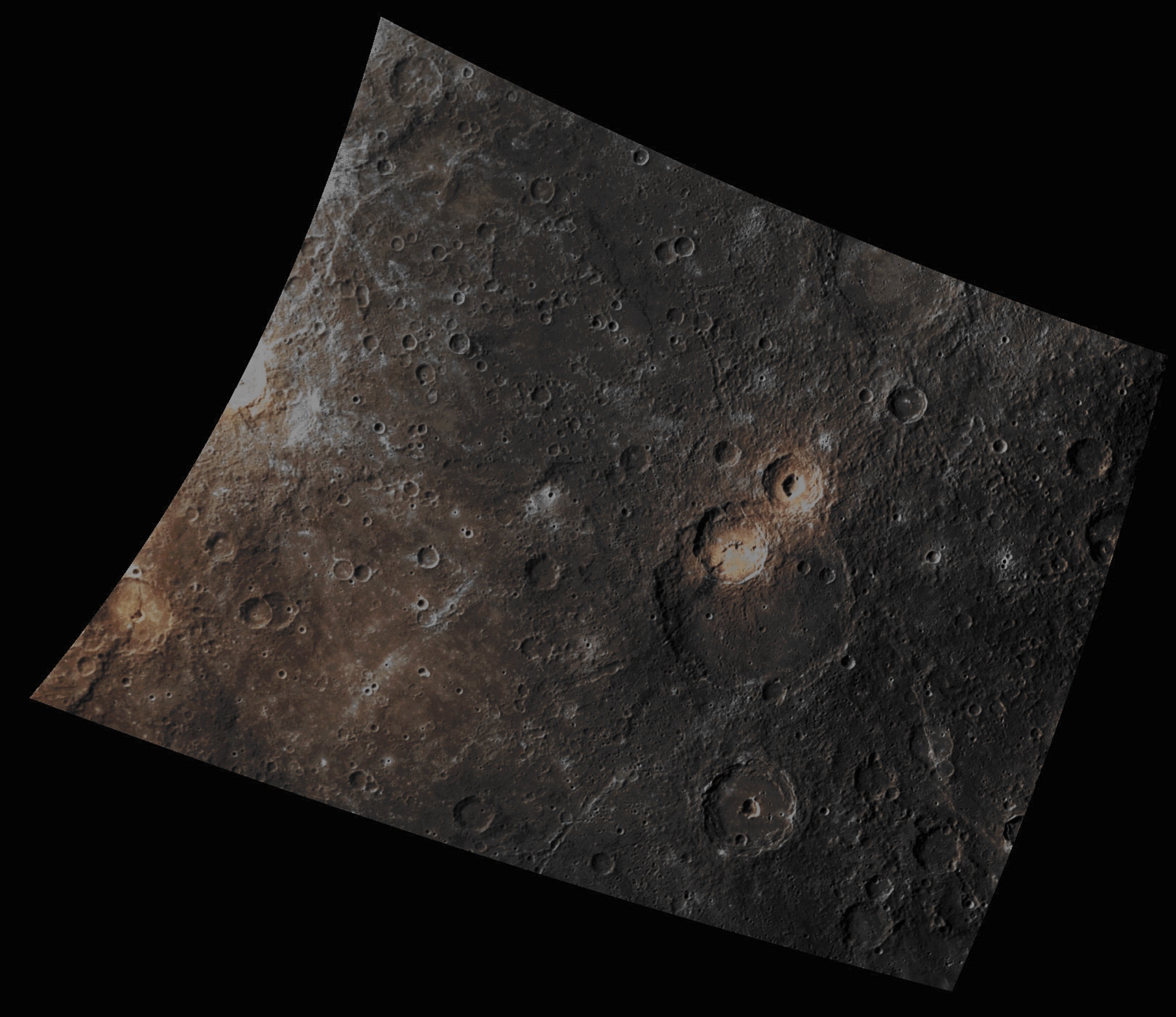
This picture (which is an image-mosaic made out of three pictures obtained by the NASA - MESSENGER Spacecraft in October 2012) shows us the large Matisse Crater (approx. 186 Km - such as about 115,506 miles - in diameter) and its proximities (just to give you an idea of the scale, consider that the whole scene here is about 890 Km - such as 552,68 miles - across). As you can see, two Unnamed Impact Craters formed tangentially to the Rim of Matisse Crater: one just inside, on the Edge of the Inner Rim, and the other one just outside, right on the Edge of the Outer Rim. You may want to notice that these two Unnamed Impact Craters have really bright yellow/white/orangish Deposits on their Floors and such a color characteristics are found, as a matter of fact, at many other locations on Mercury - usually where (we believe that) massive Pyroclastic Volcanic Eruptions took place. However, if you take a good look at the color of the Regions located towards the South/West of Matisse Crater (left corner of the frame), you will immeditaley realize that, most likely, even those (relatively) distant areas were heavily hit by the verification of the aforementioned (and massive) Volcanic Events. Date acquired: October, 21st, 2012 This picture (which is an Original NASA - MESSENGER Spacecraft's False Colors and Map-Projected image-mosaic published on the NASA - Planetary Photojournal with the ID n. PIA 17541) has been additionally processed, contrast enhanced, magnified and then re-colorized in Absolute Natural Colors (such as the colors that a human eye would actually perceive if someone were onboard the NASA - MESSENGER Spacecraft and then looked down, towards the Surface of Mercury), by using an original technique created - and, in time, dramatically improved - by the Lunar Explorer Italia Team. Different colors, as well as different shades of the same color, mean, among other things, the existence of different Elements (Minerals) present on the Surface of Mercury, each having a different Albedo (---> Reflectivity) and Chemical Composition. |
News visualized: 779 times