
February 25, 2012

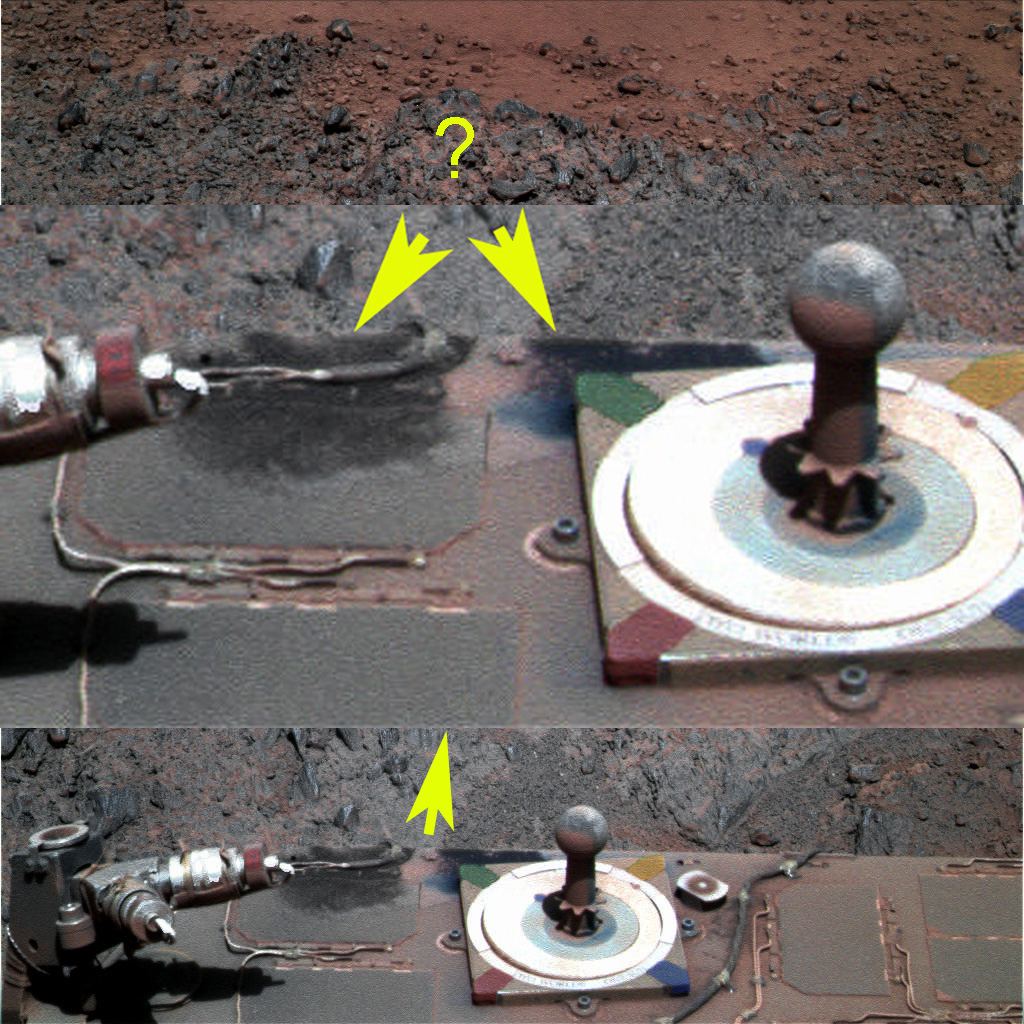
Credits: NASA/JPL/Cornell - MER Opportunity - Credits for the additional process. and color.: Dr Gianluigi Barca/Lunar Explorer Italia/IPF
|
We have learned, in time, that there are specific events, on Mars (known as "Cleansing Events"), which, from time to time, help the Solar Panels of both NASA - Mars Exploration Rovers Spirit and Opportunity to stay (relatively) clean by remaining (still relatively) free of and from the very sticky Martian Dust. And what this Cleansing Events cosist of? Well, the NASA Scientists and a very large part of the Scientific Community believe that the Cleansing Events are nothing more than the visible result of the passing, over the Mars Exploration Rovers, of an extremely strong and powerful wind: to be more specific, the "Cleaners" of both MERs Solar Panels should be the so-called Dust Devils (such as strong, well-formed, and relatively long-lived whirlwinds, ranging from small (half a meter wide and a few metres tall) to large (more than 10 meters wide and up to 800/1000 meters tall). Their primary vertical motion is upward and they are comparable to Tornadoes because they both are a weather phenomenon of a vertically oriented rotating column of air. On Earth, Dust Devils form as a swirling updraft under sunny conditions during fair weather, rarely coming close to the intensity of a Tornado (as a matter of fact, most of the Earthly Dust Devils are very small and weak, often less than 3 feet (0,9 mt) in diameter with maximum winds' speed averaging about 45 miles-per-hour (approx. 70 Km/h), and they often dissipate less than a minute after forming even though, on rare occasions, a Dust Devil can grow very large and intense, sometimes reaching a diameter of up to 300 feet (90 mt) with winds' speed in excess of approx. 60 miles-per-hour (such as about 100 Km/h) and can last for over 15/20 minutes before dissipating); but on Mars - probably due to the specific (extremely dry) weather conditions which are typical of the Red Planet - their size, duration and the maximum winds' average speed can respectively be much bigger, longer and stronger (probably, as many Mars Scientists believe, the typical Martian Dust Devil can actually reach an average size of 2/3 meters, anaverage height of 8/15, with the air rotating inside it at an average speed of more than 200 Km/h). Now, it must be underlined the fact that these "small Hurricanes" can and will certainly constitute not only a serious threat for the Astronauts that, hopefully, one day, shall walk on Mars, but that they also could (easily, in our opinion) be a danger, now, to the Rovers and their delicate equipment. But we have to admit that the NASA - MER Spirit (now no longer operational) and Opportunity (still alive and well) must have been very lucky so far, because - as our NASA Friends have repeatidly wrote in their reports - they have certainly met Dust Devils quite a few times in the past eight years of roaming, and they came out of these - however dangerous - encounters always nice and clean, in perfect shape and without suffering any down side from the experience. Not even once. Well, probably some (small) damage was actually caused, but it must have been nothing bad enough to put the Mission in danger. All that said, today we wish to draw to your attention the bizarre-looking "dark spots" that are indicated by the yellow arrows and which are so well visible on the NASA - MER Opportunity, near the colorful Sundial and right on top of a small cable: are those two dark spots the evidence of another kind of Cleansing Event? Of course, we do not know for sure, but we really want to highlight two things: 1) both the concerned areas look VERY clean (actually dustless!) and, 2) the cause of this "cleansing" (if what we are looking at it actually is a "cleansing" of some sort) cannot definitly be a Dust Devil or a wind-related event (and the reason of our last deduction is so obvious that it does not need nor deserve any explanation). So, the REAL question, now, is only one: what are we REALLY looking at? This frame has been colorized in Natural Colors by (such as the colors that a perfect human eye would actually perceive if someone were near the Mars Exploration Rover (MER) Opportunity and then looked at its Solar Panels, by using an original technique created - and, in time, dramatically improved - by the Lunar Explorer Italia Team. |
News visualized: 831 times