October 11, 2013

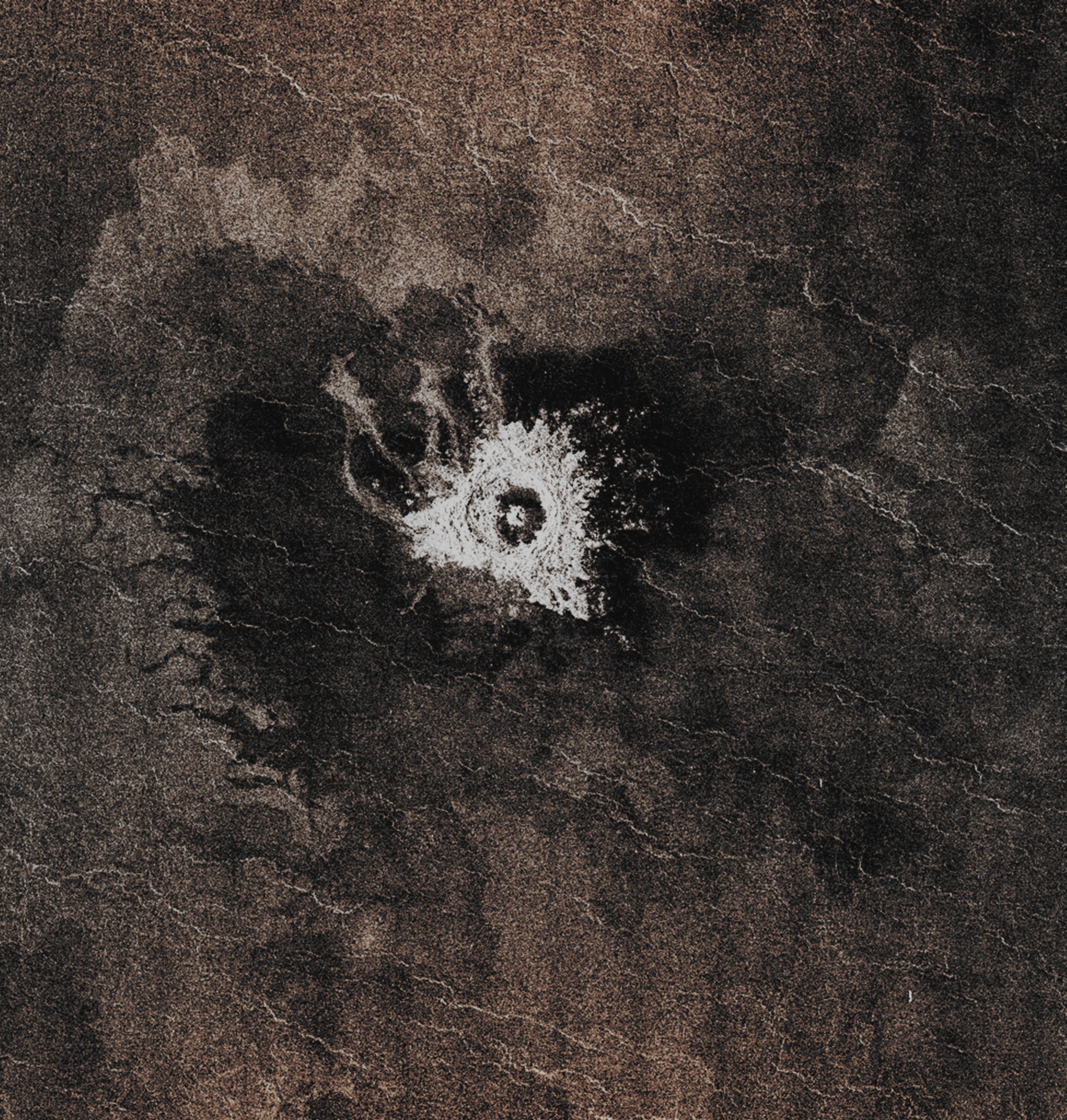
Credits: NASA/JPL - Magellan Project - Credits for the additional process. and color.: Dr Paolo C. Fienga/LXTT/IPF
|
This NASA - Magellan Spacecraft's Full-Resolution Radio-image shows us the Venusian Impact Crater Jeanne, whose diameter is about 19,5 Km (such as approx. 12,1 miles). Jeanne Crater is located at approx. 40,0° North Latitude and 331,4° East Longitude. The distinctive triangular shape of its Ejecta indicates that the Impacting Body probably hit the Venusian Surface at an oblique angle, after having travelled through the Atmosphere along a trajectory going from the South/West to the North/East. The Crater is surrounded by Dark Material of two types. The dark area on the South/Western side of Jeanne Crater is covered by smooth (---> radar-dark) Lava Flows which have a strongly digitate contact with the surrounding brighter Flows. The very dark area on the North/Eastern side of the Crater, instead, is probably covered by smooth Material - such as, for instance, fine-grained Sediment. The Dark Halo that surrounds - however unevenly - the whole Crater, as you can clearly see, is very asymmetric, thus mimicking the asymmetric shape of the Ejecta Blanket. Such a Dark Halo might have been caused by a so-called "Atmospheric Shock" - or "Pressure Wave" - that was produced - before the Impact Event took actually place - by the incoming Body. Jeanne Crater also displays several Outflow Lobes on its North/Western side, and these Flow-like Features could have formed by fine-grained Ejecta transported by a hot and turbulent flow (once again created by the arrival of the Impacting Object); alternatively, these Surface Features may have also been formed by a strong flow of Impact Melt. A definitive answer about this question, however, may never be reached. This frame (which is an Original NASA - Magellan Spacecraft Radio-Image published on the NASA - Planetary Photojournal with the n. PIA 00472), since it is just a Radio-Image of the Venusian Surface and NOT a real view of it, has been colorized, according to an educated guess carried out by Dr Paolo C. Fienga (LXTT-IPF), in what they could reasonably be its possible Absolute Natural Colors (such as the colors that a human eye would perceive if someone were onboard the NASA - Magellan Spacecraft and, once the thick layer of Venusian Clouds and Fogs is completely overcome, looked down, towards the Surface of Venus itself), by using an original technique created - and, in time, dramatically improved - by the Lunar Explorer Italia Team. |
News visualized: 886 times