
September 28, 2013

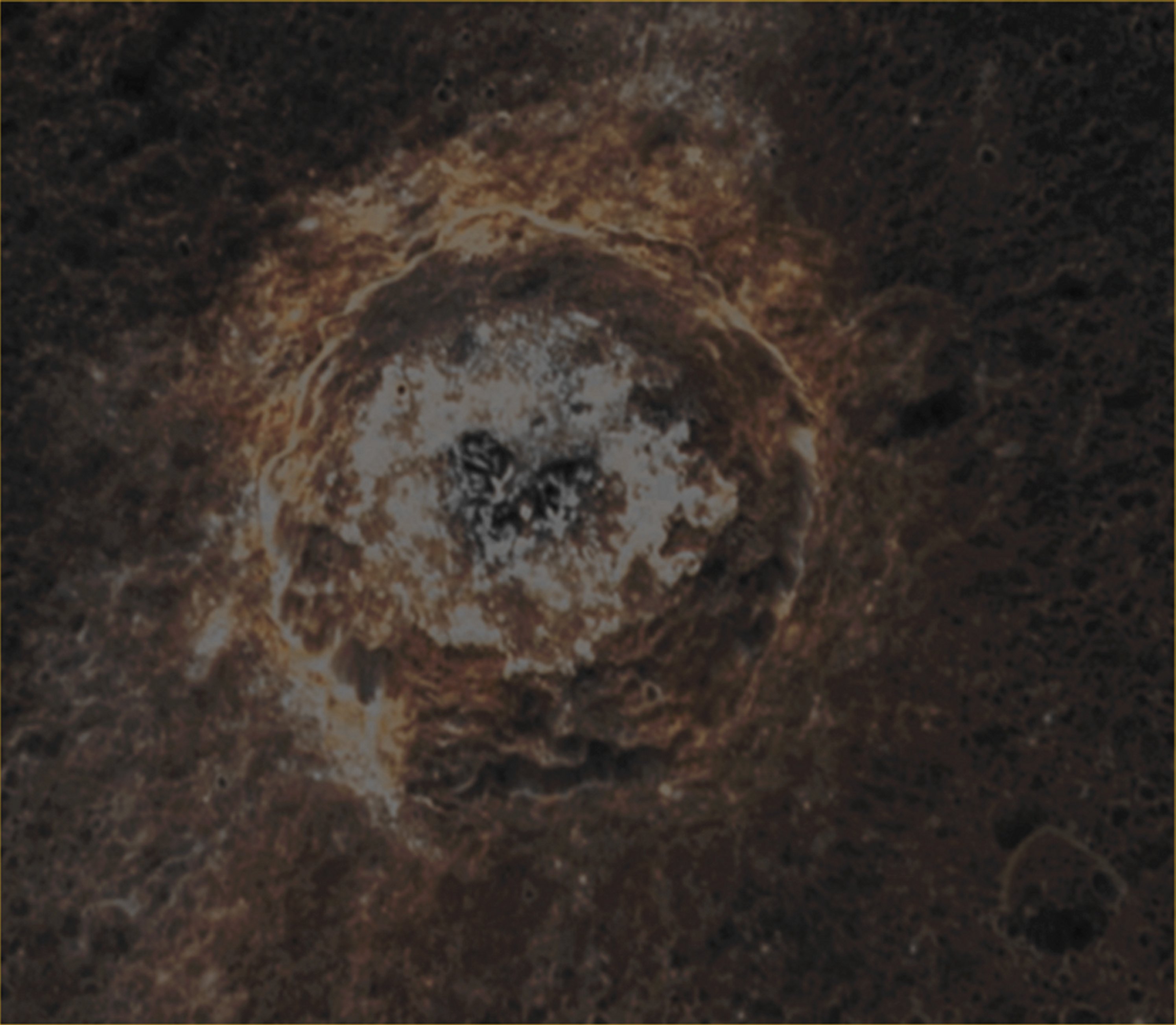
Credits: NASA/Johns Hopkins University Applied Physics Laboratory/Carnegie Institution of Washington and Dr Paolo C. Fienga/LXTT/IPF for the additional process. and color.
|
This EDM has been cut out from a beautiful image-mosaic (which has been obtained by putting together three frames taken by the NASA - Messenger Spacecraft on July, 29, 2013); it shows us the large Impact Crater known as De Graft (a Crater that received its name after the 20th century Ghanaian playwrighter, poet, and novelist, Joe De Graft and that it is about 68 Km in diameter - such as approx. 42,22 miles) and provides us with a new and higher resolution view of the color variations associated with this intriguing Impact Feature. The Floor of De Graft - like the one of many other Mercurian Impact Craters - is covered by bright (white and yellowish) Hollows; on the other hand, the Central Peaks of De Graft appear very dark (but still with bright Hollows all over them) in this Absolute Natural Colors view, and this circumstance makes De Graft somehow similar to another Mercurian Impact Crater named Bartok. Around the Rim of De Graft, the Material that shows a bright yellow, with white nuances, may be another different type of Rock that exists (or maybe existed...) below the Surface and that was excavated (---> unearthed; brought up to the Surface) during the Impact Event. Furthermore, the obvious and widespread presence of orange and yellowish portions of Terrain, in and around De Graft, could also be explained - in our opinion, as IPF - by the verification, in a (perhaps just relatively) distant past of this Region of Mercury, of some phenomena of Pyroclastic Volcanism; phenomena which, maybe, were triggered by the Impact Event that created De Graft itself (and/or - and always maybe, of course - by other Impacts which occurred just nearby and, somehow - once both their amount and magnitude are taken into duly account - heavily disturbed the whole Subsurface of this area). Date acquired: July, 29th, 2013 This picture (which is a crop taken by an an Original NASA - MESSENGER Spacecraft's false colors and Map-Projected image-mosaic published on the NASA - Planetary Photojournal with the ID n. PIA 17506) has been additionally processed, contrast enhanced, magnified, Gamma corrected and then re-colorized in Absolute Natural Colors (such as the colors that an average human eye would actually perceive if someone were onboard the NASA - Messenger Spacecraft and then looked down, towards the Surface of Mercury), by using an original technique created - and, in time, dramatically improved - by the Lunar Explorer Italia Team. Different colors, as well as different shades of the same color, mean, among other things, the existence of different Elements (Minerals) present on the Surface of Mercury, each having a different Albedo (---> Reflectivity) and Chemical Composition. |
News visualized: 864 times