

September 20, 2013

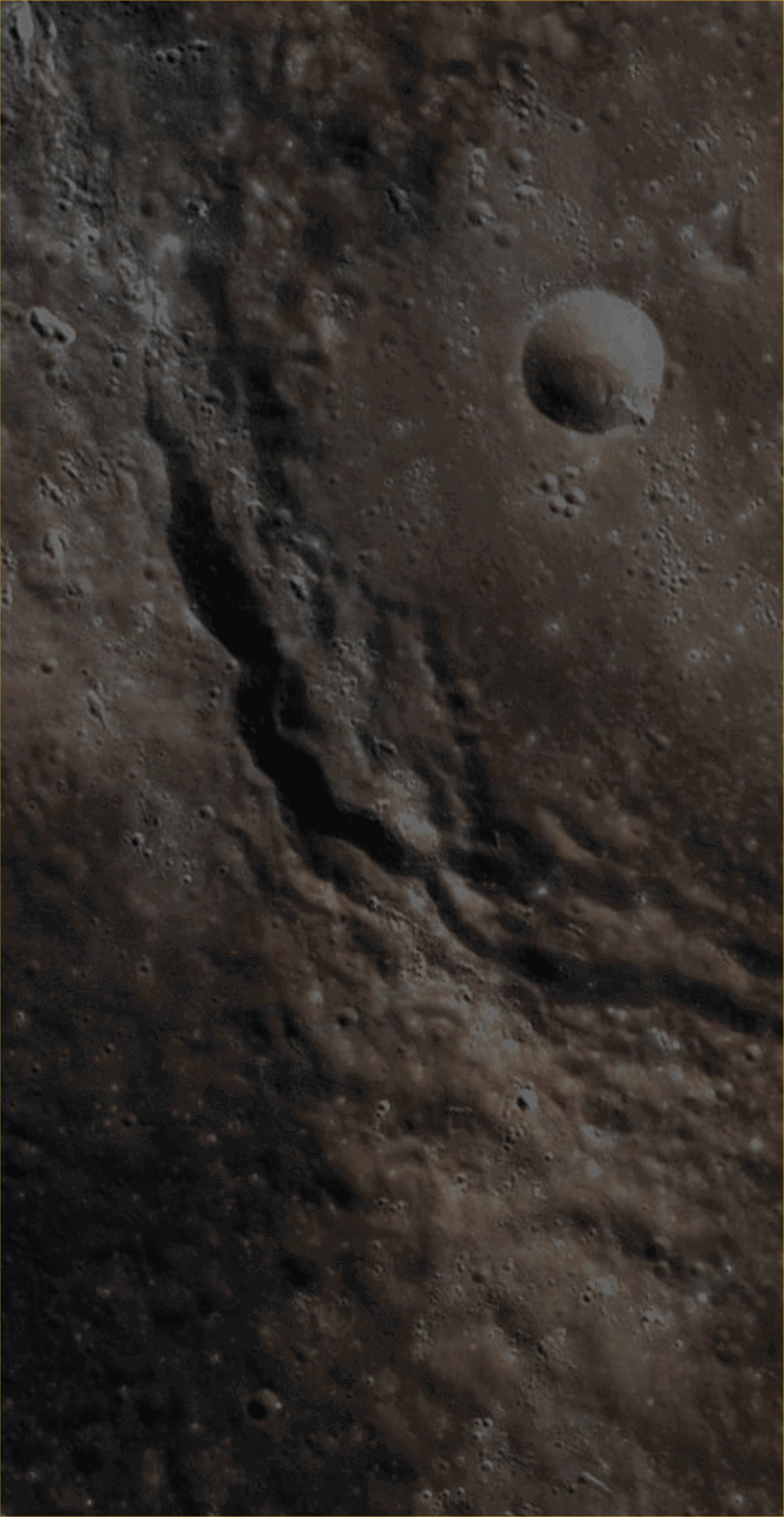
Credits: NASA/Johns Hopkins University Applied Physics Laboratory/Carnegie Institution of Washington and Dr Paolo C. Fienga/LXTT/IPF for the additional process. and color.
|
The South/Western portion of the Mercurian Impact Crater Heine (whose diameter is approx. 70 Km - such as about 43,47 miles) is quite well detailed in this Extra Detail Magnification - or EDM - which has been cropped and magnified from an image-mosaic obtained by putting together three frames taken by the NASA - Messenger Spacecraft on May, 6, 2012). In this EDM, Heine Crater, as you can see, exhibits, towards its South/Western Side (left - Sx - and lower left portion of the frame), a large area covered by what is now commonly known as "Low Reflectance Material" (or "LRM" for short). As you might have noticed, even after the EDM image-processing, no Hollows are visible in and around Heine Crater (which is kind of strange, if you consider the - let's say - "usual", physical characteristics of many - as a matter of fact, really VERY MANY! - Mercurian Impact Craters). Last, but not least (and just out of curiosity), this Impact Crater was so named after Heinrich Heine (born on December 13, 1797, in Düsseldorf and deceased in Paris on February, 17, 1856), who is considered one of the most significant German Poets of the 19th Century. One of Heine's best known poems is "Die Lorelei". Date acquired: May, 6th, 2012 This picture (which is a crop from an Original NASA - MESSENGER Spacecraft's false colors and Map-Projected image-mosaic published on the NASA - Planetary Photojournal with the ID n. PIA 17431) has been additionally processed, contrast enhanced, magnified so to enhance details' visibility, Gamma corrected and then re-colorized in Absolute Natural Colors (such as the colors that an average human eye would actually perceive if someone were onboard the NASA - Messenger Spacecraft and then looked down, towards the Surface of Mercury), by using an original technique created - and, in time, dramatically improved - by the Lunar Explorer Italia Team. Different colors, as well as different shades of the same color, mean, among other things, the existence of different Elements (Minerals) present on the Surface of Mercury, each having a different Albedo (---> Reflectivity) and Chemical Composition. |
News visualized: 833 times