

September 13, 2013

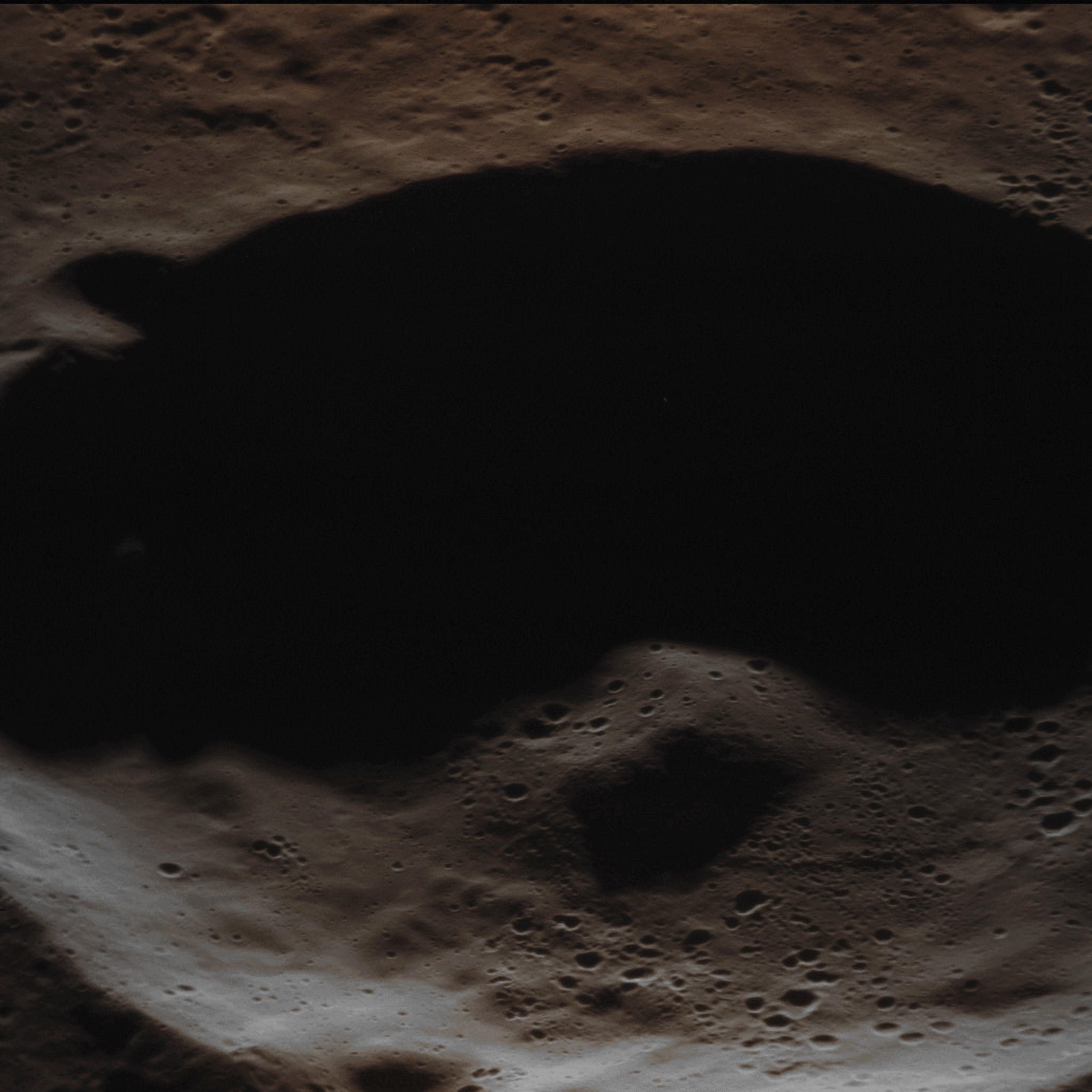
Credits: NASA/Johns Hopkins University Applied Physics Laboratory/Carnegie Institution of Washington and Dr Paolo C. Fienga/LXTT/IPF for the additional process. and color.
|
In this dramatic and suggestive scene, obtained by the NASA - MESSENGER Spacecraft on July, 7, 2013, we can see an Unnamed Impact Crater located in Mercury's Northern Volcanic Plains while is being bathed in deep darkness, as the Sun was sitting very low on the Local Horizon at the time that the picture was taken. Rising from the floor of the Crater is its Central Peak: a small Mountain resulting from certain specific impact dynamics related to the Crater's formation. A Central Peak Structure is a type of Crater Morphology that lies between the "Simple" and "Peak Ring" ones Mercurian Impact Craters' Morphologies so far discovered. This image was acquired as a High-Resolution Targeted Observation. Targeted Observations are images of a small area of Mercury's Surface which are photographed at Resolutions much higher than the 200-meter/pixel Morphology Base Map. It is not possible to cover all of Mercury's Surface at such an High Resolution, but, however, quite a few areas of high scientific interest are imaged in this mode each week. Date acquired: July, 7th, 2013 This picture (which is an Original NASA - MESSENGER Spacecraft's b/w and NON-Map-Projected image published on the NASA - Planetary Photojournal with the ID n. PIA 17456) has been additionally processed, contrast enhanced, magnified and then re-colorized in Absolute Natural Colors (such as the colors that a human eye would actually perceive if someone were onboard the NASA - MESSENGER Spacecraft and then looked down, towards the Surface of Mercury), by using an original technique created - and, in time, dramatically improved - by the Lunar Explorer Italia Team. Different colors, as well as different shades of the same color, mean, among other things, the existence of different Elements (Minerals) present on the Surface of Mercury, each having a different Albedo (---> Reflectivity) and Chemical Composition. |
News visualized: 783 times