


February 19, 2012

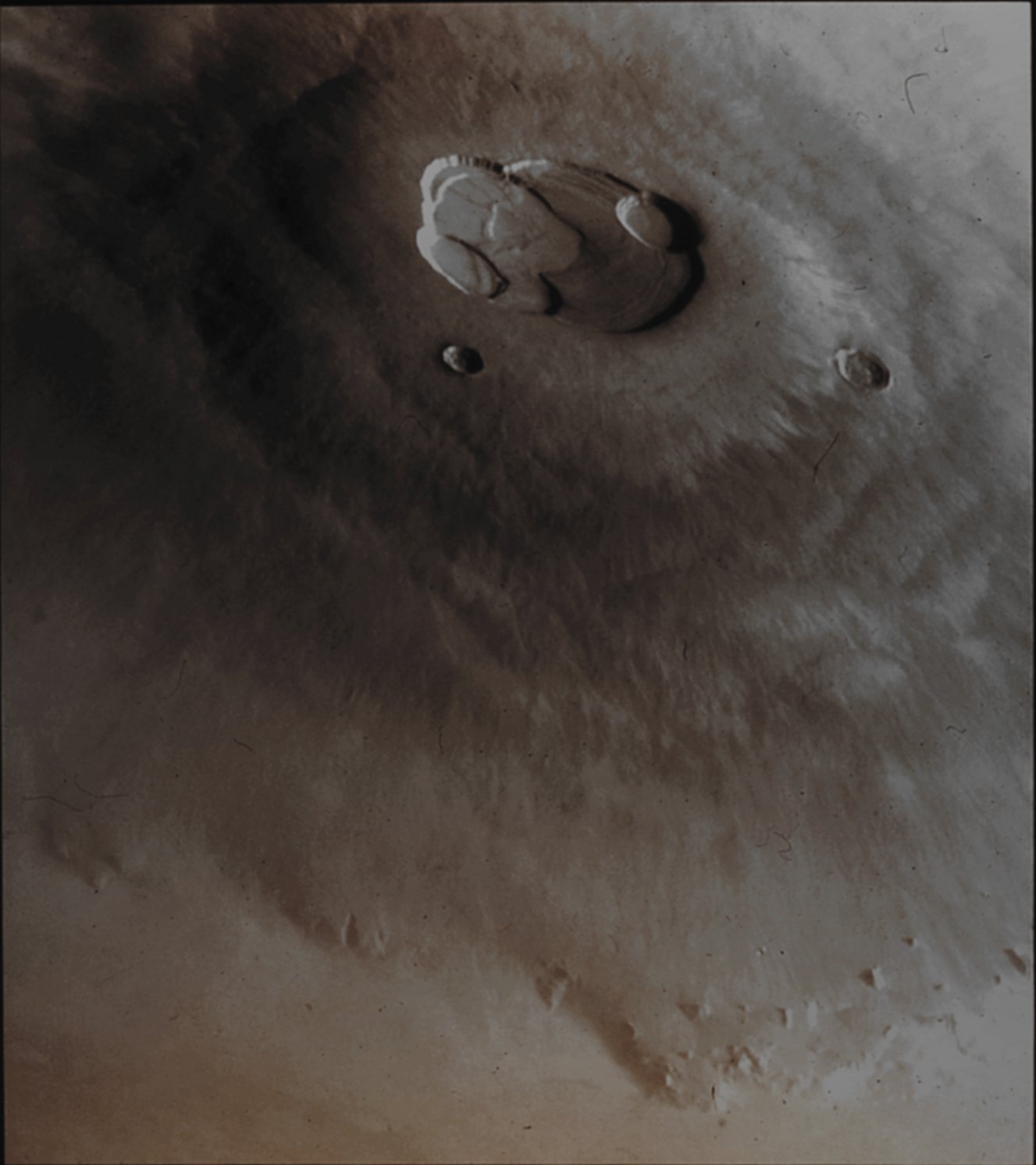
Credits: NASA/JPL-Caltech/Viking Orbiter 1 - Credits for the additional process. and color.: Dr Paolo C. Fienga/Lunar Explorer Italia/IPF
|
This NASA - Viking Orbiter 1 image, shows the Giant Martian Shield-Volcano Olympus Mons: with a diameter of more than 600 Km (approx. the size of the American State of Arizona) and a height of nearly 25 Km above the surrounding Lava Plains, Olympus Mons is almost three times taller than the Mount Everest and it is the tallest Volcano known to exist in the whole Solar System. Olympus Mons is the youngest of the large Volcanoes of Mars, having formed during the Amazonian Period, and it had been known to Astronomers since the late 19th century as the Albedo Feature known as Nix Olympica (Latin for "Snows of Olympus"), but Its mountainous nature was suspected well before NASA - Mariner 9 Spacecraft (in 1971) confirmed its identity as a mountain. Olympus Mons is located in Mars' Western Hemisphere at approximately 18°24" North Lat. and 226°00" East Long., just off the North/Western edge of the Tharsis Bulge. The Western portion of Olympus Mons lies in the Amazonis Quadrangle, while the Central and Eastern portions lie in the adjoining Tharsis Quadrangle. Two Impact Craters spotted on Olympus Mons have been assigned provisional names by the International Astronomical Union (IAU), and theu are the approx. 15,6 Km (abot 10 miles)-diameter Crater Karzok (located at 18°25" North Lat. and 131°55" West Long.) and the approx. 10,4 Km (about 6 miles)-diameter Crater Pangboche (located at 17°10" North Lat. and 133°35" West Long.). These two Impact Craters are notable for being two of the several suspected source areas for "Shergottites", such as the most abundant class of Martian Meteorites. This frame has been colorized in Absolute Natural Colors by (such as the colors that a human eye would actually perceive if someone were onboard the NASA - Viking Orbiter 1 and then looked down, towards Olympus Mons), by using an original technique created - and, in time, dramatically emproved - by the Lunar Explorer Italia Team. |
News visualized: 926 times