

August 17, 2013

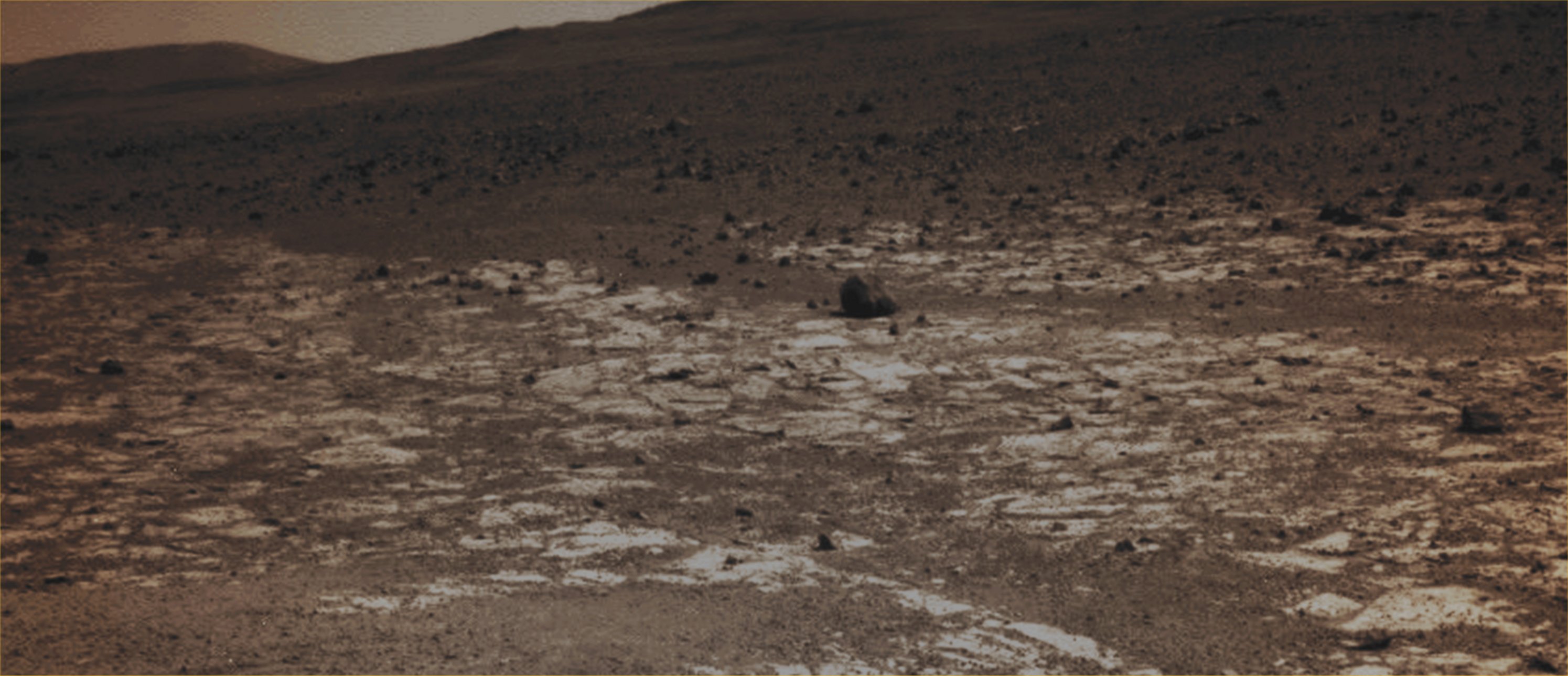
Credits: NASA/JPL- Caltech - MER Opportunity - Credits for the additional process.: Dr Paolo C. Fienga/Lunar Explorer Italia/IPF
|
This view, taken by the NASA - Mars Exploration Rover (MER) Opportunity, shows us an area where a pale-toned Geological Unit called the "Burns Foundation" that, in the foreground, abuts (---> is next to and/or has a common boundary with) a different Geological Unit. The darker Unit, which is believed to be older, marks the edge of "Solander Point": a raised segment of the Western Rim of Endeavour Crater. The Rover Team intends to study this Geological Contact Area with Opportunity before driving the Rover up onto Solander Point to examine the Rocks that will be found there. Furthermore, the point located at Solander, on its North-facing Slope, also offers an advantage for power output from Rover's Solar Panels during the upcoming Southern Hemisphere's Winter. Opportunity used the Navigation Camera (or NavCam) - which is located on its Mast - to capture this Southward-facing scene along the Eastern Flank of Solander Point, during the 3387 Martian Day, or Sol, of the Rover's work on Mars (such August 3, 2013 on Earth). The Rock at the far right-hand side of the scene (and informally named "Tick Bush"), is about 1 foot (such as approx. 30,48 centimeters) across. In the week after this image was taken, Opportunity used some of the tools located on its Robotic Arm (or "RA" for short) to examine textures and composition of Tick Bush. Last, but not least, the larger Rock that is visible near the center of the image has been informally named "Cheese Tree". This frame (which is an Original NASA - Mars Exploration Rover (MER) - "Opportunity" b/w image published on the NASA - Planetary Photojournal and identified by the ID n. PIA 17087) has been additionally processed, Gamma corrected and then colorized in Absolute Natural Colors (such as the colors that a normal - meaning "in the average" - human eye would actually perceive if someone were on the Surface of Mars, near the NASA - Mars Exploration Rover (MER) Opportunity, and then looked ahead, towards the Horizon and Sky over Endeavour Crater), by using an original technique created - and, in time, dramatically improved - by the Lunar Explorer Italia Team. |
News visualized: 746 times