
July 25, 2013

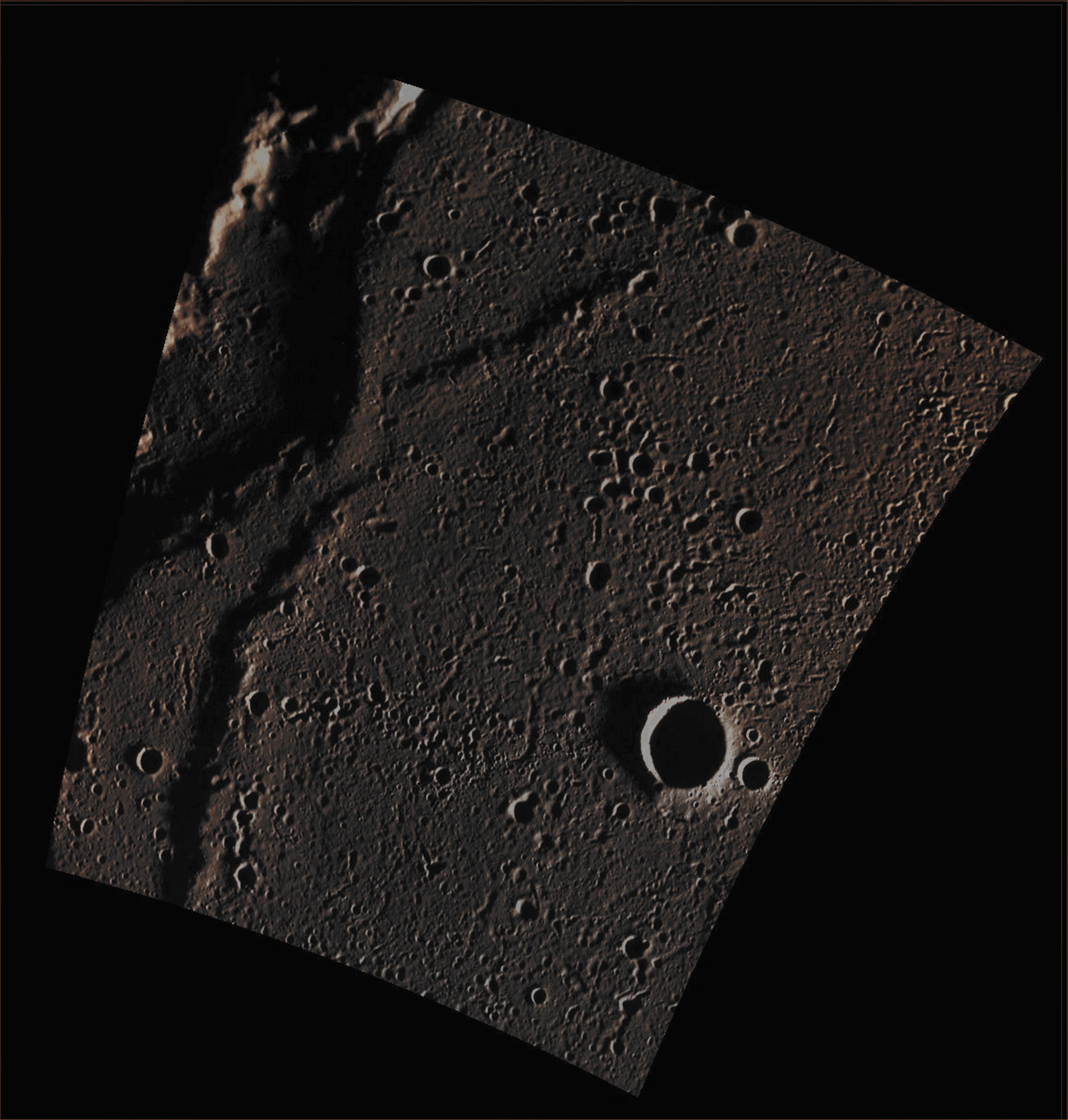
Credits: NASA/Johns Hopkins University Applied Physics Laboratory/Carnegie Institution of Washington and Dr Paolo C. Fienga/LXTT/IPF for the additional process. and color.
|
A number of relatively small and still Unnamed Impact Craters (with the larger one, found in the lower right quadrant - at about 4 o'clock - of the frame, having a diameter of approx. 9,5 Km - such as about 5,89 miles) is visible all over the scene and, in particular, in the proximities of a well defined Wrinkle (---> a slight line in or a fold of the ground) Ridge (watch to the left - Sx - of the picture) located within Goethe Basin. Furthermore, if you look very carefully this image-mosaic, you will also be able to spot quite a few interesting Crater Chains and Pits (which are both real common Surface Feature of the Planet Mercury), Since this image was taken near the North Pole of Mercury (a place where the Sun is always extremely low on the Local Horizon), all the visible shadows, as we have already noticed in previous similar images, are way sharper and, in fact, more dramatic than the ones that you can see in the Equatorial Regions of the Innermost Planet of the Solar System. Date acquired: February, 9th, 2013 This picture (which is an Original NASA - MESSENGER Spacecraft's false colors and Map-Projected image-mosaic published on the NASA - Planetary Photojournal with the ID n. PIA 17387) has been additionally processed, contrast enhanced, magnified and then re-colorized in Absolute Natural Colors (such as the colors that a human eye would actually perceive if someone were onboard the NASA - MESSENGER Spacecraft and then looked down, towards the Surface of Mercury), by using an original technique created - and, in time, dramatically improved - by the Lunar Explorer Italia Team. Different colors, as well as different shades of the same color, mean, among other things, the existence of different Elements (Minerals) present on the Surface of Mercury, each having a different Albedo (---> Reflectivity) and Chemical Composition. |
News visualized: 846 times