

July 10, 2013

Credits: NASA/Johns Hopkins University Applied Physics Laboratory/Carnegie Institution of Washington and Dr Paolo C. Fienga/LXTT/IPF for the additional process. and color.
|
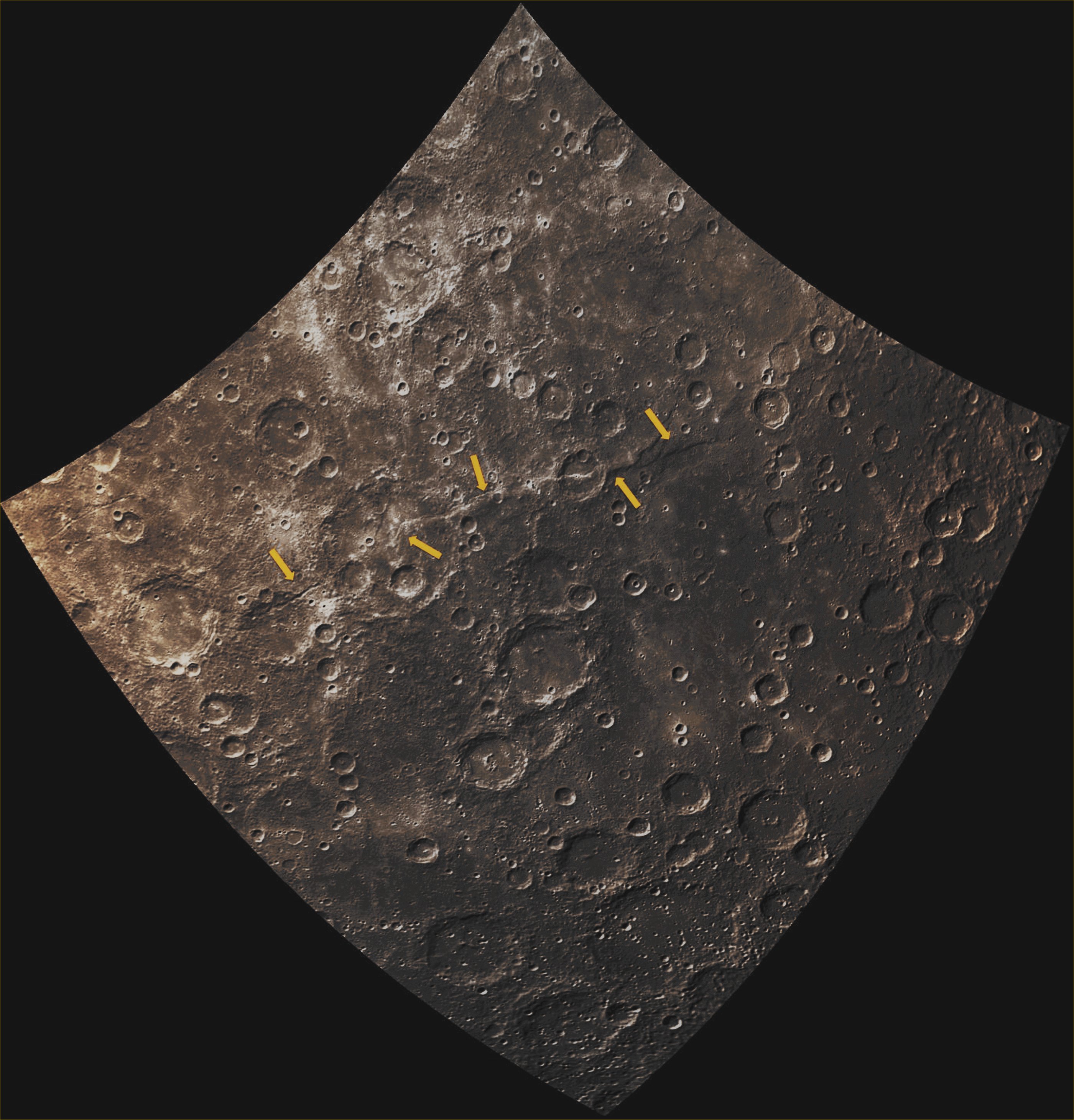
This interesting image-mosaic, which was created by putting together three (3) frames taken by the NASA - MESSENGER Spacecraft on the date of August, 17, 2011, highlights the difference between the areas on and below the newly named Belgica Rupes. The arrows show Belgica Rupes' location, that is stretching along most of the frame, for about 764 Km (such as about 474,44 miles). Notice how some of the smaller, newer Impact Craters obscure the Scarp Line, while the older ones were clearly disrupted by the formation of the Rupes. The word 'Rupes' comes from the Latin word for "Cliff" and the tallest ones in the whole Solar System (and named Verona Rupes) are found on the Uranian moon, Miranda (please, refer to the APOD of January, 21, 2012, for more information about them). All the Rupes found on Mercury have been named after vehicles of exploration; the Belgica, for instance, was a Belgian ship that explored the South Pole of the Planet Earth in the AD 1898. Just out of curiosity, the name of this Mercurian Surface Feature was approved by the International Astronomical Union (or IAU, for short) on June 6, 2013, along with nine (9) other Rupes. Date acquired: September, 7th, 2011 This picture (which is an Original NASA - MESSENGER Spacecraft's false colors and Map-Projected image-mosaic published on the NASA - Planetary Photojournal with the ID n. PIA 17377) has been additionally processed, contrast enhanced, magnified and then colorized in Absolute Natural Colors (such as the colors that a human eye would actually perceive if someone were onboard the NASA - MESSENGER Spacecraft and then looked down, towards the Surface of Mercury), by using an original technique created - and, in time, dramatically improved - by the Lunar Explorer Italia Team. Different colors, as well as different shades of the same color, mean, among other things, the existence of different Elements (Minerals) present on the Surface of Mercury, each having a different Albedo (---> Reflectivity) and Chemical Composition. |
News visualized: 708 times