
February 15, 2012

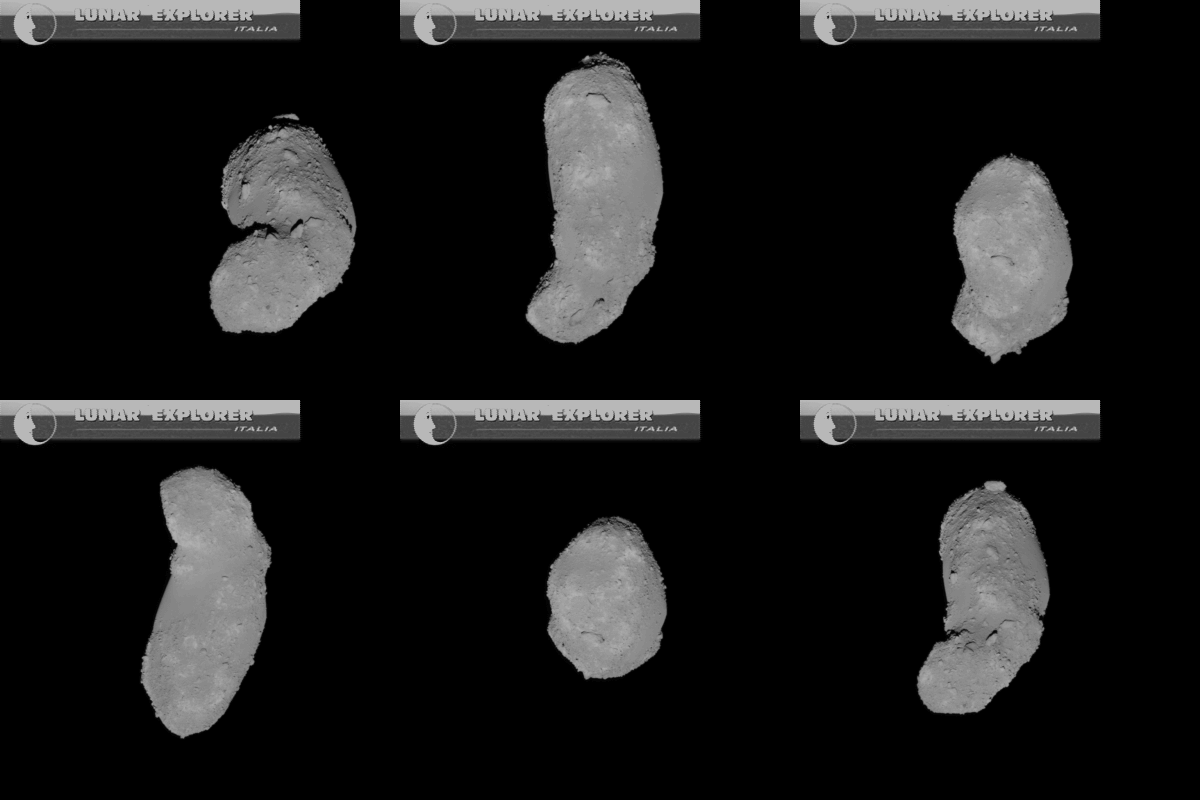
Credits: JAXA - Credits for additional process.: Dr Gianluigi Barca/LXTT/IPF
|
25143 - Itokawa is both an Apollo (the Apollo Asteroids are a group of near-Earth Asteroids, all named after the first one which was discovered, such as 1862 Apollo; these specific Celestial Bodies are Earth-crosser Asteroids, meaning that they have an orbital Semi-Major Axis greater than the one of Earth - > 1 Astronomical Unit (AU) - and a Perihelion Distance < 1,017 Astronomical Units. Some of these Bodies get very close to the Earth, making them a potential threat to our Home Planet (that is because the closer their Semi-Major Axis is to Earth's, the less eccentricity is needed for their orbit to cross the Earth's one) and Mars-crossing Asteroid. Itokawa was the first Asteroid to be the target of a sample return mission, carried out by the Japanese Space Agency (JAXA) - Space Probe "Hayabusa". Itokawa is an S-Type Asteroid and, through Radar imaging obtained by the Goldstone Deep Space Communications Complex (or GDSCC - located in the Mojave Desert, California - USA) in 2001, it was observed an ellipsoid approx. 630 (± 60) mt long and 250 (± 30) mt wide. The JAXA - Hayabusa Mission confirmed these findings and also suggested that 25143 - Itokawa may be a so-called "contact binary" Asteroid, such as a Celestial Body formed by two or more smaller Asteroids that have gravitated toward each other until they got stuck together. The Hayabusa images showed a surprising lack of Impact Craters on Itokawa as well as a very rough Surface. studded with Boulders, which was then described by the Mission Team as a "rubble pile". Furthermore, the density of the Asteroid was found too low for it to be actually made from solid rock, and this would mean that 25143 - Itokawa is not a "monolith" (meaning a "solid block of rock") but rather a ‘rubble pile’ Asteroid, such as a Celestial Body formed from rocky fragments that have cohered over time (probably several hundreds of millions of years, or even more). |
News visualized: 1120 times