

July 6, 2013

Credits: NASA/Johns Hopkins University Applied Physics Laboratory/Carnegie Institution of Washington and Dr Paolo C. Fienga/LXTT/IPF for the additional process. and color.
|
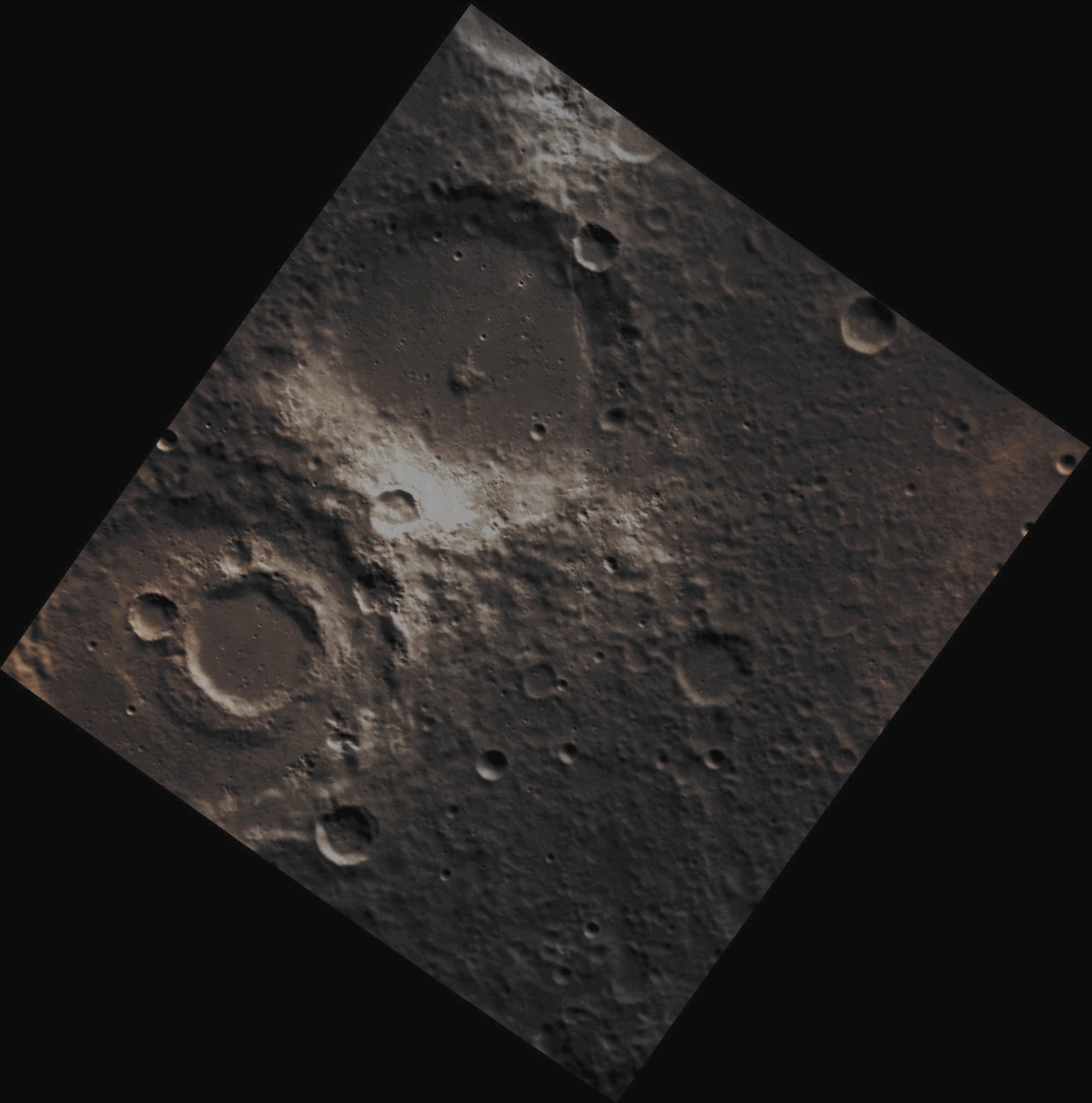
The large-sized Mercurian Impact Crater visible at the Western (left - Sx) corner of this image is named Hesiod and its diameter is of about 100 Km - such as approx. 62,1 miles; you may want to notice that some areas located in the Northern and Eastern portions of its Rim are, as you can see, deeply marked by Irregular Depressions and these Depressions are thought to be (Volcanic) Vents from which Explosive (---> Pyroclastic) Eruptions could have originated (---> occurred), in a far and distant past of Mercury's Geologic History. On the other hand, the High-Reflectance Areas (almost of a White-color and slightly over-exposed) which are visible on the South-Western portion Inner Rim and Wall of the other Unnamed Impact Crater that is located just to the North-East of Hesiod (look at the top of the image) seem to share color characteristics which, as we know now, are common to other Pyroclastic Deposits that have been already found on Mercury. You should remember that Pyroclastic Eruptions are usually driven by the presence of Volatile Compounds in the Sub-Surface of the concerned area, and the NASA - MESSENGER Spacecraft has already revealed that Mercury possesses a high abundance of Volatile Elements; a quantity that is much higher, in fact, than it was ever (and previously) expected. Date acquired: September, 7th, 2011 This picture (which is an Original NASA - MESSENGER Spacecraft's b/w Map-Projected image published on the NASA - Planetary Photojournal with the ID n. PIA 15434) has been additionally processed, contrast enhanced, magnified and then colorized in Absolute Natural Colors (such as the colors that a human eye would actually perceive if someone were onboard the NASA - MESSENGER Spacecraft and then looked down, towards the Surface of Mercury), by using an original technique created - and, in time, dramatically improved - by the Lunar Explorer Italia Team. Different colors, as well as different shades of the same color, mean, among other things, the existence of different Elements (Minerals) present on the Surface of Mercury, each having a different Albedo (---> Reflectivity) and Chemical Composition. |
News visualized: 715 times