

February 12, 2012

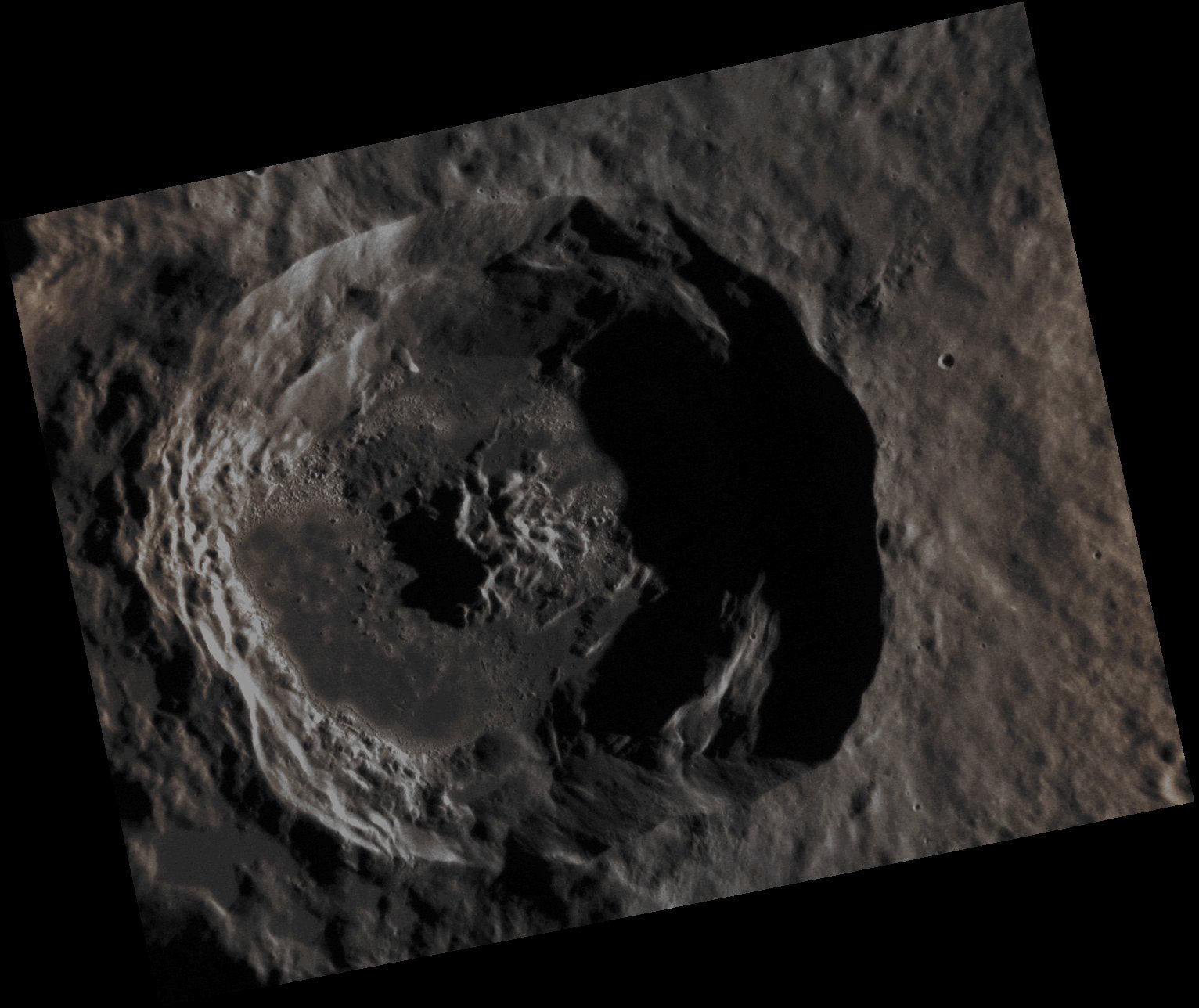
Credits: NASA/Johns Hopkins University Applied Physics Laboratory/Carnegie Institution of Washington and Dr Paolo C. Fienga/LXTT/IPF for the additional process. and color.
|
This beautiful, and as of yet Unnamed, Crater lies within the Caloris Basin - also known as Caloris Planitia -: a large Mercurian Impact Crater, about 1550 Km (approx. 960 mi) in diameter and one of the largest Impact Basins in the whole Solar System. Caloris is a Latin word that means "heat", or "warmth", and this Basin has been so-named because, every second time that Mercury passes is Perihelion (such as the point of least distance of Mercury from the Sun), our Parent Star shines almost directly overhead it. Caloris Basin, which was discovered in 1974, is surrounded by a ring of Mountains approx. 2 Km (about 1,2 mi) tall. The Floor of the Unnamed Impact Crater shown in today's picture, provides another example of the beautiful "Hollows" (such as rounded Surface Depressions which may have been formed through Sublimation of a component of the material exposed by the Impact Event) recently discovered on Mercury. This image was acquired as a HRTO (such as a "High-Resolution Targeted Observation"). Targeted observations are images of a small area on Mercury's Surface at resolutions much higher than the 250-meter/pixel (820 feet/pixel) morphology base map or the 1-Km/pixel (0,6 miles/pixel) color base map. It is not possible to cover all of Mercury's Surface at this high resolution during MESSENGER's one-year mission, but several areas of high scientific interest are generally imaged in this mode each week. Date acquired: October, 28th, 2011 Image Mission Elapsed Time (MET): 228326267 Image ID: 943690 Instrument: Narrow Angle Camera (NAC) of the Mercury Dual Imaging System (MDIS) Center Latitude: 38,44° North Center Longitude: 175,6° East Resolution: 42 meters/pixel Scale: this Unnamed Crater is approximately 38 Km (such as about 24 miles) across Solar Incidence Angle: 76,1° (meaning that the Sun, at the time the picture was taken, was about 13,9° above the Local Horizon) Emission Angle: 40,0° Sun-Mercury-MESSENGER (or "Phase") Angle: 116,1° This frame has been colorized in Absolute Natural Colors by (such as the colors that a human eye would actually perceive if someone were onboard the MESSENGER Spacecraft and then looked down, towards the Surface of Mercury, by using an original technique created - and, in time, dramatically improved - by the Lunar Explorer Italia Team. |
News visualized: 932 times