

June 5, 2013

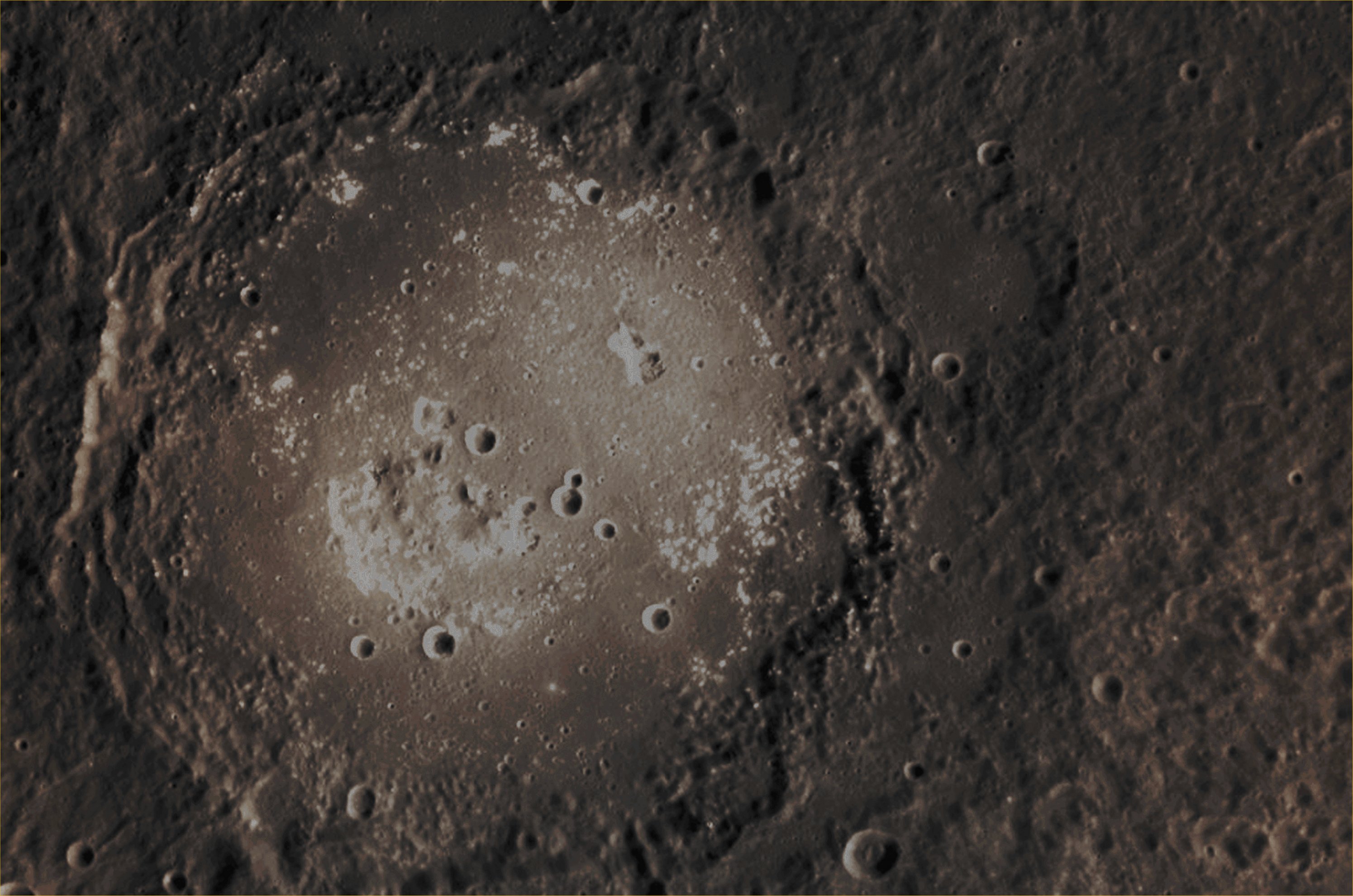
Credits: NASA/Johns Hopkins University Applied Physics Laboratory/Carnegie Institution of Washington and Dr Paolo C. Fienga/LXTT/IPF for the additional process. and color.
|
The very bright Floor of the Mercurian Impact Crater Lermontov (approx. 166 Km - such as about 103,086 miles - in diameter and so named after Mikhail Lermontov - the esteemed Russian poet whose most famous poem was, perhaps, "Death of the Poet") was first imaged by the NASA - Mariner 10 Spacecraft in the AD 1974 and, in this frame, it stands in clear contrast with the surrounding - and dark - Terrain. The large Depressions - Collapse Pits, maybe? - found on the Floor of Lermontov have been interpreted, by Planetary Scientists, as a possible evidence of the occurrence (in a far and distant past of Mercury) of Pyroclastic Phenomena (---> Explosive Volcanism), and such a circumstance, if, one day, shall be proven true, can provide us with a few insights into the Volcanic History of Mercury. Furthermore, you may notice that the Floor of Lermontov Crater - in several areas located all around the aforementioned huge Depressions - appears to have been widely altered by the formation of a great number of extremely bright Hollows (which is, however, a now well known and very common characteristic of many - if not all - Mercurian Impact Craters). Date acquired: February 12th, 2013 This picture (which has been cropped from an Original NASA - MESSENGER Spacecraft's b/w Map-Projected frame published on the NASA - Planetary Photojournal with the ID n. PIA 17058) has been additionally processed, contrast enhanced, magnified and then colorized in Absolute Natural Colors (such as the colors that a human eye would actually perceive if someone were onboard the NASA - MESSENGER Spacecraft and then looked down, towards the Surface of Mercury), by using an original technique created - and, in time, dramatically improved - by the Lunar Explorer Italia Team. Different colors, as well as different shades of the same color, mean, among other things, the existence of different Elements (Minerals) present on the Surface of Mercury, each having a different Albedo (---> Reflectivity) and Chemical Composition. |
News visualized: 828 times