

May 6, 2013

Credits: NASA/Johns Hopkins University Applied Physics Laboratory/Carnegie Institution of Washington and Dr Paolo C. Fienga/LXTT/IPF for the additional process. and color.
|
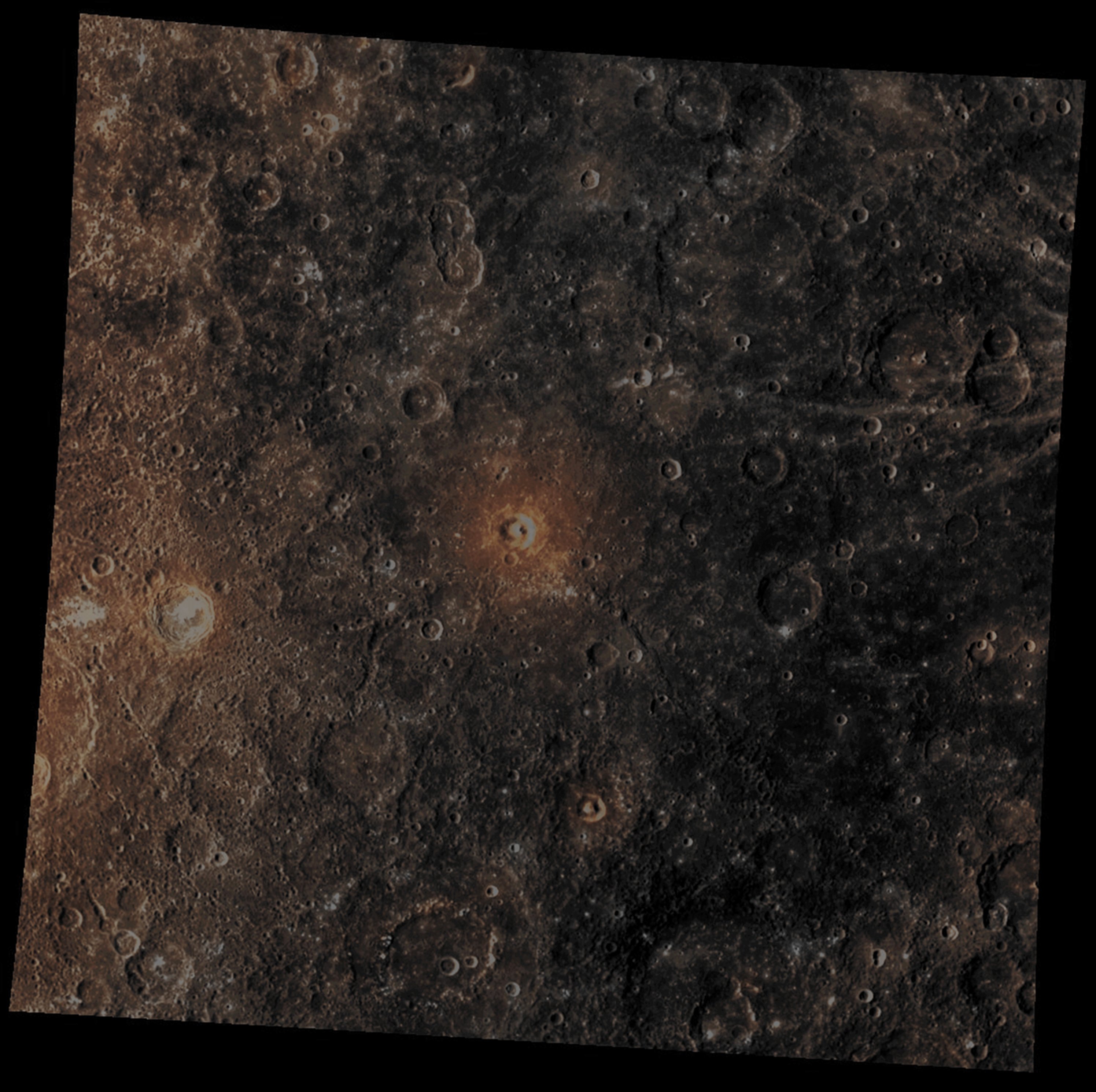
At the center of today's picture (which is an image-mosaic approx. 750 Km - such as 465,75 miles - wide), you can see a so-called "Red Spot", which is an informal designation used by the MESSENGER Team to describe an area with overall High Reflectance as compared to its surroundings - meaning, in other words, a higher Reflectance than the Average Reflectance of a given Mercurian Region at the longer-Wavelength end (---> red) of the Visible Light Spectrum. Red Spots are thought to be sites where Pyroclastic (---> explosive) Volcanic Eruptions might have occurred in a very distant past of Mercury's Geological History. However, as you can see in the picture, the Absolute Natural Color of the "Red Spot" is not red at all, but rather a light and bright white and yellow in the center, which becomes a dark orange with brown nuances all over its outer margins. The Impact Crater visible near the left edge of this image-mosaic, slightly over-exposed and with Bright Deposits (---> Hollows) on its Floor, is Theophanes Crater (if you wish to see Theophanes Crater in large detail, please go the APOD's Archive and watch the image that was published on March, 10, 2013). Date acquired: December, 14th, 2011 This picture (which has been cropped from an Original NASA - MESSENGER Spacecraft false color image-mosaic published on the NASA - Planetary Photojournal with the ID n. PIA 17021) has been additionally processed and then re-colorized in Absolute Natural Colors (such as the colors that a human eye would actually perceive if someone were onboard the NASA - MESSENGER Spacecraft and then looked down, towards the Surface of Mercury), by using an original technique created - and, in time, dramatically improved - by the Lunar Explorer Italia Team. Different colors, as well as different shades of the same color, mean, among other things, the existence of different Elements (Minerals) present on the Surface of Mercury, each having a different Albedo (---> Reflectivity) and Chemical Composition. |
News visualized: 763 times