

February 8, 2012

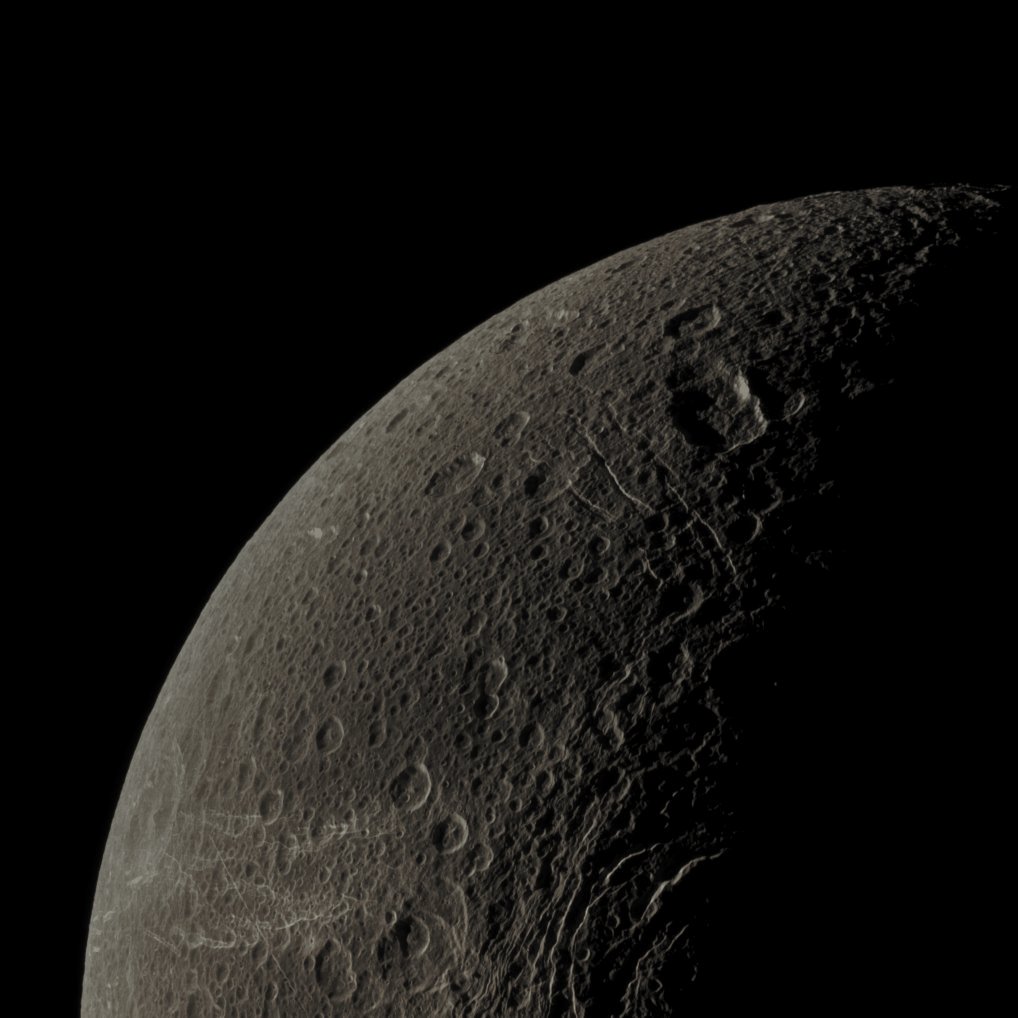
Credits: NASA/JPL/Space Science Institute - Credits for the additional process. and color.: Dr Paolo C. Fienga/Lunar Explorer Italia/IPF
|
When the NASA - Voyager Space Probe photographed Dione in 1980, it showed what appeared to be Wispy Features covering its Trailing Hemisphere. The origin of these features was really mysterious, as all that was known at that time was that the material had a high Albedo and was (seemed to be) thin enough that it did not obscure the Surface Features underneath it. One hypothesis was that shortly after its formation, Dione was geologically active, and some process, such as Ice (Cryo) Volcanism, remodeled much of its Surface, with the Streaks forming as effects of these "cold eruptions" (in other words, the erupted material did not posses, at the time of the eruption, enough momentum to reach the Escape Velocity - unlike the ice-particles emitted from the Tiger Stripes on Enceladus - and therefore it fell back on to the Surface of Dione as dirty snow or ash). Later, after all Dione's internal activity and subsequent resurfacing ceased, cratering continued primarily on the Leading Hemisphere of this Celestial Body, and wiped out the Streak Patterns. This theory, however, was proven wrong by the NASA - Cassini Spacecraft Fly-By of December 13, 2004, which produced close-up images. These revealed that the 'Wisps' were in fact not "dirty" Ice Deposits at all, but rather bright Ice Cliffs, probably created by Tectonic Fractures. The NASA - Cassini Spacecraft then performed an even closer Fly-By of Dione (on October 11, 2005), and captured several oblique images of the Cliffs (from a distance of less than 500 Km), showing that some of them were several hundred meters high. What we see today, in this NASA - Cassini Spacecraft frame, is a sample of such a "Wispy Terrain", which, as it was already said and noticed since the Voyager days, is capable to reflect Sunlight brightly (as we can see in the lower left of this Cassini image of the Northern Latitudes of Dione). The lit Terrain seen here is between the Trailing Hemisphere and the Saturn-facing Side of Dione. North is up. The image was taken in Visible Light with the Cassini Spacecraft narrow-angle camera on Dec. 20, 2010. The view was obtained at a distance of approx. 107.000 Km (about 66.447 miles) from Dione and at a Sun-Dione-Spacecraft, or Phase, Angle of 109°. Image scale is roughly 640 meters (2100 feet) per pixel. This frame has been colorized in Absolute Natural Colors by (such as the colors that a human eye would actually perceive if someone were onboard the NASA - Cassini Spacecraft and then looked towards the Saturnian moon Dione), by using an original technique created - and, in time, dramatically improved - by the Lunar Explorer Italia Team. |
News visualized: 1030 times