
February 5, 2012

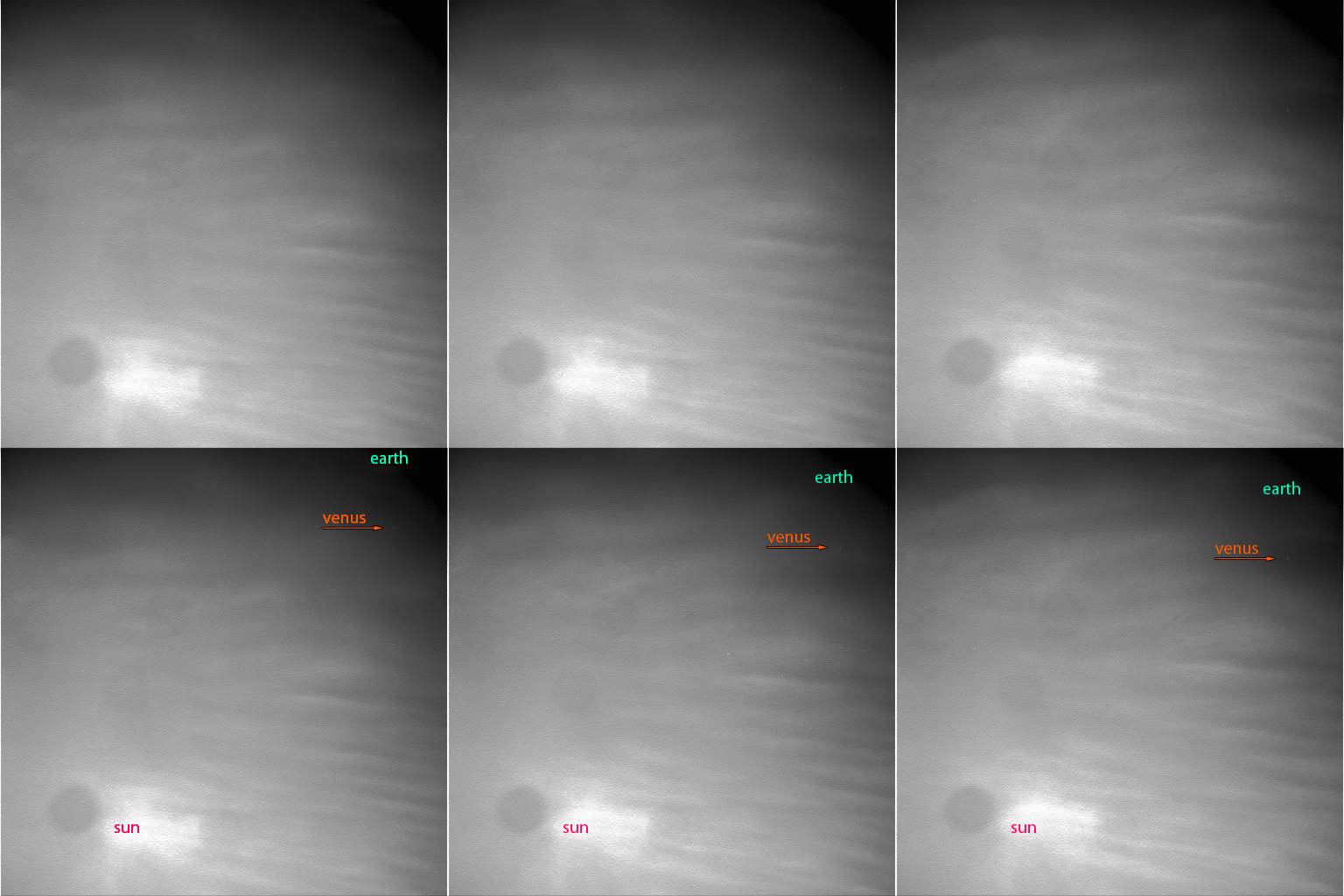
Credits: NASA/JPL/Cornell/USGS - MER Opportunity - Credits for the additional process.: Elisabetta Bonora and Marco Faccin/Lunar Explorer Italia/IPF
|
This extremely fascinating as well as highly educational GIF-Movie, tells us a number of things about the Atmosphere of Mars. For instance, it says that even during daytime, and when the Sun is still relatively high in the Sky, some of the most brilliant Celestial Bodies can be easily seen from the Surface. And this fact is an heavy (and hardly questionable) proof that the Martian Atmosphere is, actually, fairly thin. We also believe, though (and as it has already been said and written in the past), that the Martian Atmosphere (maybe neither at all times, during the whole Martian Year, nor everywhere on the Red Planet) could slightly be thicker at very low altitudes only; this means that a reletively dense (and therefore richer and warmer) Atmosphere could be found, on Mars, inside very deep Surface Depressions, like Skylights, Caverns, Lava Tunnels and also inside deep Collapse Features, like Channels and Pits. On the other and (and, of course, in our opinion), if we stood, for example, in the middle of a Desert (like Meridiani Planum), at the Datum (such as Zero Altitude), we could probably experience a thicker Atmosphere at certain conditions and, very likely, only during some specific moments of the Martian Year. In other words, we believe, as IPF, that the Martian Atmosphere is, with no doubts, very thin, BUT probably not (always) omogeneous. This means and implies that we might find, from time to time (more likely during the late Spring and untill the middle Martian Summer) and in some Regions, several zones where the Atmosphere at the Datum is actually thicker. Then how much thicker - you might ask -? That, nobody knows, but it is reasonable to believe that such a "local (and maybe even regional) bubble" of thicker Atmosphere will not (never, in fact) exceed the height of only a few meters above the Datum itself. Another useful information that we receive from the GIF-Movie is related to the amount and speed of the Clouds that we can see in the Martian Sky. As a matter of fact, and unlike it was believed in the past (even a really recent past...), we have learned that the Martian Atmosphere hosts huge amounts of thin Water-Ice Clouds quite often (let's not forget that we have registered the presenze of Cloud Strata in the Sky of Meridiani Planum many times during Opportunity's 8 years of exploration, as well as we have duly noticed the presence of Large Cumuli in the Skies over Vastitas Borealis, thanks to the pictures taken by the NASA Phoenix Lander) and that these Clouds, whose average altitude should be around the 10/12 Kilometers (or maybe even more: some NASA Scientists believe that the Martian Clouds could rich even a 20-Km altitude!), move very fast. Much faster (even though we are far away from the verification of a phenomenon known as "Super-Rotation") than the Clouds which we can see every day in the Skies of our Home Planet. The frames forming this short sequence have been recorded by the Navigation Camera (NavCam) of NASA Mars Exploration Rover (MER) Opportunity during its 2847th Martian Day (or Sol) of exploration of the Martian Region of Meridiani Planum. The sequence starts at 17:23:57 Mars Local Solar Time (such as on January, 27th, 2012 at 14:04 UTC) and it ends at 17:27:48 Mars Local Solar Time (such as on January, 27th, 2012 at 14:08 UTC). |
News visualized: 915 times