
February 4, 2012

Craedits: NASA/JPL-Caltech/UCLA/MPS/DLR/IDA - Credits for the additional process. and color.: Dr Paolo C. Fienga/Lunar Explorer Italia/IPF
|
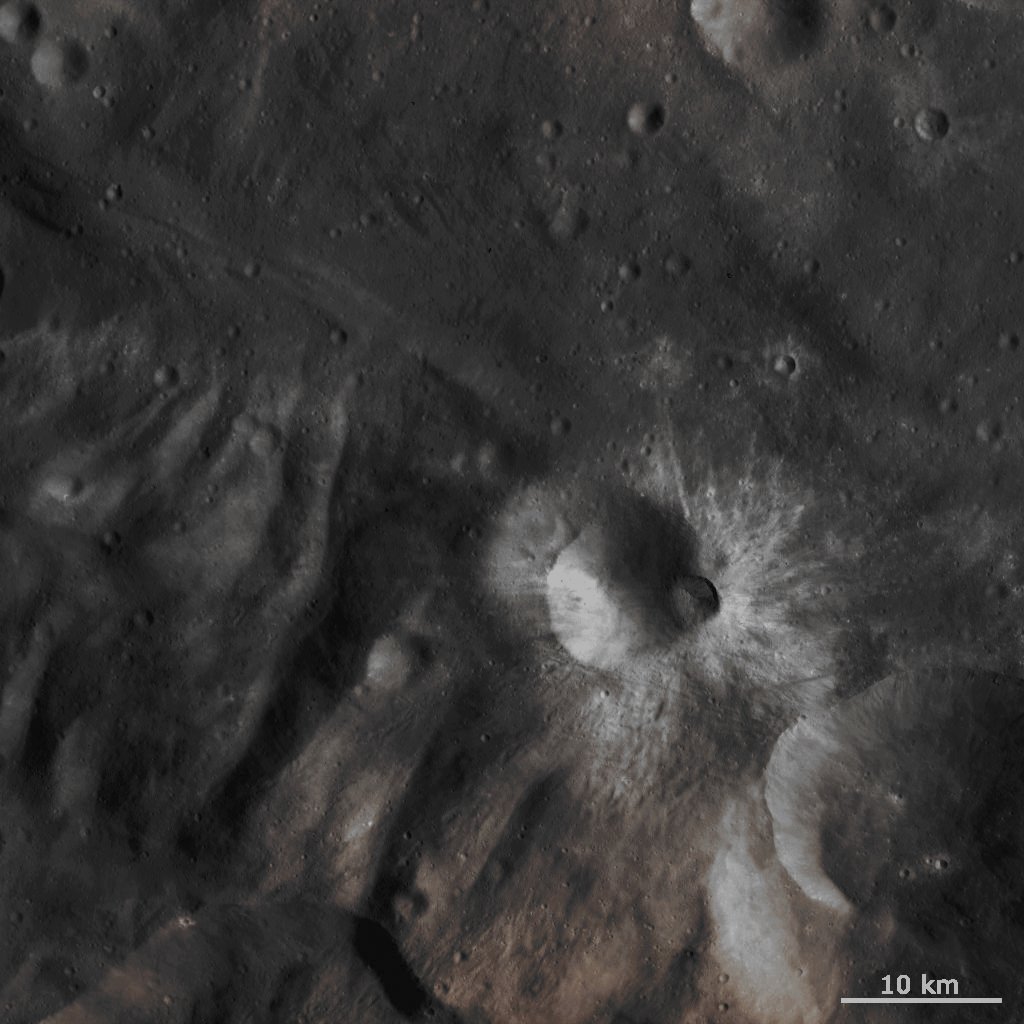
This NASA's Dawn Spacecraft FC (Framing Camera) image is dominated by bright Rayed Craters of different sizes. The most prominent bright Rayed Crater is the approximately 8 Km diameter Crater located, roughly, at the center of the image. This Crater is named Tuccia and the Quadrangle in which it is located was named after it. Towards the bottom of the image its bright Rays extend for over 10 Km but towards the top the Rays are much less extensive. Tuccia Crater has a smaller, fresher, younger Crater on its Rim which also seems to have bright Rays emanating from it. It is clear that this smaller Crater is younger because it overprints the larger one and has a fresher, sharper Rim than Tuccia's. Slightly above these Craters is a much smaller, roughly 2-Km-diameter, bright and still Unnamed Rayed Crater. To the left of it, there is a patch of bright material that is associated with Craters that are only a few pixels in diameter. It is here also well visible a good example of the Hummocky (---> wavy/undulating) Terrain which characterizes Vesta's South Polar Region (loow towards the bottom left of the frame), and Tuccia Crater has been emplaced right onto this Hummocky Terrain. This image has been taken in 4-Vesta's Tuccia Quadrangle and its (centered) Latitude and Longitude co-ordinates are 38,8° South and 200,2° East. NASA's Dawn Spacecraft obtained this image with its Framing Camera on October 17th, 2011, through the camera's clear filter. The distance of the Spacecraft from the Surface of Vesta was about 702 Km and the frame has a resolution of about 70 meters per pixel. This picture was acquired during the HAMO (High Altitude Mapping Orbit) phase of the mission. This frame has been colorized in Absolute Natural Colors (such as the colors that a human eye would actually perceive if someone were onboard the NASA - Dawn Spacecraft and then looked down towards the Surface of 4-Vesta), by using an original technique created - and, in time, dramatically improved - by the Lunar Explorer Italia Team.
|
News visualized: 848 times