


February 3, 2013

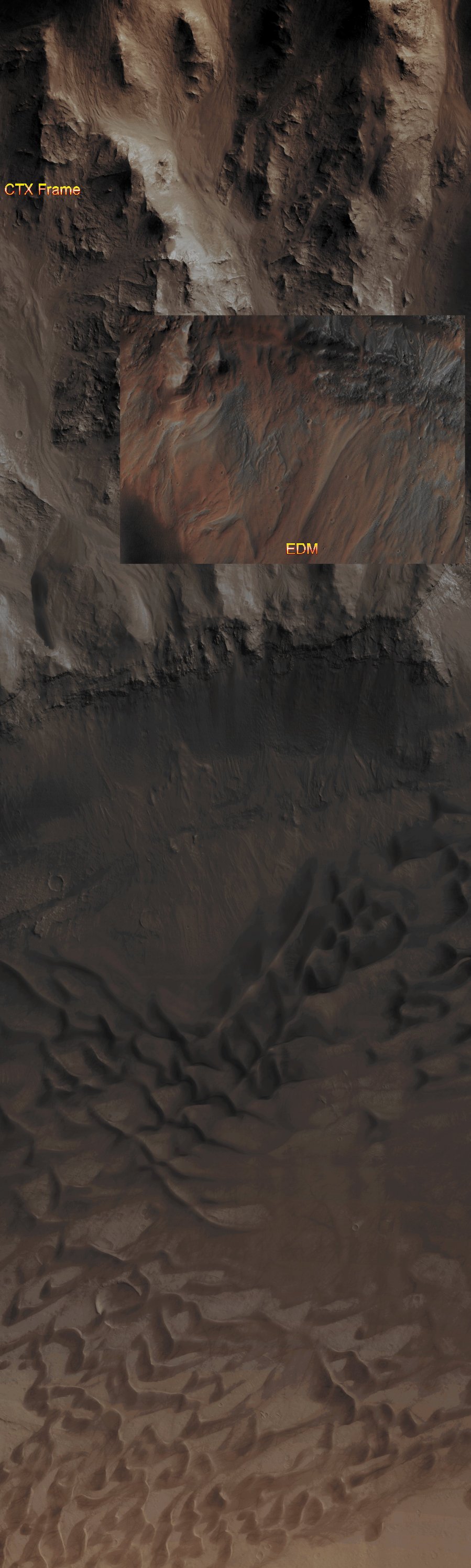
Credits: NASA/JPL/University of Arizona - Credits for the additional process. and color.: Dr Paolo C. Fienga/Lunar Explorer Italia/IPF
|
One of the suggested goals for this observation - carried out by the NASA - Mars Reconnaissance Orbiter - was to investigate some of the relation existing between Dune Material and Wall-Rock, being the Wall-Rock considered as a suspected/possible Sand Source. As it can be seen in whole CTX Frame, the Rocky Outcrops emulating Dark Material are located upslope of the Dunefield. Furthermore, adjacent HiRISE images (like PSP_007218_1660) have shown some evidence that the Dune Material might also be locally derived. Finally, the comparisons that can be made between this picture with other HiRISE images are also helpful to monitor the variations of the visible Surface Features as they occur in (always) relatively short laps of time (like the changings in the Dunes' Slip-Faces and Rock Slides). All the Surface Features visible here are located in Coprates Chasma, which is part of the large Valles Marineris Canyon System: the largest one in the whole Solar System. Mars Local Time: 14:45 (Early Afternoon) These pictures (which are a NASA - Original Mars Reconnaissance Orbiter CTX b/w frame identified by the serial n. ESP_025164_1655 and a NASA - Original Mars Reconnaissance Orbiter EDM false-color frame identified by the serial n. ESP_025164_1655-1) have been additionally processed and then colorized (and re-colorized, respectively) in Absolute Natural Colors (such as the colors that a human eye would actually perceive if someone were onboard the NASA - Mars Reconnaissance Orbiter and then looked down, towards the Surface of Mars), by using an original technique created - and, in time, dramatically improved - by the Lunar Explorer Italia Team. |
News visualized: 825 times