

February 3, 2012

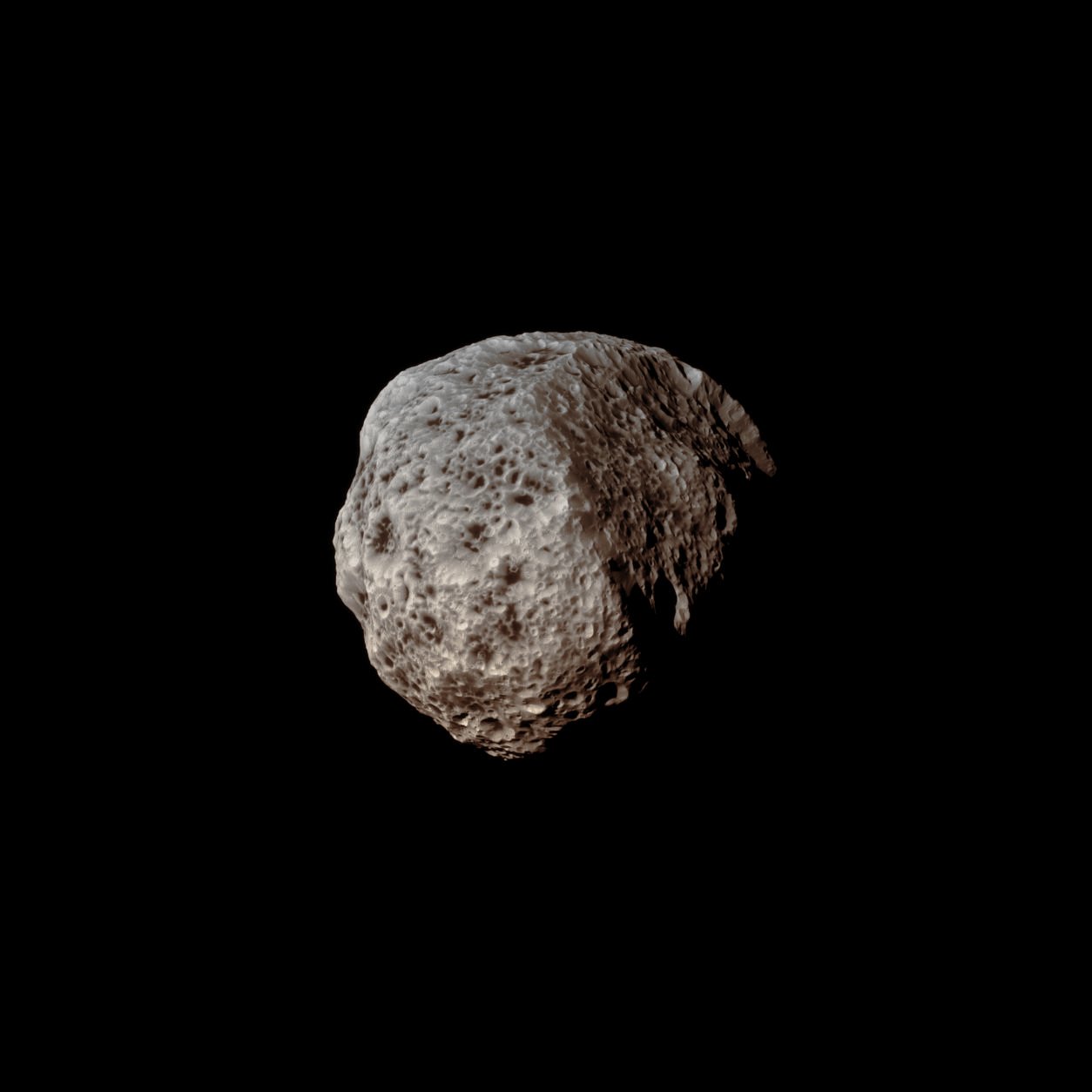
Credits: NASA/JPL/Space Science Institute - Credits for the additional process. and color.: Dr Paolo C. Fienga/Lunar Explorer Italia/IPF
|
The sponge-like Surface of Saturn's moon Hyperion is highlighted in this NASA - Cassini Spacecraft portrait, captured during its September 16, 2011, Fly-By. Hyperion (which is about 168 miles, or approx. 270 Km across) has an irregular shape, and it tumbles through its orbit: that is, it does not spin at a constant rate or in a constant orientation (and, as a consequence of such facts, a standard reference Latitude-Longitude System has not yet been devised for this Celestial Body). However, images such as this one extend the previous coverage and allow a better inventory of Hyperion's Surface Features, shape and changes in its spin. We wish to underline that one (and maybe the most meaningful) of the known (and so far, very many) peculiarities of Hyperion, is the presence, within a number of its sponge-like Craters, of a dark substance which, as the Italian Private Researcher Dr Paolo C. Fienga (the Creator and Curator of the Site "Lunar Explorer Italia") wrote in an Abstract dated September 2005 "...could reasonably be the evidence of surfacing hydrocarbons...". It is to be said that just a few weeks later, this really bold hypothesis was confirmed by NASA. This frame has been colorized in Absolute Natural Colors by (such as the colors that a human eye would actually perceive if someone were onboard the Cassini Orbiter and then looked towards the Saturnian moon Hyperion), by using an original technique created - and, in time, dramatically improved - by the Lunar Explorer Italia Team. |
News visualized: 884 times