
January 21, 2013

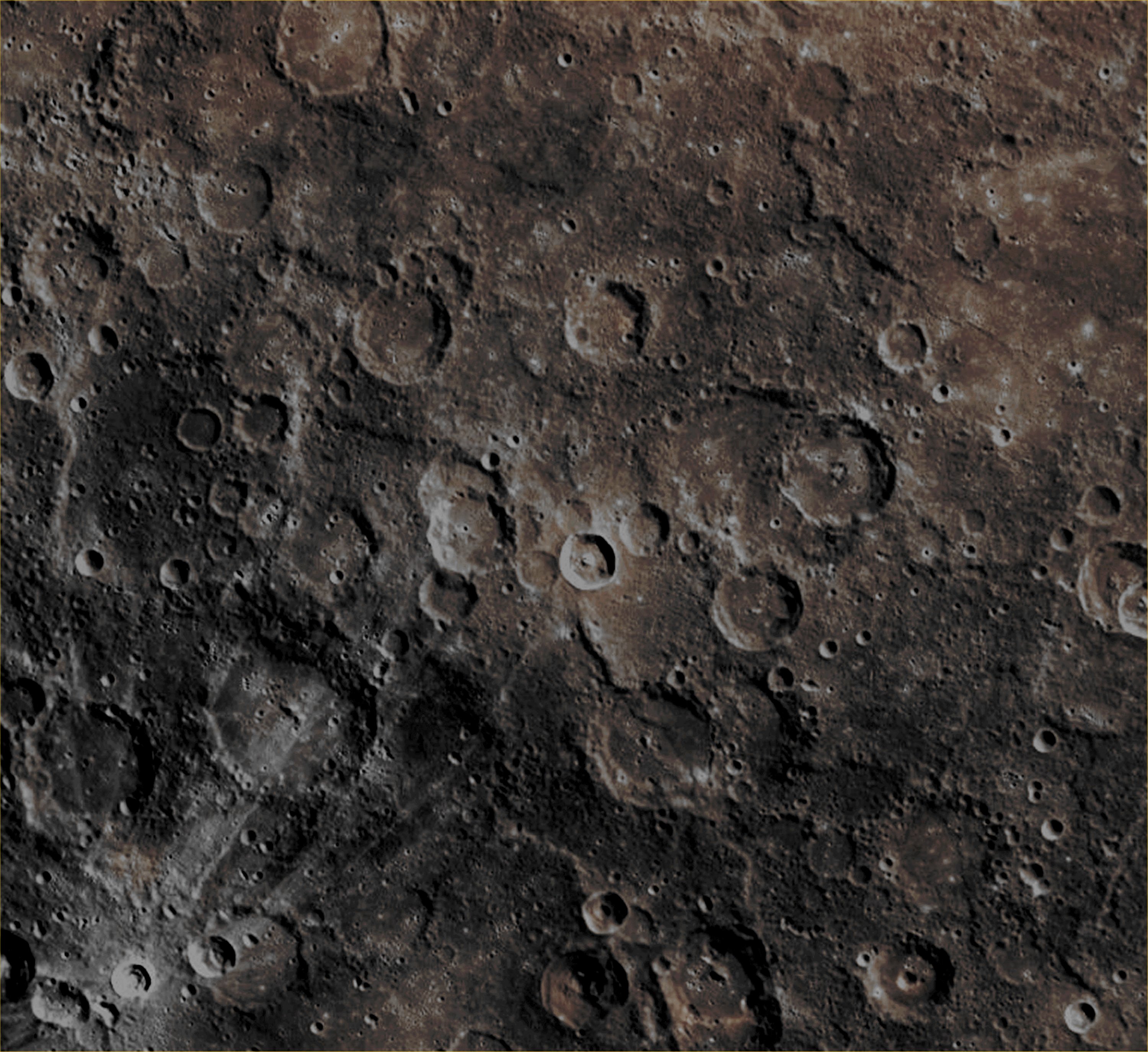
Credits: NASA/Johns Hopkins University Applied Physics Laboratory/Carnegie Institution of Washington and Dr Paolo C. Fienga/LXTT/IPF for the additional process. and color.
|
In the lower left portion of today's image you can easily identify a small and extremely young Rayed Impact Crater whose diameter is approx. 16 Km (such as about 9,9 miles). The Rays have a typical light gray color and this fact (which is really recurrent on Mercury) is mainly caused by the extreme youth of the Rays themselves (do not forget that Surfaces directly exposed to the Space Environment of Mercury for very long periods, tend to "redden" and darken). In addition, the Crater formed in a dark (as a matter fact, we can say almost black, in certain areas) Terrain known as "Low Reflectance Material" (---> Material that reflects the light coming from the Sun very poorly). On the other hand, the area of Mercury that is visible toward the top right of the frame is known as "Intermediate Terrain" (---> Terrain whose Albedo is much higher than the LRM Terrain). Date acquired: November, 30th, 2011 This picture (which is an Original NASA - MESSENGER Spacecraft false color image mosaic published on the NASA - Planetary Photojournal with the ID n. PIA 16677) has been additionally processed and then re-colorized in Absolute Natural Colors (such as the colors that a human eye would actually perceive if someone were onboard the NASA - MESSENGER Spacecraft and then looked down, towards the Surface of Mercury), by using an original technique created - and, in time, dramatically improved - by the Lunar Explorer Italia Team. Different colors, as well as different shades of the same color, mean, among other things, the existence of different Elements (Minerals) present on the Surface of Mercury, each having a different Albedo (---> Reflectivity) and Chemical Composition. |
News visualized: 823 times