

February 1, 2012

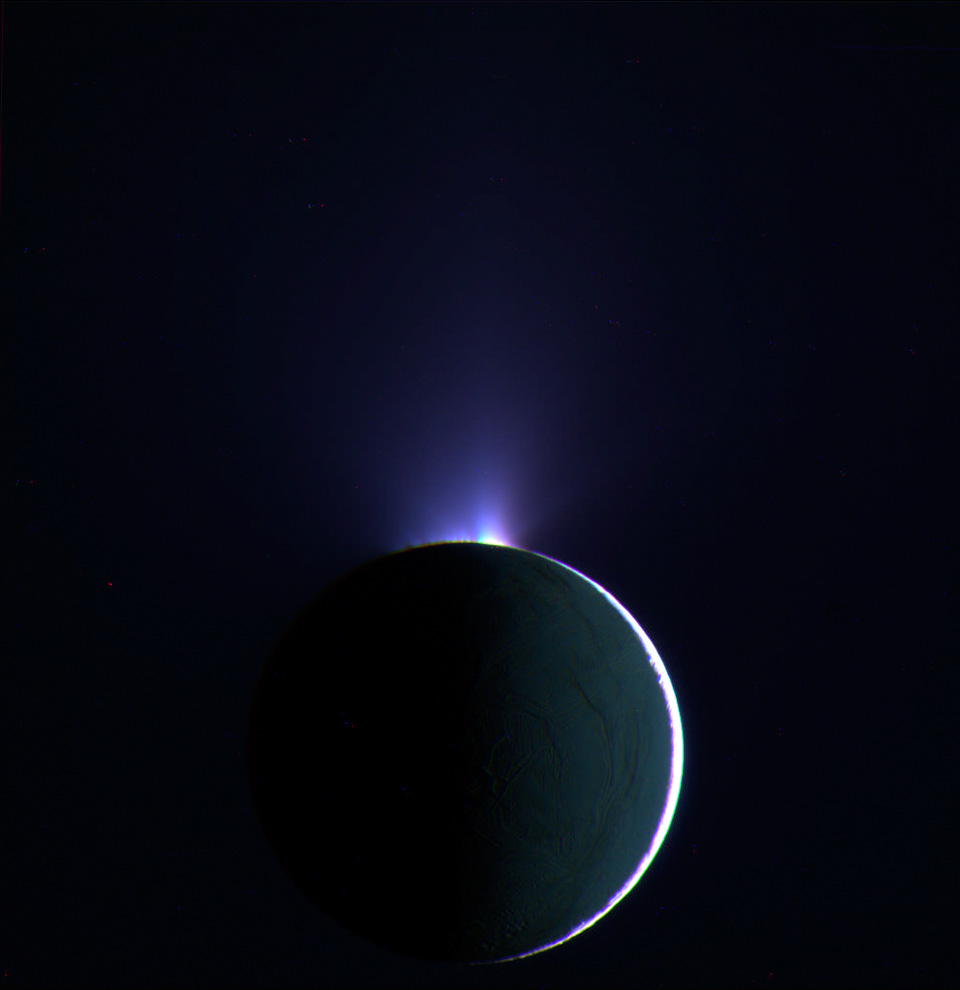
Credits: NASA/JPL/Space Science Institute - Credits for the additional process. and color.: Elisabetta Bonora and Marco Faccin/Lunar Explorer Italia/IPF
|
As Saturn's active moon Enceladus continues to spew Icy Particles into the Space, scientists keep trying to understand the mechanics of what is going on beneath its fractured South Polar Terrain. Several models have already been proposed to explain this unbelievable phenomenon, and one of them, suggested by the Cassini Imaging Science Team (in a paper published in the journal "Science", on March 10, 2006) is our favourite. The model suggests that Underground Reservoirs of pressurized Liquid Water, whose temperature is above 273 degrees Kelvin (such as higher than 0° Celsius), could fuel Geysers that send jets of Icy Material into the Skies above the moon's South Pole, by "pushing" the water particles through those Vents that have been named as "Tiger Stripes" (and which are nothing else but extremely deep Fractures of the Surface, as well seen in Cassini Spacecraft close views of Enceladus' South Polar Terrain). The temperature of the pressurized Liquid Water increases, of course, with depth and, probably, because of some combination/interaction between internal Radioactive Decay and Tidal Flexing, perhaps concentrated within the Tiger Stripe Fractures and brought about by the particular characteristics of Enceladus' orbit around Saturn (this meaning that the Tidal Interaction existing between the two aforementioned Celestial Bodies is capable to prime a mutual heat-creating phenomenon which, taken into account their dimensions, becomes very considerable for the smaller one - note: this phenomenon is known as Tidal Friction). However, it is still unclear how the deep interior of Enceladus actually functions, nor whether the moon, in its interior, is fully differentiated (such as separated into layers, with rock at the center and ice outside). This frame has been colorized in Natural Colors (such as the colors that a perfect human eye would actually perceive if someone were onboard the Cassini Spacecraft and looked towards Enceladus), and then slightly enhanced, in order to show some of the Surface details just barely visible in the shaded (night) side of Enceladus and to maximize the subtle color variations existing on both Enceladus' Surface and its Icy Plumes, by using an original technique created - and, in time, dramatically improved - by the Lunar Explorer Italia Team. |
News visualized: 851 times