


January 13, 2013

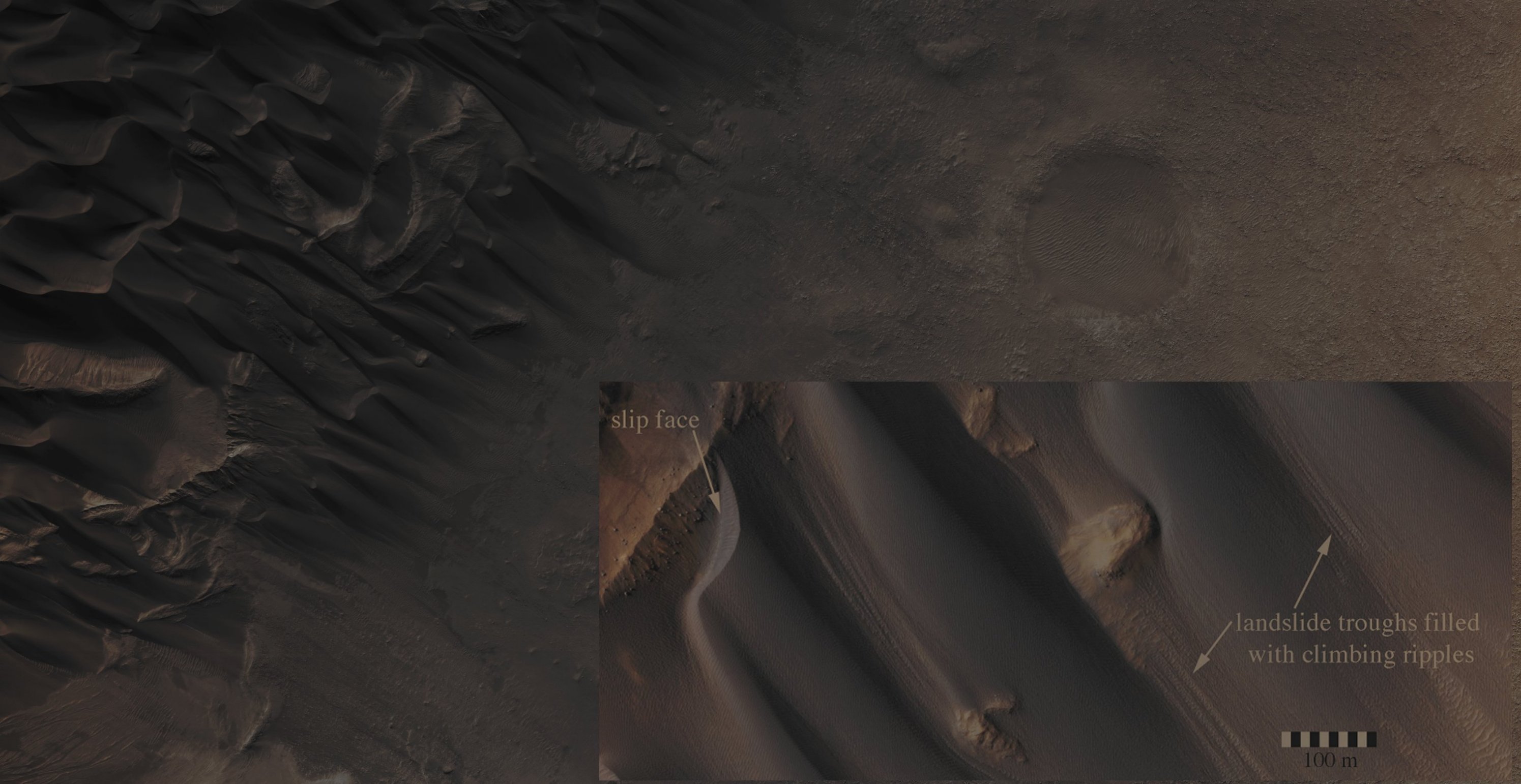
Credits: NASA/JPL/University of Arizona - Credits for the additional process. and color.: Dr Paolo C. Fienga/Lunar Explorer Italia/IPF
|
Today's APOD is a frame that has been taken on November, 19th, 2012, by the NASA - Mars Reconnaissance Orbiter, and it shows us the Southernmost part of a large Dunefield, located in Nereidum Montes, which is being monitored for changes in Dune and Ripple positions. Many of the Dunes visible in this image are overlying some very steep Slopes. However, if you pay some particular attention to the details of the landscape shown in the left side of the picture, you will notice that the Slopes are dipping to the South, while the Dunes, as evidenced by the North-facing orientation of their Steep Slip Faces, are being blown upslope, such as to the North. These so-called "Climbing Dunes" - which, by the way, have been found even elsewhere on Mars (for instance, in the Great Equatorial Canyon System known as "Valles Marineris") prove the existence of (relatively) strong Southerly Winds (---> Winds coming from the South) that keep blowing over this Region. Furthermore, the EDM shows one of these Steep Slip Faces and, in addition, several apparent Landslide Troughs which are present all over the scene. These Surface Features (such as the Landslide Troughs) can be interpreted as Sand that has slumped down the Slope (as a consequence of the verification of a phenomenon known as "Mass" or "Gravity Wasting") and, some time later, has been remobilized again by the Wind, so to form these Climbing Ripples within the Troughs. Mars Local Time: 15:43 (Middle Afternoon) These pictures (which are a NASA - Original Mars Reconnaissance Orbiter CTX b/w frame identified by the serial n. ESP_029608_1390 and a NASA - Original Mars Reconnaissance Orbiter EDM false-color frame identified by the serial n. ESP_029608_1390-1) have been additionally processed and then colorized (and re-colorized, respectively) in Absolute Natural Colors (such as the colors that a human eye would actually perceive if someone were onboard the NASA - Mars Reconnaissance Orbiter and then looked down, towards the Surface of Mars), by using an original technique created - and, in time, dramatically improved - by the Lunar Explorer Italia Team. |
News visualized: 808 times