
November 2, 2012

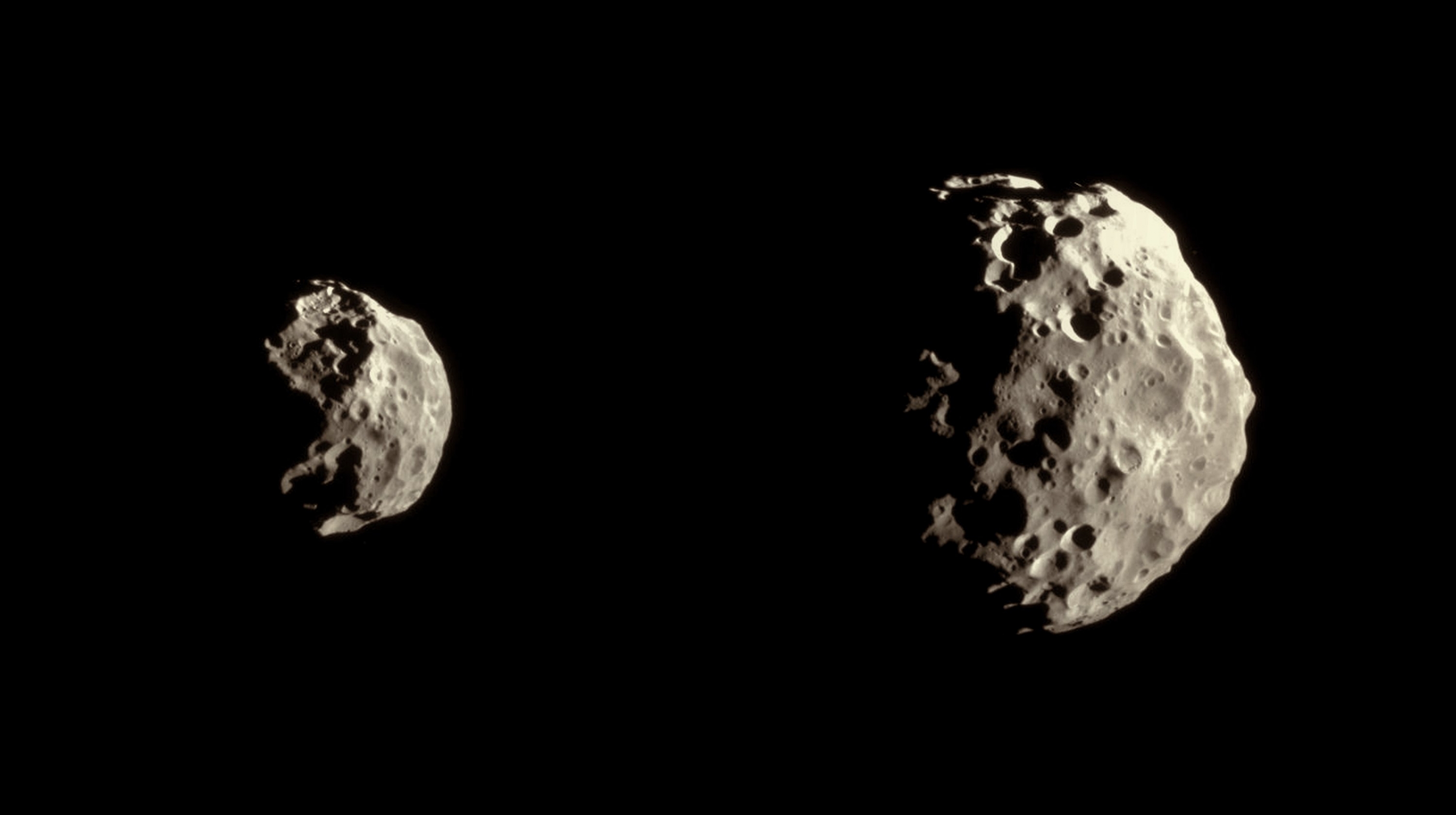
Credits: NASA/JPL/Space Science Institute - Credits for the additional process. and color.: Dr Paolo C. Fienga/Lunar Explorer Italia/IPF
|
Early images returned from the first detailed reconnaissance of the Saturnian small Outer moon, Phoebe, show breathtaking details in the moon's pockmarked Surface that already have imaging scientists puzzling over the history of this Celestial Body. These two pictures, however, are only a preview of what to expect from the High Resolution images which will show details about 10 times smaller. Phoebe has already revealed itself to be a rugged, heavily cratered Celestial Body, with overlapping Craters of varying sizes, and this kind of morphology, as you know, suggests that we are looking at a very old Surface. There are apparently many Impact Craters smaller than 1 km, and such a circumstance indicates that projectiles (---> impactors) probably smaller than 100 meters once pummeled Phoebe. Whether these impactors were Cometary or Asteroidal in origin, or were just debris that resulted from impacts which occurred on other Bodies within the Saturn System, is hotly debated (and, we wish to add, as IPF, uselessly debated, since this is the typical subject matter which does not have - actually: that cannot have - a final answer). Furthermore, as you can see for yourself, there are also clear variations in the Surface Brightness all across Phebe. The second, Higher Resolution frame (at right - Dx), further reveals the moon's battered Surface, including another Impact Crater near the right hand edge with bright Rays that extend outward from its center. Some Linear Surface Features that, in a way, could be reminiscent of those seen on the Martian moon Phobos - such as the so-called "Linear Grooves" - are faintly visible in the upper part of this second image. There are also a few suggestions of Linear Ridges (or Grooves) as well as of Chains of Craters, perhaps radial to a larger Impact Crater (here not visible though), just hidden on the un-illuminated Region of Phoebe, in the upper left. These two pictures (which are Original NASA - CASSINI Spacecraft b/w frames published on the NASA - Planetary Photojournal with the ID n. PIA 06066) have been additionally processed and then colorized in Absolute Natural Colors (such as the colors that a human eye would actually perceive if someone were onboard the NASA - CASSINI Spacecraft and then looked outside, towards the Saturnian Outer moon, Phoebe), by using an original technique created - and, in time, dramatically improved - by the Lunar Explorer Italia Team. Different colors, as well as different shades of the same color, mean, among other things, the existence of different Elements (Minerals) present on the Surface of Phoebe, each having a different Albedo (---> Reflectivity) and Chemical Composition. |
News visualized: 801 times