

September 20, 2012

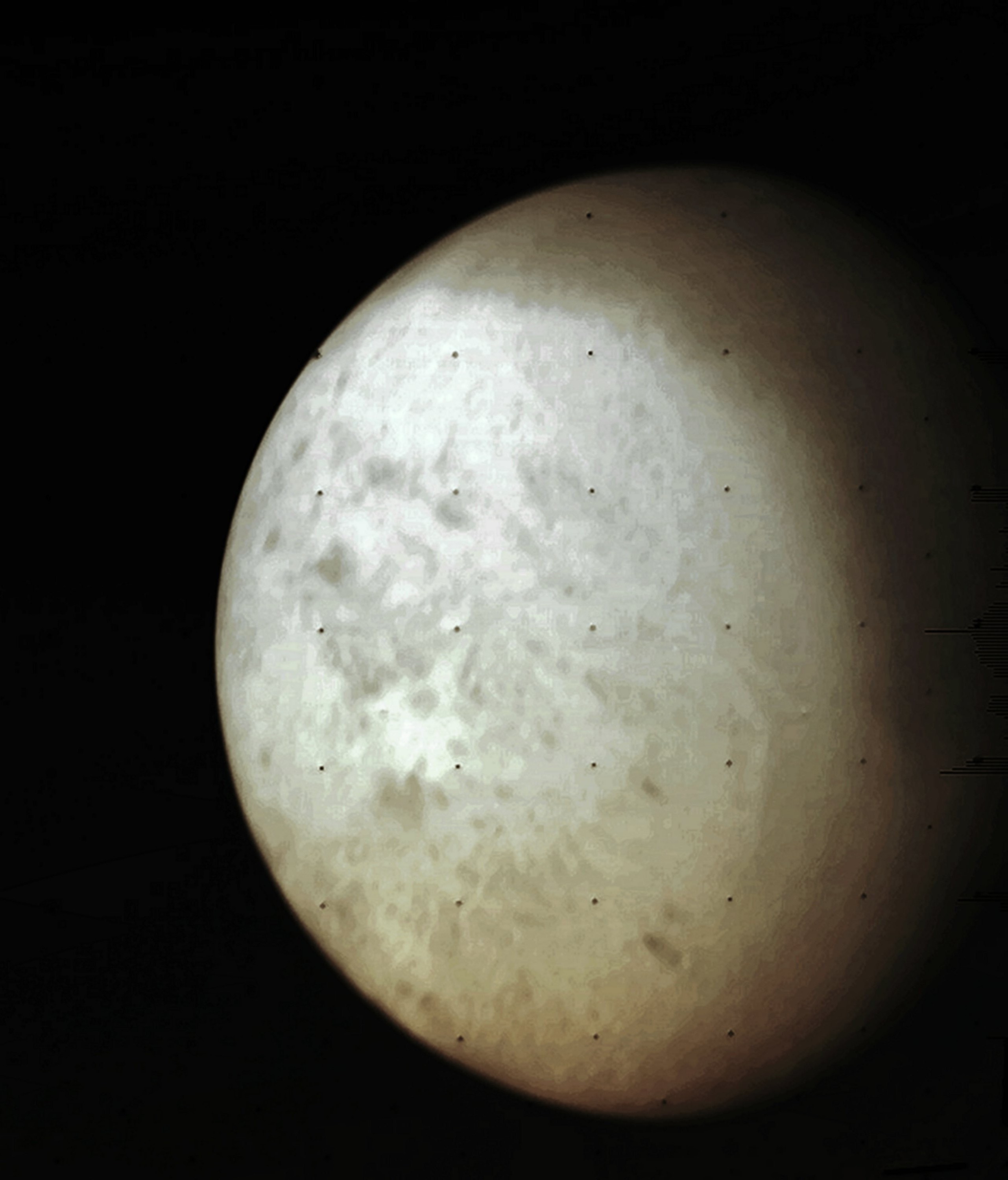
Credits: NASA - Voyager 2 Project; Credits fo the additional process. and color.: Dr Paolo C. Fienga/LXTT/IPF
|
The NASA - Voyager 2 Space Probe was about 530.000 Km (such as approx. 330.000 miles) from Neptune's largest moon, Triton, when this photo was taken, on August 24, 1989. With a resolution of approx. 10 Km (about 6 miles) per pixel, this is the first photo of Triton that is fit to to reveal some Surface Topography. The South Pole, which is continuously illuminated by Sunlight at this season, is towards the bottom left of the frame, and the boundary line between the bright Southern Hemisphere and the darker Northern Hemisphere is clearly visible. Both the Darker Regions to the North and the very bright Sub-Equatorial Band show a complex pattern of irregular topography that somewhat resembles to the so-called "Fretted Terrain" that is visible on several areas of Venus and Mars. Said that, we can speculate that the patches of dark color so well visible (almost everywhere) in the bright Southern Hemisphere, may be the result of topography, if Triton's Crust is predominantly made of Water Ice (which is obviously rigid at Triton's extremely low Surface Temperature). Alternatively, the mottling could be due to markings on a smooth Surface, if the Crust of Triton is actually composed of Nitrogen, Carbon Monoxide, or Methane, since all these Elements become kind of "soft" at these very, very low Surface Temperature This frame (which is the Original NASA - Voyager 2 b/w frame n. 1138639) has been additionally processed and then colorized, according to an informed speculation carried out by Dr Paolo C. Fienga (LXTT-IPF), in Absolute Natural Colors (such as the colors that a human eye would actually perceive if someone were onboard the NASA - Voyager 2 Space Probe and then looked outside, towards the Neptunian moon Triton), by using an original technique created - and, in time, dramatically improved - by the Lunar Explorer Italia Team. Different colors, as well as different shades of the same color, mean, among others, the existence of different Elements present on the Surface of Titon, each having a different Albedo (---> Reflectivity) and Chemical Composition. |
News visualized: 828 times