

August 20, 2012

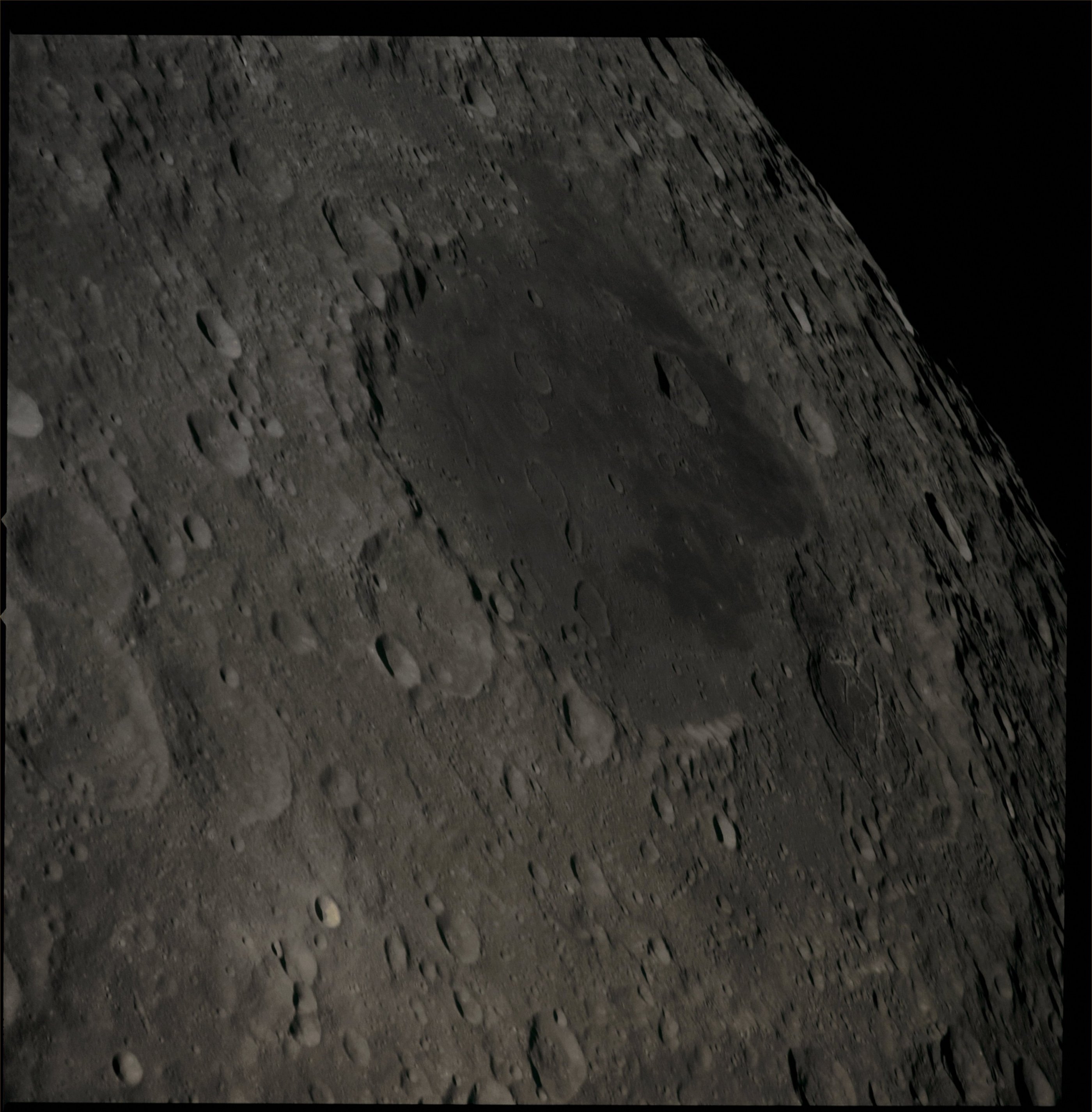
Credits: NASA/JPL-Apollo 13 Crew; additional process. and color.: Dr Paolo C. Fienga/LXTT/IPF
|
The Mare Moscoviense (---> "Sea of Moscow" - Coord.: approx. 27,3° North Lat. and about 147,9° East Long.) is one of the very few Lunar Maria located on the so-called "Far (or also known as "Dark") Side" of the Moon and, just like the Mare Marginis, it appears to be fairly thin. The Mare Moscoviense is centered within a large Impact Basin and its Surface is much lower - as to the Lunar Datum - than both the Surface of the Outer Basin Floor, as well as the base of so-called Lunar Far Side Highlands. As a matter of fact, only a few Basins located on the Far Side of the Moon seem to be deep enough to allow the verification of the so-called "Mare Volcanism" and this means, in other words, that even though large Impact Basins can be found on both the Near and the Far Side of the Moon, the large Maria are mostly found on the Near one. And why is that? Of course, a final answer, for now (and, likely, even in the most distant future) cannot and will not be given, but a possible (and plausible) explanation for this fact is, in our opinion (as IPF) that the Mare Lavas could reach the Surface more often and more easily on the Near Side rather than on the Far one, due to the Tidal Attraction that the Planet Earth exercised (and, of course, still exercises) on that Side of the Moon which, since it is always facing Earth, is actually closer to it (and, therefore, more affected by Earth's Gravitational Pull). The Basin Material goes back to the Nectarian Epoch (the Nectarian Epoch - or Period - of the Lunar Geologic Timescale runs from 3920 Million Years ago to 3850 Million Years ago. It is the period during which the Nectaris Basin and other Major Lunar Basins were formed after the occurrence of extremely large Impact Events), while the Mare Material goes back to the Upper Imbrian Epoch (which occurred between 3800 Million Years ago to about 3200 Million Years ago). After the analysis of some of the data collected during the JAXA - SELENE Probe Mission, a few scientists suggested that Volcanism in Mare Moscoviense might have been active for ~ (approx.) 1,5 Billion Years, following the formation of the Moscoviense Basin; on the other hand, however, the formation of this Mare could well also have been the final result of a strong and (relatively) long lasting series of Meteorite Cluster Impacts, rather than the consequence of one or more Volcanic Events (which, once you consider the amount of energy required to melt Lava in the Mare Moscoviense, should have been unbelievably powerful and, in the end, quite unlikely). As far as the surroundings of the Mare Moscoviense are concerned, the Impact Crater Komarov is located to the South-East of the Mare, while the Impact Crater Titov lies to the North. This Lunar Region was informally named Mare Moscoviense after the first images of the Far Side of the Moon were returned by the Soviet Probe Luna 3. However, the name Mare Moscoviense (that has always been widely used in the Astronomical Community) has also been recognized by the International Astrtonomical Union (IAU) and is in current use. This frame has been colorized in Absolute Natural Colors by (such as the colors that a human eye would actually perceive if someone were onboard the NASA - Apollo 13 Spacecraft and then looked outside, towards the Surface of the Moon), by using an original technique created - and, in time, dramatically improved - by the Lunar Explorer Italia Team.
|
News visualized: 852 times