

August 4, 2012

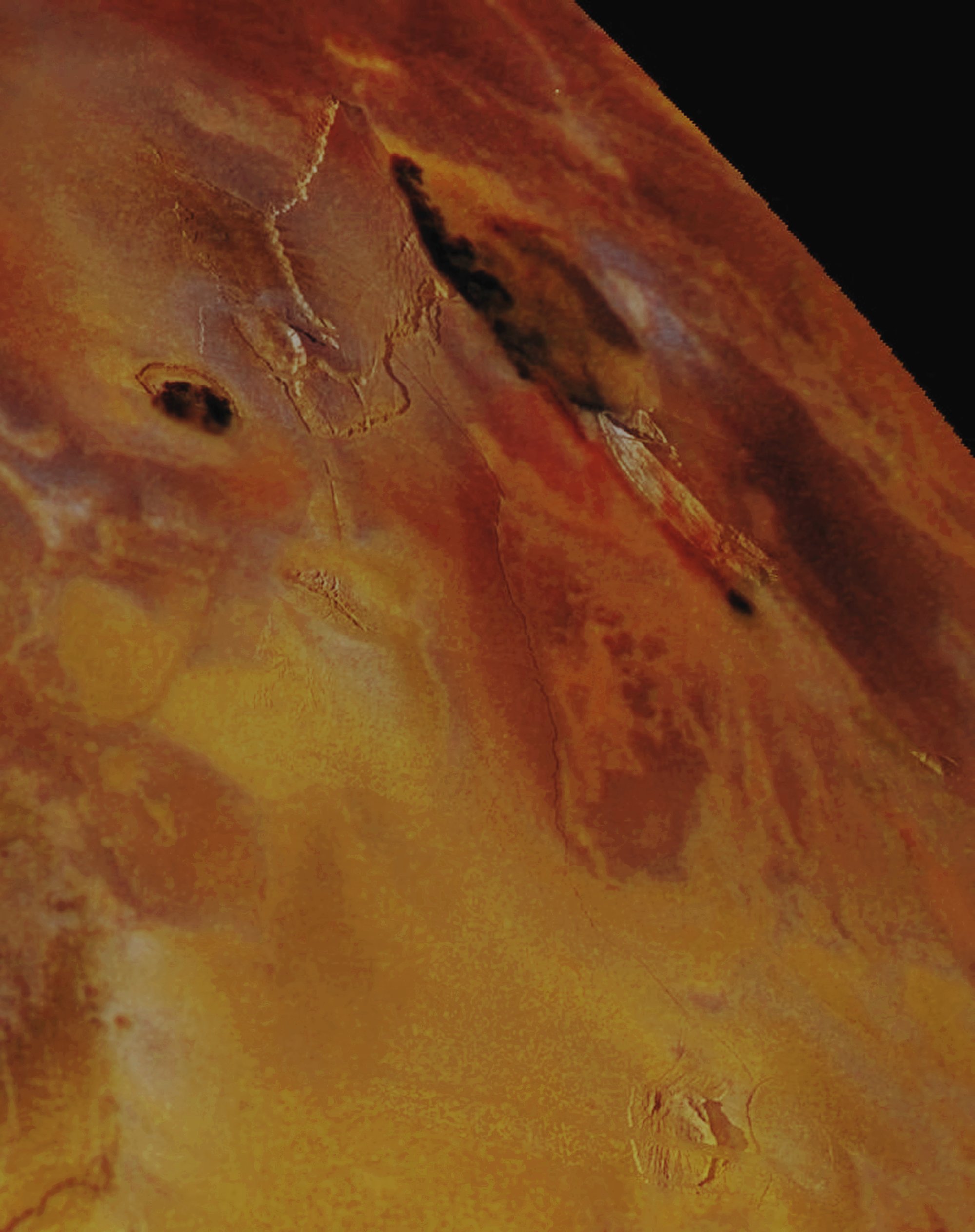
Credits: NASA/JPL/Univ. of Arizona - Galileo Project - Credits for the additional process. and color.: Dr Paolo C. Fienga/Lunar Explorer Italia/IPF
|
The Zal Patera Region of Jupiter's Volcanic moon Io is shown in this combination of High and Low Resolution (HR and LR for short) images taken by the NASA - Galileo Spacecraft on July, 3, 1999 and on November 25, of the same year. By combining these two types of frames, the Galileo scientists were able to better understand the relationships existing between the different Minerals and Materials that characterize the entire Surface of Io and the underlying Geologic Structures. For example, in the center, toward the top of the picture, the Edge of the Zal Caldera (such as the Volcanic Crater) is marked by very dark (actually almost black) Flows, and it coincides with the Edge of a Plateau. Also, the dark brown/red Surface Material (visible just above and to the right of the upper central portion of the image and which fades in the Region located towards the lower portion of the frame) is typically associated with Active Volcanic Regions of Io (this meaning that the aforementioned Surface Material is found in places where Molten Lava is erupting onto the Surface). Here, the dark brown/red Surface Material follows the base of a Mountain: a fact which may also indicate, among other things, that Sulphurous Gases are being released and escaping along a Fault associated with the formation of the Mountain itself. This frame has been colorized in Absolute Natural Colors (such as the colors that a human eye would actually perceive if someone were onboard the NASA - Galileo Spacecraft and then looked outside, towards the Jovian moon Io), by using an original technique created - and, in time, dramatically improved - by the Lunar Explorer Italia Team.
|
News visualized: 913 times