

July 28, 2012

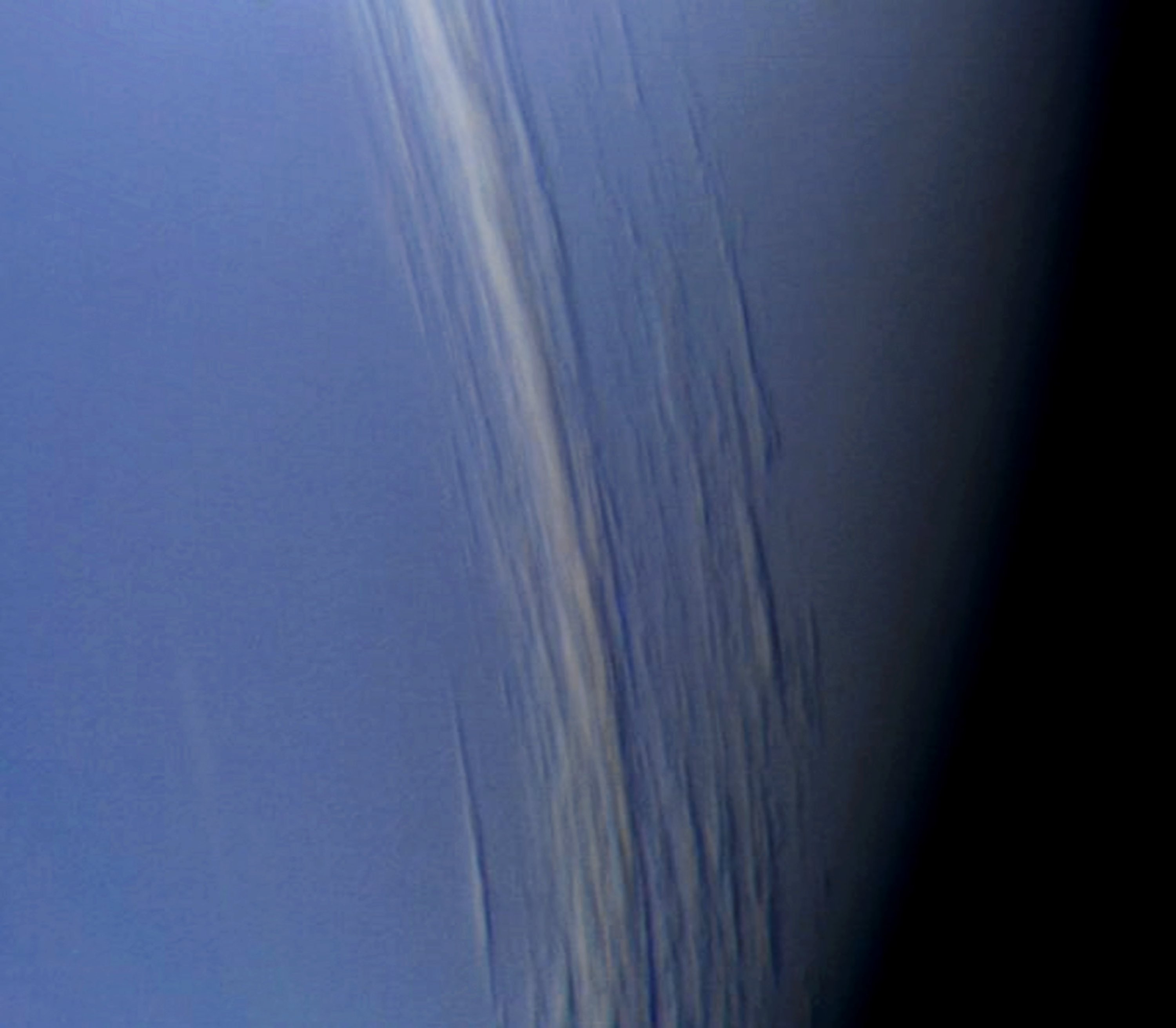
Credits: NASA - Voyager 2 Project; Credits fo the additional process. and color.: Dr Paolo C. Fienga/LXTT/IPF
|
This NASA - Voyager 2, High Resolution (HR) image, taken about 2 (two) hours before the Closest Approach of the Spacecraft with the Gas-Giant Planet Neptune, provides us with obvious evidence about the existence of so-called "Vertical Relief" (i.e.: Columnar/Pillar-shaped Features) in Neptune's bright Cloud Streaks. These Clouds were observed at a Latitude of approx. 29° North, near Neptune's Eastern Terminator. The Linear Cloud-Forms are stretched approximately along lines of constant Latitude, and the Sun shines from the lower left. The bright sides of the Clouds which face the Sun are brighter than the surrounding Cloud-Deck because, as you can easily understand, they are more directly exposed to the Sunlight. Shadows can be clearly seen on the side that is opposite to the Sun. These Shadows, however, are less distinct at short Wavelengths (i.e.: through the Violet Filter) and more distinct at long Wavelengths (i.e.: through the Orange Filter). This phenomenon can be understood if the underlying Cloud-Deck (such as the one on which the Shadows are cast), is at a relatively greater depth, in which case the so-called "Scattering" of the Sunlight that has occurred in the overlying Atmosphere, will diffuse light into (and onto) the Shadows themselves. Since the Scattering of Blue Light occurs in a much more efficient way than the Scattering of Red Light, the Shadows will appear VERY dark at the longest (such as the "reddest") Wavelengths, while they will look of blueish color under a simple White Light Illumination. The resolution of this image is roughly 11 Km (about 6,8 miles) per pixel and the distance of the Spacecraft from Neptune, at the time the image was taken, was of only about 157.000 Km (such as approx. 98.000 miles). The width of the Cloud Streaks range from about 50 to about 200 Km (approx. 31 to 124 miles); on the other hand, the width of their Shadows range from about 30 to about 50 Km (approx. 18 up to 31 miles). The thickness of these Neptunian Clouds can be estimated in an order of approx. 50 Km (such as about 31 miles). This frame has been colorized in Absolute Natural Colors (such as the colors that a human eye would actually perceive if someone were onboard the NASA - Voyager 2 Space Probe and then looked outside, towards Neptune), by using an original technique created - and, in time, dramatically improved - by the Lunar Explorer Italia Team. |
News visualized: 780 times