
July 25, 2012

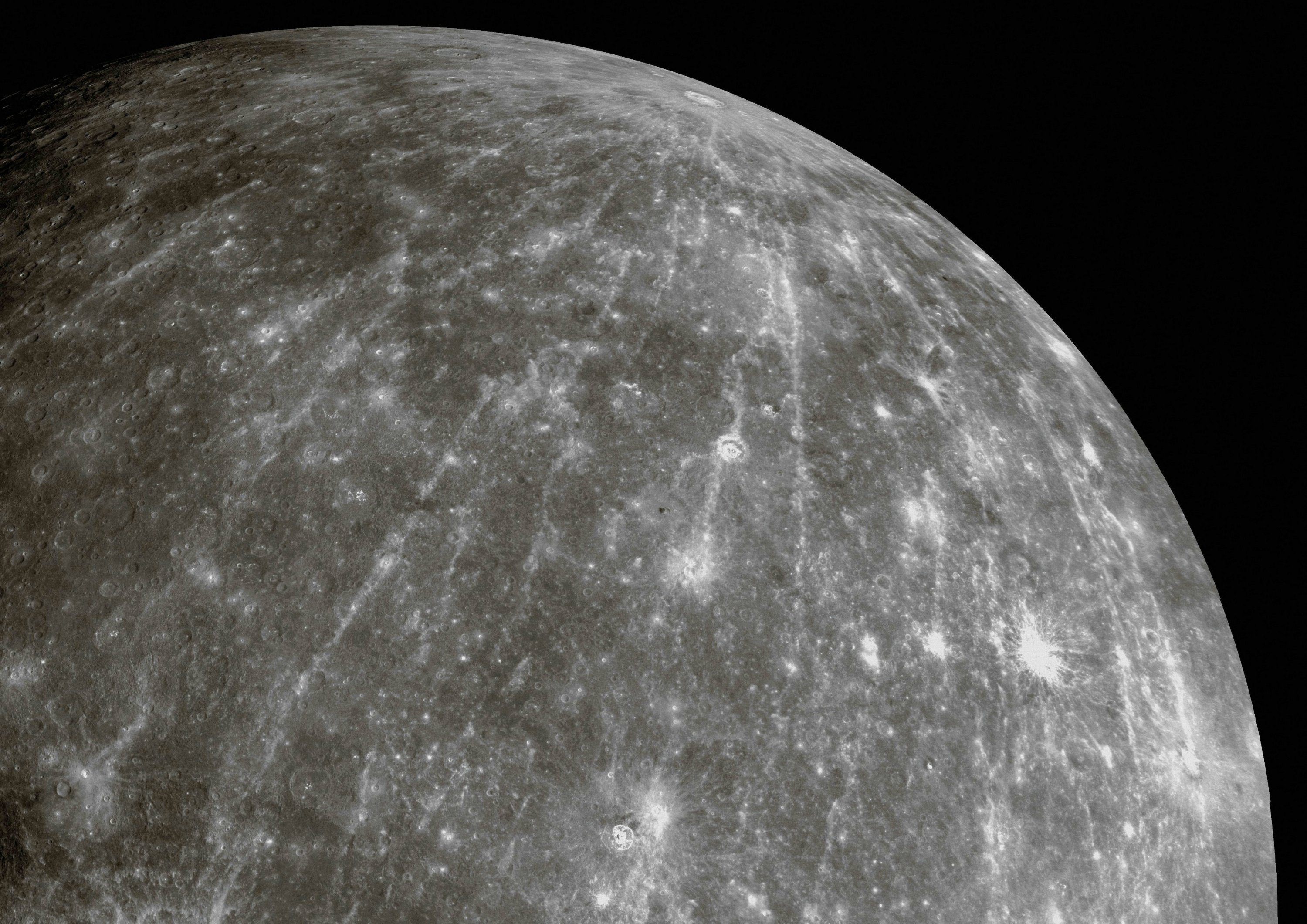
Credits: NASA/Johns Hopkins University Applied Physics Laboratory/Carnegie Institution of Washington and Dr Paolo C. Fienga/LXTT/IPF for the additional process. and color.
|
This mosaic of NAC images shows the Impact Crater Hokusai, located on the Planet Mercury at a Latitude of approx. 58° North. Hokusai (that here is visible near the Upper Limb of Mercury, at about one o' clock), shows an impressive System of Rays, which extend as much as a thousand kilometers (such as more than 600 miles) across the entire Planet and are they are the longest that have yet been identified on Mercury. Craters with Bright Rays are thought to be relatively young, because the Rays are still visible, and this fact indicates that they have suffered less exposure to the aformentioned Space Weathering Processes than Impact Craters which lack Rays; well, such a consideration is basically correct BUT, as IPF, we have to say and underline, however (and just for the sake of clarity), that it should also be considered the fact that the creation of a System of Rays emanating from a certain (given) Impact Crater depends, among other things, on the existence (and simultaneous concurrence) of a number of additional circumstances, whose lack may very well lead to the formation of a "Rayless" (or an almost "Rayless") Impact Crater. In other words: the lack of Rays IS NOT (and CANNOT be considered) a 100% reliable indicator that a specific Impact Crater is "old"!. Although the extent of some of Hokusai's Rays has been determined, the images acquired during the NASA - MESSENGER Spacecraft's 3rd Fly-By of Planet Mercury were not good enough to show all of them. However, during the NASA - MESSENGER Spacecraft's Orbital Observations, which have started in March 2011, the Mercury Dual Imaging System (MDIS) has already acquired high-resolution color images that are fit to cover almost the entire Surface of Mercury. Afterwards, when the Global Color Map of Planet Mercury is complete, then Scientists shall finally be able to better understand the effective extent of the unbelievable Systems of Rays emanating from Hokusai Crater, as well as the characteristics and extent of other System of Rays emanating from quite a few other young Mercurian Impact Craters, which are now going to be mapped for the first time in History. This frame has been colorized in Absolute Natural Colors (such as the colors that a human eye would actually perceive if someone were onboard the NASA - MESSENGER Spacecraft and then looked outside, towards the Planet Mercury), by using an original technique created - and, in time, dramatically improved - by the Lunar Explorer Italia Team.
|
News visualized: 1967 times