

July 24, 2012

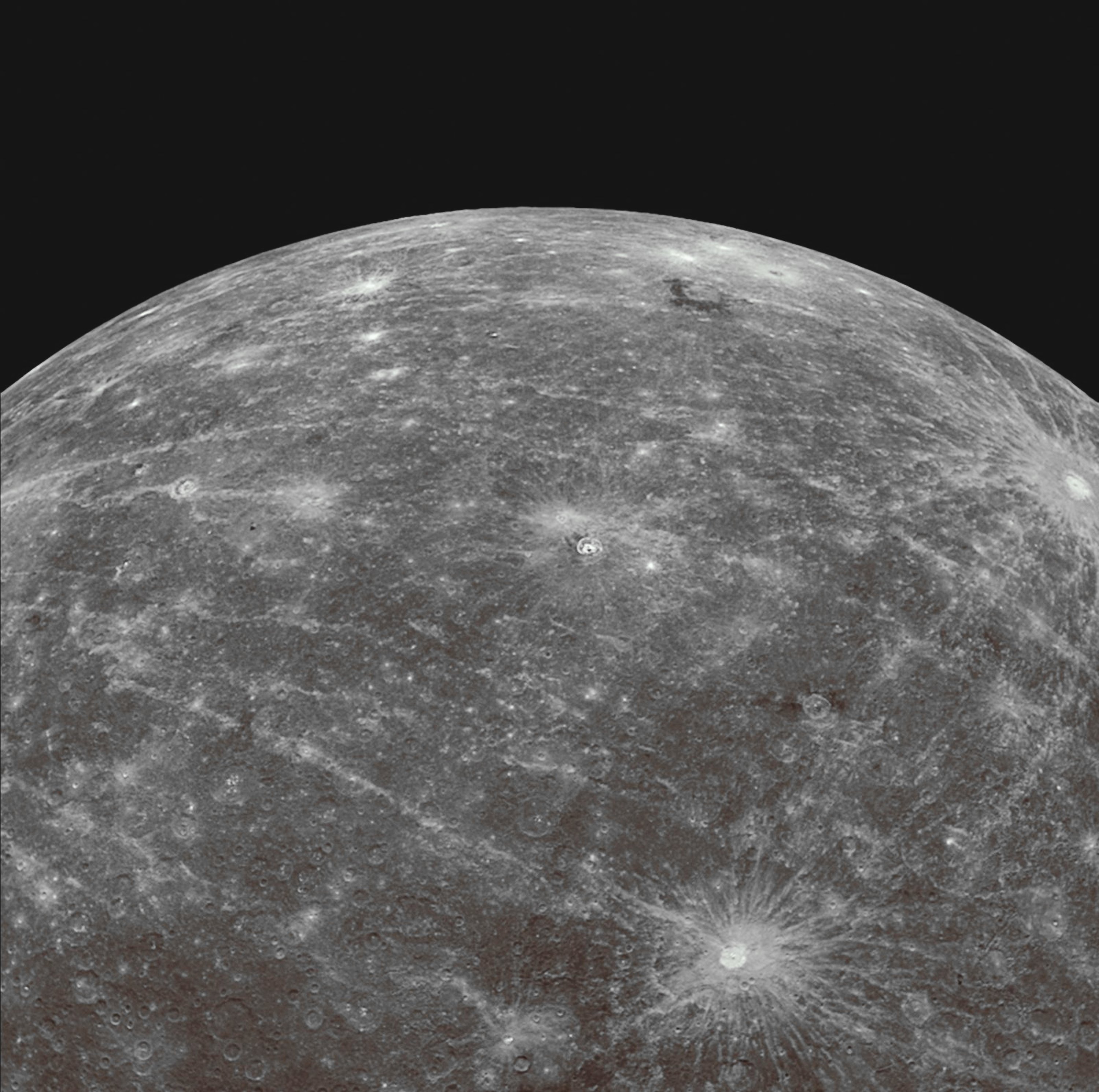
Credits: NASA/Johns Hopkins University Applied Physics Laboratory/Carnegie Institution of Washington and Dr Paolo C. Fienga/LXTT/IPF for the additional process. and color.
|
Only one week after the NASA - MESSENGER Orbiter successful 2nd Fly-By of the Planet Mercury, already about 95% of the Mercurian Surface had, finally, been viewed by a man-made Spacecraft; this means, in other words, that a nearly global Spacecraft Imaging Coverage of the Surface of Mercury was achieved for the first time in the History of the Unmanned Exploration of the Solar System. This Wide Angle Camera (WAC) image is just 1 (one) of 99 (ninety-nine), in a set of 3-(three)-columns-by-3-(three)-rows-by-11-(eleven)-color filters, that, in some time, shall be combined into a color mosaic of Mercury (to be precise, in a view of Mercury that was obtained just when the NASA - MESSENGER Orbiter was departing the Innermost Planet for the second time during its Interplanetary Cruise). Kuiper Crater, with its bright Ejecta Rays, is visible on the left edge of the image and it was seen also by the NASA - Mariner 10 Spacecraft, but most of the Terrain located to the East of Kuiper is now visible to human eyes for the very first time in History. A newly imaged (and, so far) Unnamed Crater with an unusual "Halo" of Dark Material is well visible towards the top of the frame, near the Mercurian Limb, while other Unnamed Impact Craters showing some extremely interesting Surface Features (for instance, near the center of the image, it can be seen a Crater that shows something like a "Double-Inner Rim", with a an unusually-looking White Material deposited on part of its Inner Walls and Floor and with a "Dark Spot" right in its center; relatively similar to this Crater, there is another one, located more to the left of the frame and not too distant from the previous one, that shows a white Outer Rim and Walls, but very dark Inner Walls; on its Floor, again some White Material can be seen and, in its center, some Sinuous and Dark Surface Feature, whose nature, however, cannot be identified from this distance). We wish to remind you that, on Mercury (like on every other known Celestial Body of the Solar System that does not possess a significant Magnetic Field nor a (complex and, at least relatively, thick) Atmosphere), the Surface Materials having a white color, are supposed to be (always Geologically speaking, of course) recent, since the older Surface Materials - due to the a phenomenon known as "Space Weathering" -, show a very dark color (until, in a few million years, they become completely black). The long, bright Rays that can be seen extending almost across the entire visible Surface of Mercury, emanate from another Unnamed Crater that lies to the North of this image (and that is not visible here). Date Acquired: October 6, 2008 Image Mission Elapsed Time (MET): 131772818 Instrument: Wide Angle Camera (WAC) of the Mercury Dual Imaging System (MDIS) WAC Filter: 1 (700 nanometers) Resolution: 2,6 Km/pixel (such as about 1,6 miles/pixel) Scale: the left side of the image is about 2700 Km tall (such as approx. 1700 miles) Spacecraft Distance from Mercury: about 15.000 Km (such as approx. 9300 miles) This frame has been colorized in Absolute Natural Colors (such as the colors that a human eye would actually perceive if someone were onboard the NASA - MESSENGER Spacecraft and then looked outside, towards the Planet Mercury), by using an original technique created - and, in time, dramatically improved - by the Lunar Explorer Italia Team.
|
News visualized: 731 times