January 20, 2012

Credits: NASA-Apollo 17 Crew - NASA/JPL/NSSDC - Credits for the additional process. and color.: Dr Marco Faccin/Lunar Explorer Italia/IPF
|
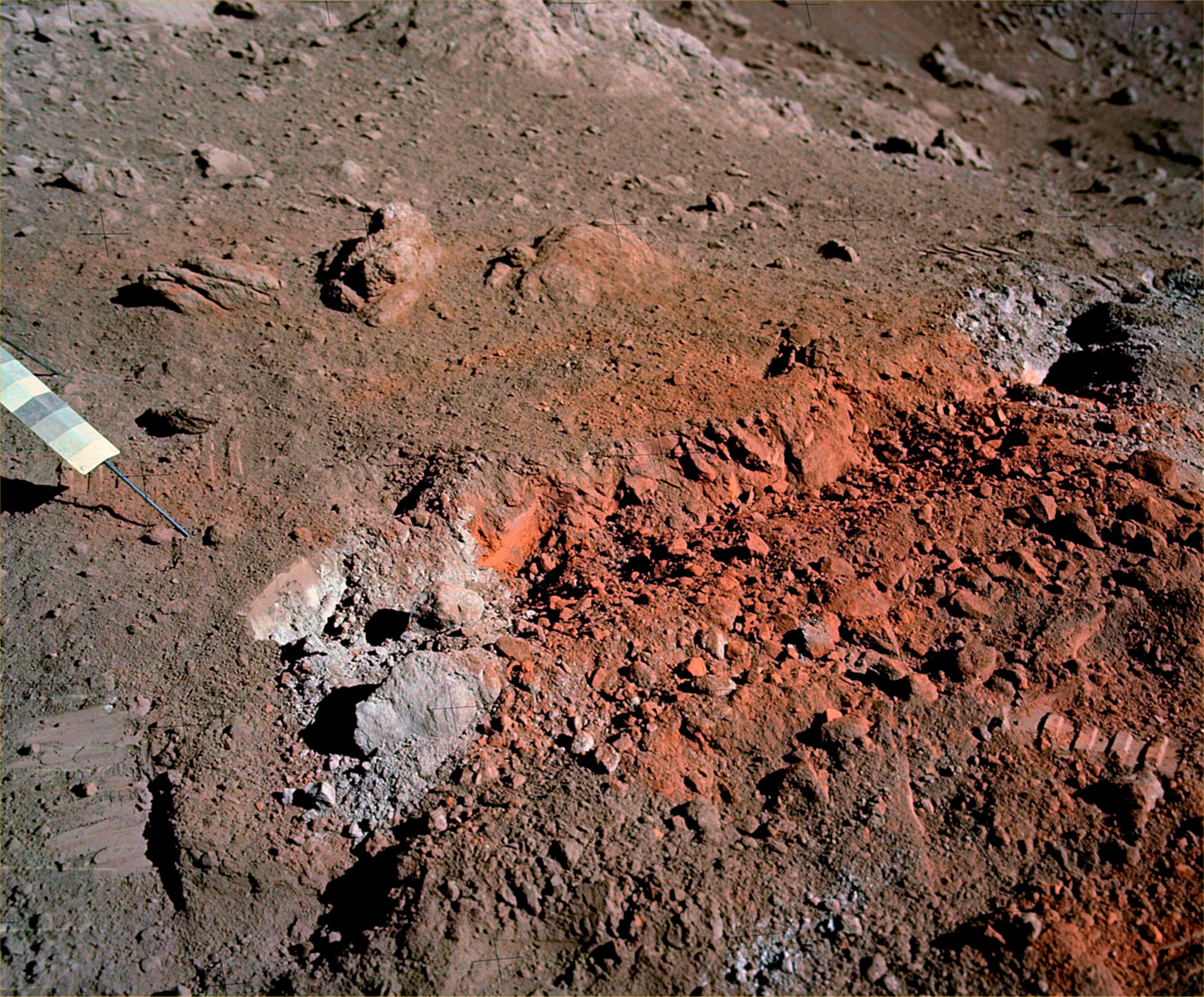
This the Moon, not Mars and so, what the Orange Soil that we see all over this area of the Lunar Surface could be? Well, as Dr Eric Jones (the Curator of the Apollo Lunar Surface Journal) wrote "...The patch of Orange Soil seemed to form a band that ran parallel to the Rim of the Crater (Shorty) and as Schmitt dug a trench across the band, it became evident that, under a thin layer of altered Surface Soil, the ground was a deep red at the center of the band, fading to orange toward the edge. By the time Schmitt had finished the trench, Cernan had finished dusting the TV camera - so that Houston could have a good look - and arrived on the site with the Gnomon and a supply of sample bags. The Gnomon was a lovely little device consisting of a free-swinging and colored staff, mounted on a Tripod base...". On Earth, orange or rust-colored rocks and soil around Volcanic Vents are often the result of literal rusting of Iron by Volcanic Water Vapor. If this was the cause of the Orange Soil at Shorty Crater, then we could assume that some amounts of Volcanic Gasses might still be present on the Moon. A possible evidence relevant to the basic correctness of the abovementioned hypothesis can be found, in our opinion, throughout the explanation of some TLP (----> Transient Lunar Phenomena) - such as sudden and usually very short Flare-like and Star-like lights visible on the Lunar Surface - as the visible results of Residual Lunar Volcanic Activity or maybe Outgassing Phoenomena due to Residual Seismic Lunar Activity. For those who are really interested, an official collection of these extremely fascinating and yet very controversial phenomena is in the NASA Technical Report R-277 (which it is, yes, a little old - it was published in July 1968 -, but it still is, however, a VERY interesting and educational reading for Scientists, Researchers and simple Space-Lovers). This frame has been colorized in Natural Colors (such as the colors that a perfect human eye - as well as an Electronic Eye - would actually perceive if someone were on the Surface of the Moon, near the Lunar Rover, and then looked around), by using an original technique created - and, in time, dramatically improved - by the Lunar Explorer Italia Team. |
News visualized: 4965 times