

July 16, 2012

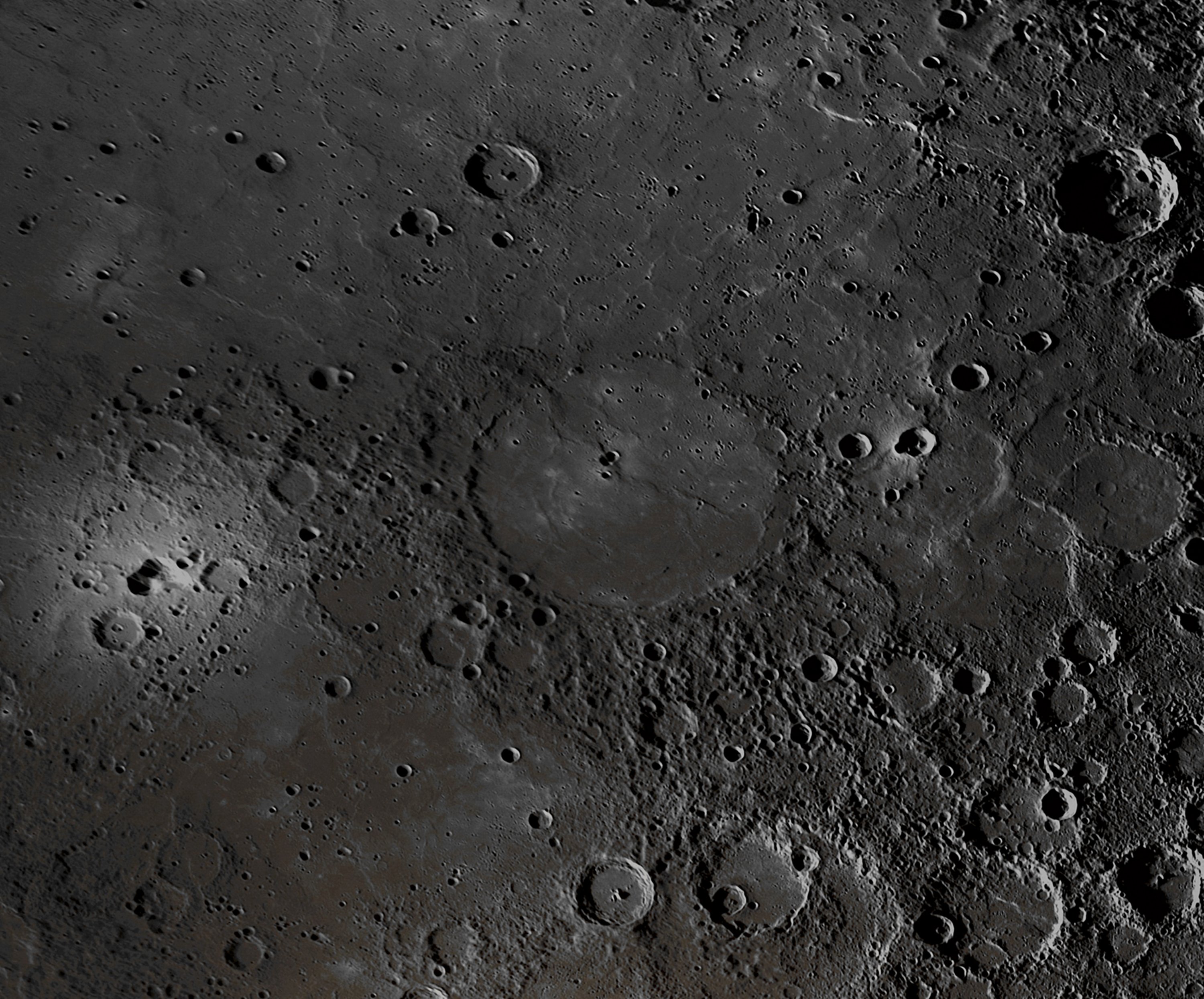
Credits: NASA/Johns Hopkins University Applied Physics Laboratory/Carnegie Institution of Washington and Dr Paolo C. Fienga/LXTT/IPF for the additional process. and color.
|
Visible in the center of this image is the Impact Crater Copland, recently named in honor of the American composer and pianist Aaron Copland. Aaron Copland and this Crater were both unquestionably worthy candidates for named Mercurian Surface Features, but how this specific Crater came to be known as Copland has an interesting back-story. Amateur Astronomer Ronald Dantowitz and his colleagues Scott Teare and Marek Kozubal used the Mt. Wilson 60-inch telescope in the AD 1998 to observe a very bright Surface Feature located on this portion of Mercury's Surface, and they assumed that it could have been a (probably relatively recent) Impact Crater. Mr. Dantowitz expressed his wish that such a Crater were named "Copland", once better images of the area would have been obtained from a Spacecraft. Surprisingly, the NASA - MESSENGER Spacecraft images from the third Fly-By of Mercury revealed that the small bright Surface Feature (here visible on the left edge of this image, was not an Impact Crater but, more likely, a Volcanic Vent. No convention for naming Volcanic Vents on Mercury has yet been adopted, basically because none of such Surface Features had never been identified prior to the NASA - MESSENGER Spacecraft 1st Mercury Fly-By. However, even if a convention for naming Volcanic Surface Features on Mercury is adopted in the future, the naming rules will likely differ from those for Impact Craters, and thus "Copland" would probably not be an acceptable name for this specific (and VERY bright) Volcanic Feature. Sometime afterwards, a MESSENGER Team Member corresponded with Mr. Dantowitz and suggested that the name Copland could have been proposed, instead, for a quite large Impact Crater located nearby. Mr. Dantowitz agreed, and the International Astronomical Union (IAU) approved the name Copland on March 3, 2010. Is there a "moral" to this - in a way - funny and interesting story? Probably just one: the Honorable Members of the International Astronomical Union (IAU) have, and are always left, as usual (and unfortunately), with REALLY too much time on their hands... Anyway, Copland Crater is flooded, as you can see, with Volcanic Smooth Plains Material that could well be related to the activity that formed, eons ago, the bright Volcanic Vent (actually, the only interesting Surface Feature that is visible in the whole frame). Date Acquired: September 29, 2009 This frame has been colorized in Absolute Natural Colors (such as the colors that a human eye would actually perceive if someone were onboard the NASA - MESSENGER Spacecraft and then looked down, towards the Surface of Mercury), by using an original technique created - and, in time, dramatically improved - by the Lunar Explorer Italia Team. |
News visualized: 789 times