


July 15, 2012

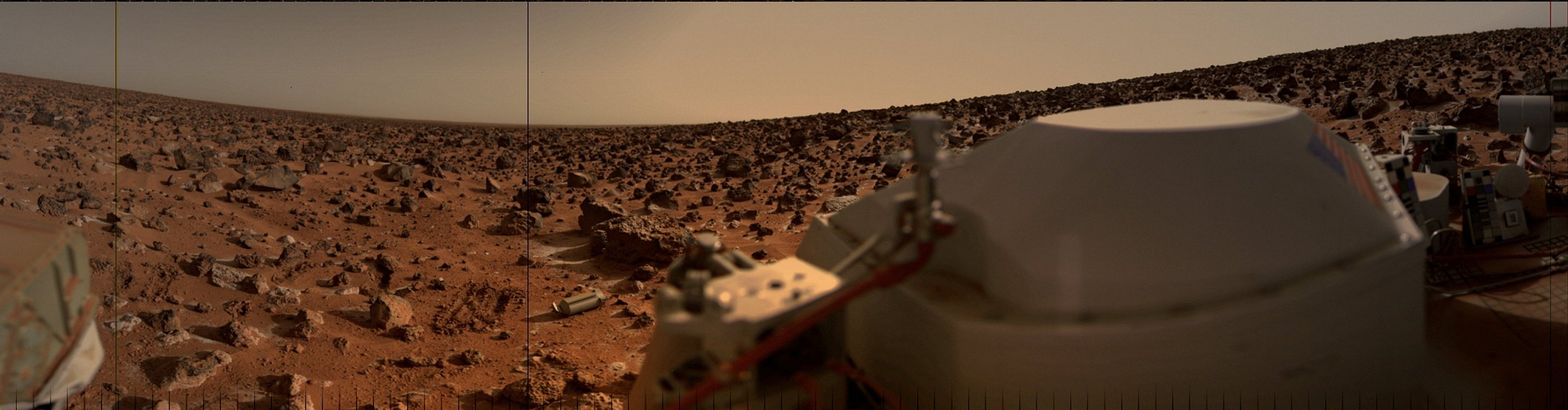
Credits: NASA/JPL-Caltech/USGS - Viking Lander 1 Mission - Credits for the additional process. and color.: Drr Marco Faccin and Paolo C. Fienga/Lunar Explorer Italia/IPF
|
The NASA - Viking One Lander and its Aeroshell separated from the Orbiter on July, 20, of the AD 1976, at 08:51 UTC. At the time of separation, the Lander was orbiting at an average speed of about 4 Km/s. The Aeroshell's Retrorockets were briefly fired to start the Lander to the so-called "Deorbiting Maneuver". After a few hours, at an altitude of about 300 Km, the Lander was reoriented for the "Atmospheric Entry". The Aeroshell, with its ablative Heat-Shield, strongly slowed the Spacecraft down, as it plunged through the Martian Atmosphere. During this time, entry science experiments were performed by using a Retarding Potential Analyzer, a Mass Spectrometer as well as Pressure, Temperature and Atmospheric Density Sensors. At 6 Km altitude, traveling at about 250 mt/sec, the 16 mt diameter Lander Parachutes deployed. Just 7 (seven) seconds later, the Aeroshell was jettisoned, and 8 (eight) seconds after that event, the three Legs of the Lander were fully extended. In 45", the Parachute had dramatically slowed the Lander down to a speed of approx. 60 mt/sec. Once an altitude of about 1,5 Km was reached, the Retrorockets were ignited and, 40" later, moving at a speed of about 2,4 mt/sec, the Lander arrived on Mars, with a relatively light jolt. The Legs of the NASA - Viking One Lander had "Honeycomb Aluminum Shock Absorbers", perfectly fit to dramatically soften the Landing. The Landing Rockets used an 18 nozzle design to spread the Hydrogen and Nitrogen Exhaust over a large area. The NASA Technicians, in fact, calculated that this kind of approach, would have meant that that the Surface of Mars would not have been heated up by more than 1 (one) degree Celsius, and that the Landing itself would have caused a movement of no more than 1 millimeter of Surface Material. Since most of the Viking's experiments were actually focused on the aformentioned Surface Material, a more straightforward design would not have served. The NASA - Viking 1 Lander touched down in Western Chryse Planitia at 22° 41' 49" North Lat. and 48° 13' 19" West Long., at a Reference Altitude of − (minus) 2,69 Km, relative to a reference Ellipsoid with an Equatorial Radius of 3397,2 Km and a Flatness of 0,0105 (---> 22,480° North Lat. and 47,967° West Long. - Planetographic) at 11:53:06 UT (such as 16:13 Mars Local Solar Time - Middle Afternoon Hours). Approximately 22 Kg of propellants were left unused after the Landing. Transmission of the first Surface image began 25" after Landing and took about 4 (four) minutes to complete. During these minutes, the Lander activated itself: it erected a High-Gain Antenna (that should have always stayed pointed towards the Planet Earth, so to allow direct communications) and then it deployed a Meteorology Boom, that was mounted with a series of Sensors (such as the ones described in the first paragraph hereabove). In the next 7 (seven) minutes, the second picture of the 300° Panoramic Scene was successfully taken. The NASA - Viking One Lander was named the "Thomas Mutch Memorial Station" in January 1982, in honor of the Leader of the Viking Imaging Team. The Lander operated for 2245 Soles (such as about 2306 Earth Days, or approx. 6 years), until November 11, 1982, when a faulty command sent by Ground Control resulted in the loss of contact. The command was intended to uplink a new Battery Charging Software that should have been useful to improve the Lander's deteriorating Battery Capacity but, unfortunately, it inadvertently overwrote some extra data that were mistakenly used by the Antenna Pointing Software, with obvious outcomes... Several attempts to regain contact with the Lander during the next 4 (four) months, based on the presumed Antenna position, were tried, but, as you can imagine, with no successful results. During the AD 2006, the Viking One Lander was imaged while peacefully lying on the Martian Surface, by the NASA - Mars Reconnaissance Orbiter. This frame has been colorized in Absolute Natural Colors (such as the colors that a normal human eye would actually perceive if someone were on the Surface of Mars, near the NASA - Viking One Lander, and then looked around and towards the Horizon), by using an original technique created - and, in time, dramatically improved - by the Lunar Explorer Italia Team.
|
News visualized: 776 times