
July 10, 2012

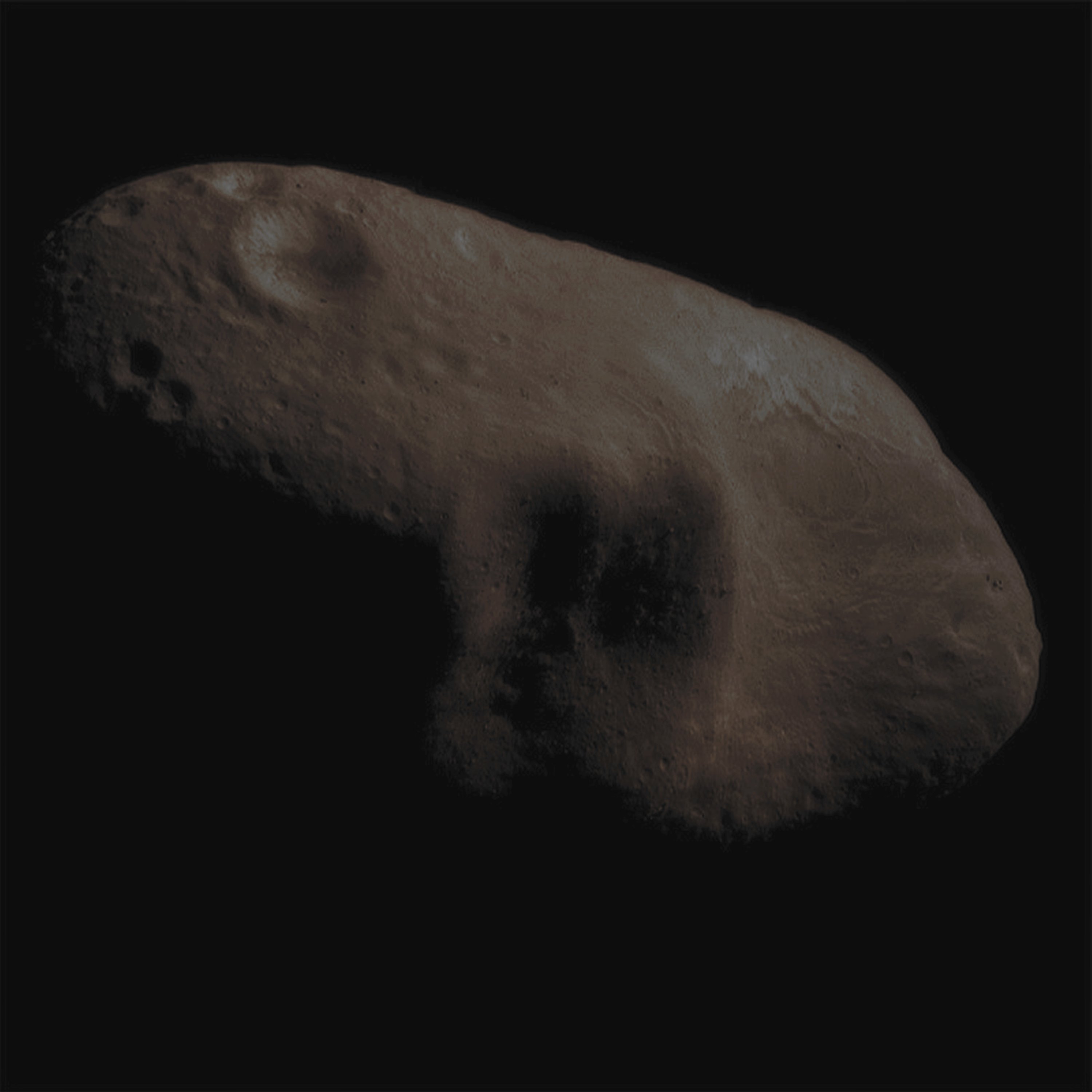
Credits: NASA - NEAR Project - Arizona State University; Credits fo the additional process. and color.: Dr Paolo C. Fienga/LXTT/IPF
|
This mosaic (obtained from NEAR images n. 0127504836, 0127504898, 0127505146, 0127505208,0127505394 and 0127505456), shows, among others, the so-called "Saddle Region" of the large Asteroid 433-Eros, as well as a shadowed Surface Feature visible to its left; all the frames that were used to create the mosaic were taken on March, 3rd, of the AD 2000, by the NASA - NEAR Spacecraft, from a distance of approx. 204 Km (such as about 127 miles) from the Target. In this mosaic, Surface Features as small as 20 meters (65 feet) across are visible and, in fact, this is one of the best composite-views ever obtained of this area as well as of the whole Asteroid. The Sun, which was coming from the North-East, was illuminating a shadowed Surface Feature that consisted of 3 (three) relatively large Impact Craters, situated in an adjacent position as to each other. The two largest ones, are each about 4 to 5 Km (such as approx. 2 to 3 miles) across. Because the Sun was very low with respect to these Impact Craters (meaning that it was very low on their Local Horizon), even small Topographic Surface Features could cast long shadows, thus making them easier to be seen. As a result, several huge Boulders, located on the Crater Walls and ranging, in diameter, from approx. 50 to about 100 meters, can be easily distinguished. The "Saddle" (visible on the right of the mosaic) is a relatively smooth Region of the Asteroid 433-Eros, and it is characterized by the presence of only a few Impact Craters, and several Grooves running across it. At the top of the Saddle, there are several curved Grooves that are (note: it would be better to say that they "look") brighter than the surrounding Surface. Some kind of unusual Brightness Patterns can also be distinguished in the Impact Crater located at the top left of the mosaic and, as a matter of fact, the Walls of the aforementioned Impact Crater appear to be highly reflective while its Floor is way less reflective than other nearby areas of the Asteroid. This mosaic has been colorized in Absolute Natural Colors (such as the colors that a human eye would actually perceive if someone were onboard the NASA - NEAR Spacecraft and then looked outside, towards the Asteroid 433-Eros), by using an original technique created - and, in time, dramatically improved - by the Lunar Explorer Italia Team. |
News visualized: 791 times