

July 3, 2012

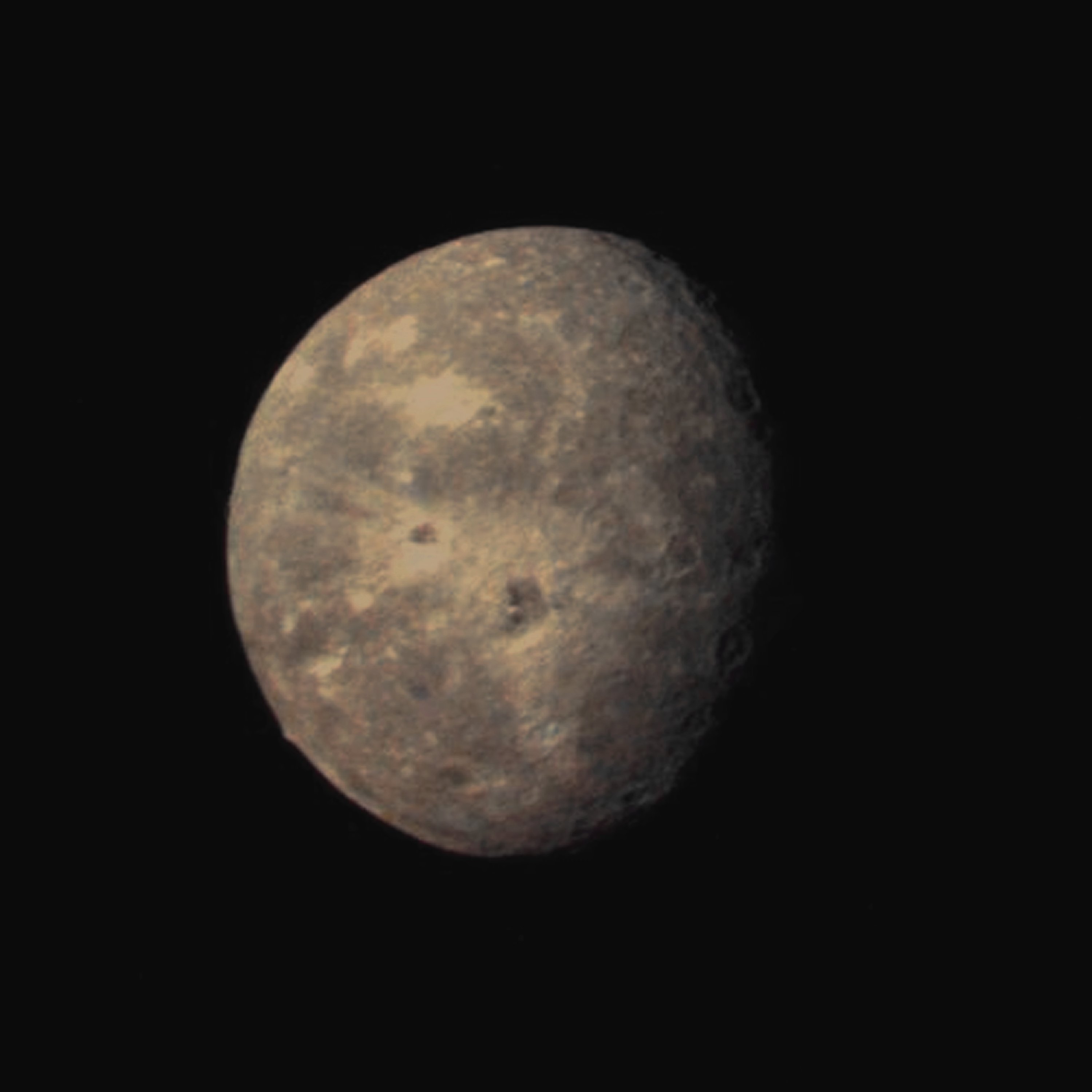
Credits: NASA/JPL/Voyager 2 Spacecraft - Credits for the additional process. and color.: Dr Paolo C. Fienga/Lunar Explorer Italia/IPF
|
This NASA - Voyager 2 Probe picture of the Uranian outermost moon, Oberon, is the best one that the Spacecraft acquired during its fast passage through the Uranus' System. The picture was taken on January 24, of the AD 1986, from a distance of approx. 660.000 Km. and it is fit to show Surface details as small as 12 Km. Clearly visible on the illuminated and Icy Surface of Oberon are several large Impact Craters, most of which are surrounded by bright Rays (somehow similar to those seen on the Jovian moon Callistus). Quite prominent, near the center of Oberon's disk, there is a large Impact Crater with a bright Central Peak and a Floor that seems partially covered with very dark material. A few Planetary Scientists have speculated that this dark material could be a mixture of (dirty) Water-Ice and Carbon-rich Minerals that were erupted onto the Crater Floor sometime after its formation. Another striking Topographic Feature (peeking out on the lower left Limb of Oberon) is a large, "pointed" Mountain (that we, as IPF, have speculated that it could be an ancient and, most likely, now totally extinct Volcano) which is about 6 Km high and that we have informally named as "The Oberon's Peak". This frame has been colorized in Absolute Natural Colors (such as the colors that a human eye would perceive if someone were onboard the NASA - Voyager 2 Probe and then looked outside, towards the Uranian moon Oberon), by using an original technique created - and, in time, dramatically improved - by the Lunar Explorer Italia Team.
|
News visualized: 951 times