


June 25, 2012

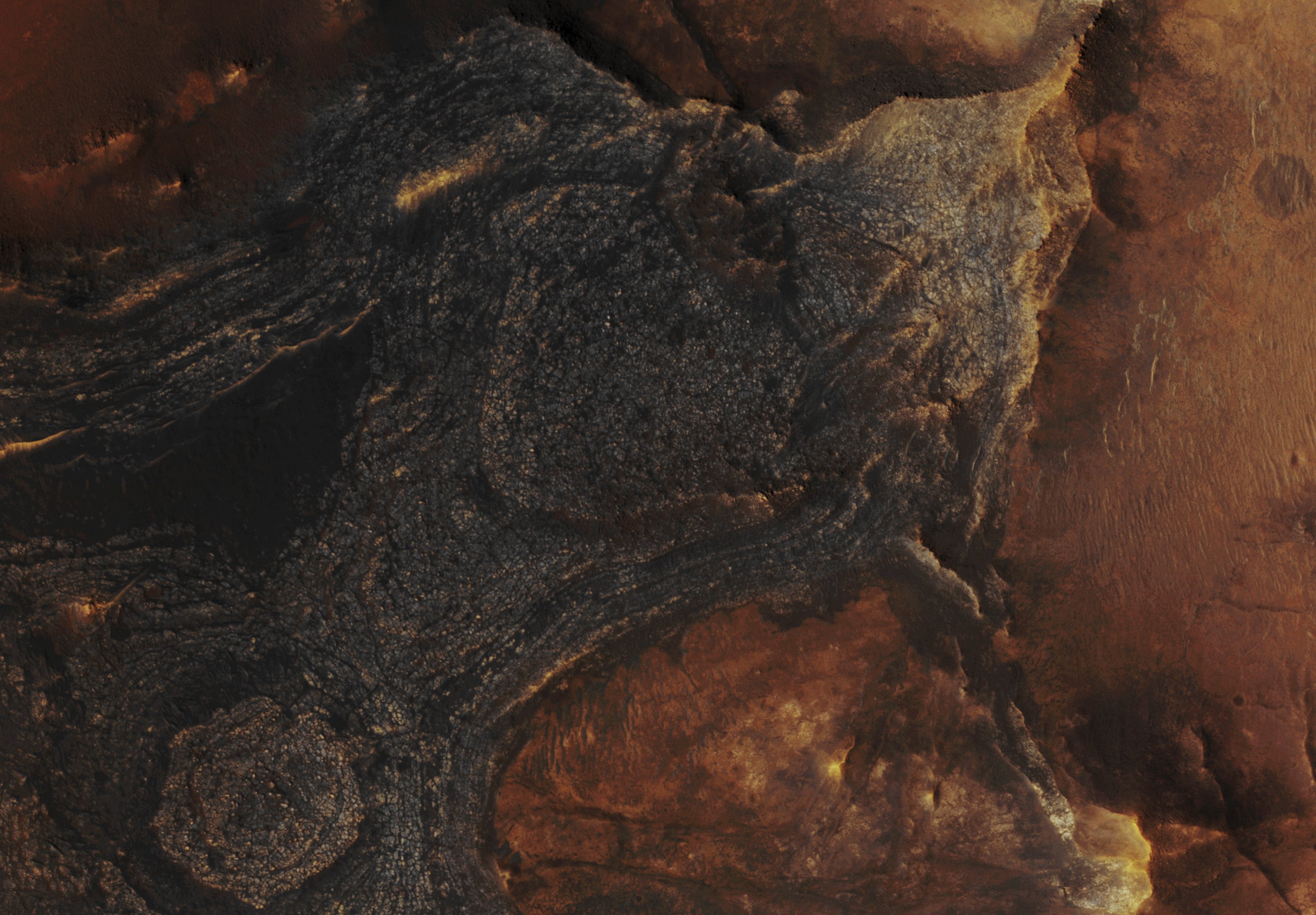
Credits: NASA/JPL/University of Arizona - Credits for the additional process. and color.: Dr Paolo C. Fienga/Lunar Explorer Italia/IPF
|
This frame (which is an EDM from a CTX frame showing a small portion of the Martian Region known as Nili Fossae) shows us some beutiful and colourful Layers that may contain Carbonate Minerals. Carbonates are commonly formed on Earth by Marine Organisms but the origin of these Carbonates on Mars is still (and for now) unknown. The only information that seems undisputable is that the formation of such a Mineral must have involved the action od Liquid Waters. Nili Fossae is a large "Fracture" in the Surface of Mars that has been eroded and partly filled in by Sediments and Clay-rich Ejecta; it is located at approximately 22° North Lat. and 75° East Long. and has an elevation of − 0,6 Km (− 0,37 miles). Nili Fossae was on the list of potential Landing Sites of the NASA - Mars Science Laboratory, arriving on Mars in month of August of the AD 2012, but its candidature was dropped way before the final 4 (four) potential Landing Sites were determined. However, just to make this Region more interesting for future (deeper) studies, we wish to underline that a large exposure of Olivine is located over there. In December of the AD 2008, the NASA - Mars Reconnaissance Orbiter found that many rocks located at Nili Fossae contain Carbonate Minerals, which (as we have seen herebefore) is a VERY significant discovery, from a Geological point of view. Other Minerals identified by the NASA - Mars Reconnaissance Orbiter are Aluminum Smectite, Iron/Magnesium Smectite, Hydrated Silica, Kaolinite Group Minerals, and Iron Oxides. NASA Scientists discovered that Nili Fossae is also the source of Plumes of Methane, raising the question of whether this source originates from Biological Elements. A few Researchers suggested (in July of the AD 2010) that Carbonate-bearing Rocks found in the Nili Fossae Region of Mars are made up of Hydrothermally altered Ultramafic Rocks (also known as Ultrabasic Rocks, they are Igneous and Meta-Igneous Rocks with very low Silica content). As a consequence of that, it has been speculated that such an Hydrothermal Activity could have provided sufficient energy for the birth and development of some kind of Local Biological Activity - and the evidence of the presence of Indigenous Living Organisms could have been preserved. As far as the origin of this Region is concerned, it is now also believed that the Nili Fossae "Fracture" could have been created as a (collateral) result (or a so-called "by-result") of the Giant Impact that formed the nearby Isidis Basin. Mars Local Time: 15:09 (Early Afternoon) This frame has been colorized in Absolute Natural Colors (such as the colors that a human eye would actually perceive if someone were onboard the NASA - Mars Reconnaissance Orbiter and then looked down, towards the Surface of Mars), by using an original technique created - and, in time, dramatically improved - by the Lunar Explorer Italia Team.
|
News visualized: 733 times