

June 18, 2012

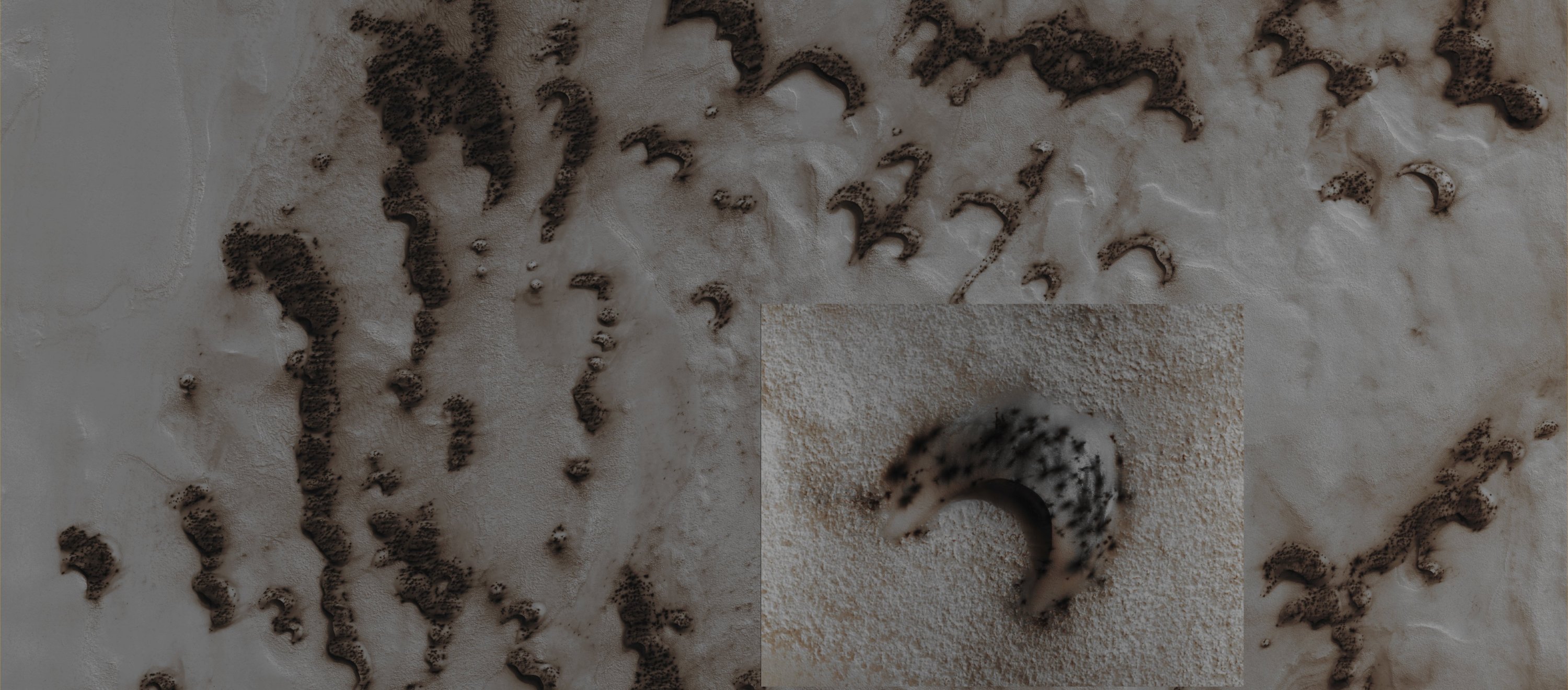
Credits: NASA/JPL/University of Arizona - Credits for the additional process. and color.: Dr Paolo C. Fienga/Lunar Explorer Italia/IPF
|
These "Barchan" (meaning "crescent-shaped") Sand Dunes are found within the North Polar Erg (---> Sand Sea) of Mars. This specific type of Dune, in fact, provides Planetary Researchers with a great record of the Wind Environment existing at the time when they formed and moved: Barchan Dunes' Horns point downwind. Although the question about the present-day Sand Motion is still open (note: the question, here, is regarding the speed and directionality of the Dunes' and Dunefields' motion, not the motion itself, which is undisputable), it appears quite obvious that these Dunes are active, (such as they are subject to motion - that is governed by the Local Winds and, of course, that occurs when the Dunes are not litterally "frozen" - as well as to changings in their physical appearence (when they are not covered in Frost): just consider, for instance, that their Crestlines are very sharp and their Slipfaces (such as the inner curved region between the Horns/Downwind Surface) appears very smooth and steep. In this image, taken during the Northern Spring Season, the Dunes and the Ground are still widely (almost completely) covered by Seasonal Frost. The speckled appearance of the Dunes is due to the warming of the area: as a matter of fact, as the Carbon Dioxide (CO2) Frost and Ice on the Dunes gets warmer, it suddenly sublimates (such as it turns from a solid state to a gaseous one), thus creating small Jets that expose/deposit Dark Sand and Dust onto the Surface. Notice, however, that there are no spots on the Ground between the Dunes and that is because the Ground stays more uniformly cold, unlike the Darker Dune Sand. As the Northern Spring continues, more spots will appear on the Dunes until, in a very short time, all of the Frost on the Dunes and Ground will be gone, and the Dark Dune Sand will be exposed (as it will stay until the next Martian Northern Hemisphere's Winter). Mars Local Time: 13:57 (Early Afternoon) This frame has been colorized in Absolute Natural Colors (such as the colors that a human eye would actually perceive if someone were onboard the NASA - Mars Reconnaissance Orbiter and then looked down, towards the Surface of Mars), by using an original technique created - and, in time, dramatically improved - by the Lunar Explorer Italia Team.
|
News visualized: 707 times