

June 16, 2012

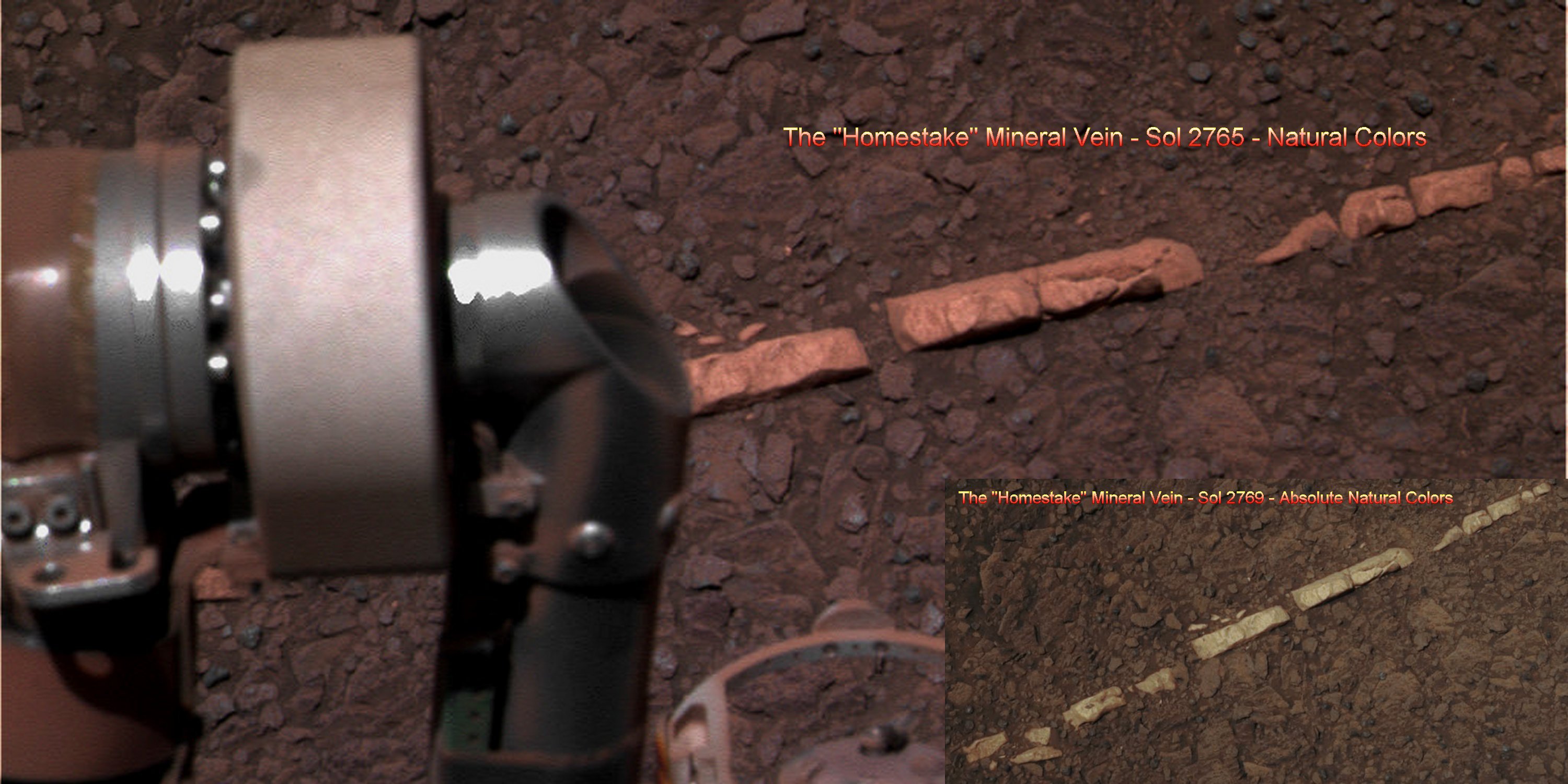
Credits: NASA/JPL/Cornell - MER Opportunity - Credits for the CTX Frame's additional process. and color.: Dr Gianluigi Barca/Lunar Explorer Italia/IPF; Inset: Dr Paolo C. Fienga/Lunar Explorer Italia/IPF
|
Images and data collected by the NASA - Mars Exploration Rover Opportunity and presented at the American Geophysical Union's Conference taken in San Francisco (CA) on December, 7, 2011, indicate that, billions of years ago, Water once flowed through Underground Fractures located in the Martian Region of Meridiani Planum. The exposed Mineral Vein (seen here in two images taken from the Rover's Panoramic Camera (PanCam) on two different Soles (or Martian Days) - is apparently made of Gypsum, deposited by Water. Called "Homestake", the Mineral Vein is 0,4 to 0,8" (inches) large (such as about the width of a human thumb) and 16 to 20" long (such as 40 to 50 cm). The NASA - Mars Exploration Rover Opportunity, which has already been on Mars for almost eight years, has been exploring the area located along the West Rim of the Endeavour Crater, since August 2011. After identifying the visible deposit in November 2011, Opportunity's Microscopic Imager as well as the Alpha Particle X-Ray Spectrometer (located on the Rover's Robotic Arm) have deeply examined the Vein and, according to NASA People, the Spectrometer identified Calcium and Sulphur in a ratio that is high enough to point to a Surface Feature made of relatively pure Calcium Sulphate. While the CTX Frame has been colorized in Natural Colors (such as the colors that a perfect human eye - or an Electronic Eye - would actually perceive if someone were on the Surface of Mars, near the NASA - Mars Exploration Rover Opportunity, and then looked down, at the Homestake Mineral Vein), the EDM Frame has been colorized in Absolute Natural Colors (such as the colors that a noraml human eye would actually perceive if someone were on the Surface of Mars, near the NASA - Mars Exploration Rover Opportunity, and then looked down, at the Homestake Mineral Vein). Both colorizations were made by using an original technique created - and, in time, dramatically improved - by the Lunar Explorer Italia Team
|
News visualized: 703 times