

June 12, 2012

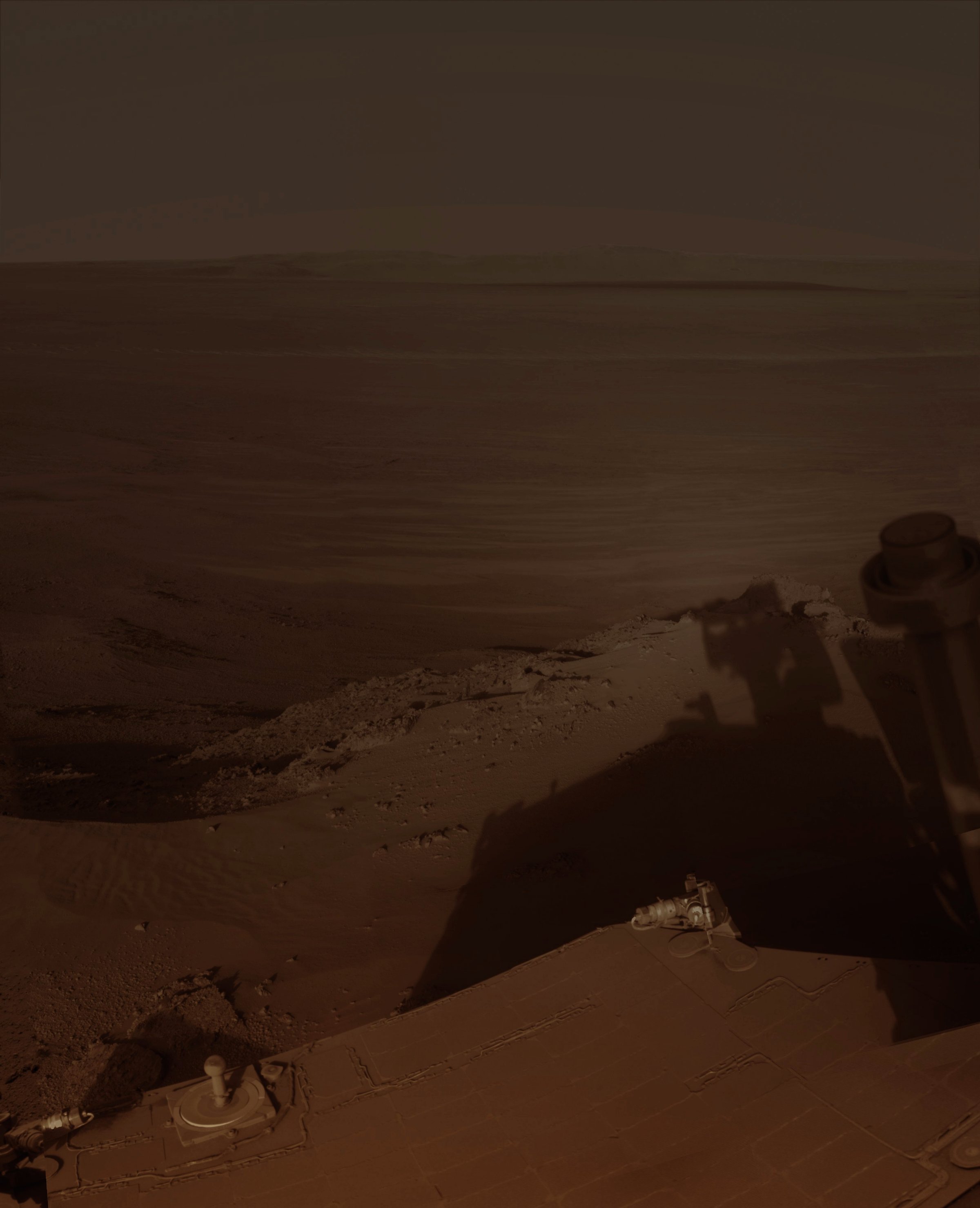
Credits: NASA/JPL/Cornell/Arizona State University (ASU) - MER Opportunity - Credits for the additional process..: Dr Paolo C. Fienga/Lunar Explorer Italia/IPF
|
The NASA - Mars Exploration Rover-B Opportunity catches its own Late-Afternoon Shadow in this (in a way) dramatically lit view to the East, and all the way across Endeavour Crater. The Rover used its Panoramic Camera (PanCam) between about 16:30 and 17:00 Mars Local Solar Time to record a number of images (taken through different filters) which were afterwards combined in order to create this Mosaic View. Most of the images that were used to compose the mosaic were recorded during the 2888th Martian Day, or Sol, of Opportunity's work on Mars (such as March 9, 2012); at that time, Opportunity was spending low-solar-energy weeks of the Martian Winter at the Greeley Haven Outcrop (located on the Cape York segment of Endeavour's Western Rim). In order to give to this mosaic a rectangular aspect, some small parts of its edges, as well as the Sky above Endeavour Crater, were filled in with parts of another image acquired earlier (and as a part of a 360-degree panorama obtained from the same location). Opportunity has been studying the Western Rim of Endeavour Crater since its arrival, which occurred in the month of August of the AD 2011. Endeavour Crater has a diameter of about 14 miles (such as approx. 22 Km) which means, in other wor(l)ds, that it covers an area which is roughly the same size than the one covered by the American City of Seattle. Endeavour Crater is more than 20 times wider than Victoria Crater, such as the largest Impact Crater that the NASA - Mars Exploration Rover-B Opportunity had previously examined. The Interior Basin of Endeavour is in the upper half of this view. This frame has been colorized in Absolute Natural Colors (such as the colors that a normal human eye would actually perceive if someone were on the Surface of Mars, near the NASA - Mars Exploration Rover-B Opportunity, and then looked towards the Eastern side of Endeavour Crater), by using an original technique created - and, in time, dramatically improved - by the Lunar Explorer Italia Team. Note: some of you might think that this view is "too dark" to be realistic; as a matter of fact - and unless the data we have collected so far have all been completely misunderstood - the "quantity" of light that is caught by the Electronic Eyes of the NASA - Mars Exploration Rover-B Opportunity is way more than the "quantity" of light that a human eye could ever catch! Said that, the consequences are obvious: Mars, at all times (but especially in Winter and at nightfall), is a VERY dark place... |
News visualized: 776 times